Artwork
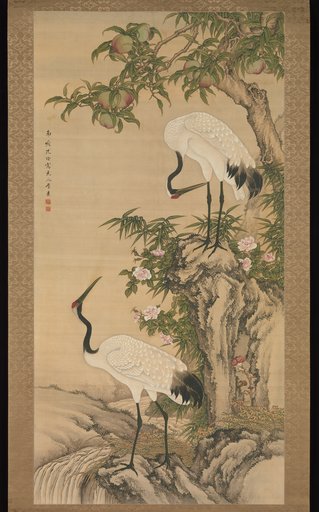
清 沈銓 月季桃鶴圖 軸|Cranes, peach tree, and China rose
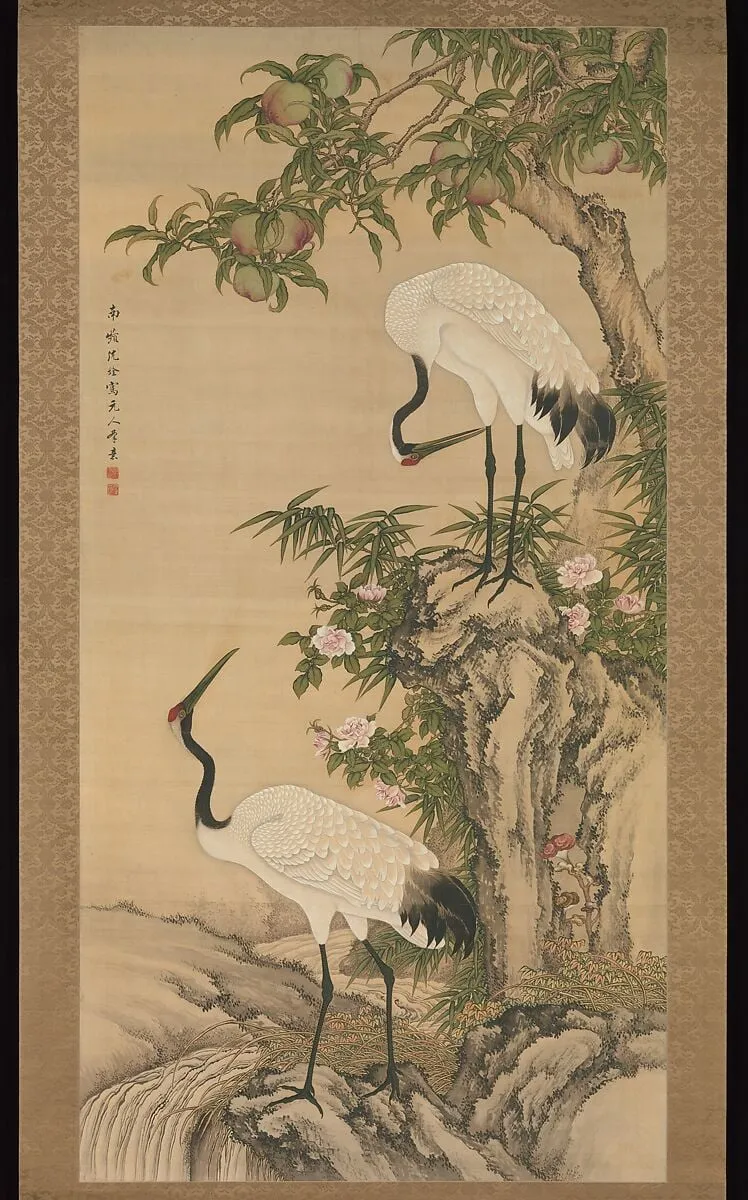
清 沈銓 月季桃鶴圖 軸|Cranes, peach tree, and China rose is an ink painting by the Baroque artist Shen Quan. It dates from 1716 and is held in the collection of the Metropolitan Museum of Art.
- Accession no.
- 1975.268.81
- Credit line
- The Harry G. C. Packard Collection of Asian Art, Gift of Harry G. C. Packard, and Purchase, Fletcher, Rogers, Harris Brisbane Dick, and Louis V. Bell Funds, Joseph Pulitzer Bequest, and The Annenberg Fund Inc. Gift, 1975
About this work
Subject & Meaning
The inclusion of the China rose, alongside these elements, contributes to a thematic focus on enduring life and natural harmony.
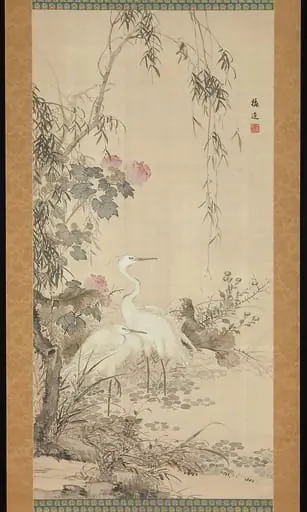
The artwork depicts a crane, a peach tree, and a China rose, arranged within a landscape composition. While the specific iconographic program is not detailed in the available records, the selected flora and fauna traditionally carry auspicious meanings in Chinese art. The crane is a conventional symbol of longevity and immortality, while the peach tree is similarly associated with long life and vitality in East Asian visual culture.
The inclusion of the China rose, alongside these elements, contributes to a thematic focus on enduring life and natural harmony. Created in 1716, the painting synthesizes these motifs into a single visual statement, reflecting cultural values regarding health and longevity through its specific choice of subjects.
Technique & Style
Executed in 1716 as a hanging scroll, the work employs ink and mineral pigments on silk, consistent with professional court taste of the early Qing. The artist layered delicate washes for petals and leaves, reserving denser ink for the cranes’ plumage and branch structure, exploiting silk’s absorbency to achieve subtle tonal shifts. Stylistically, the composition balances naturalistic detail with decorative elegance, aligning with Shen Quan’s courtly manner: the tree’s gnarled trunk curves in a sinuous S, while the cranes stand in poised asymmetry, their elongated legs and slender necks echoing the refined line tradition of Song academic bird-and-flower painting.
History & Provenance
The work is held by the Metropolitan Museum of Art, New York, where it is catalogued as accession number 1989.273.1. It was first publicly exhibited in 2000 as part of the museum’s reinstallation of Chinese paintings, and thereafter appeared in the 2004 special exhibition “Art of the Chinese Courts: Treasures from the Forbidden City and the Royal Collection,” also at the Metropolitan Museum.
Overview
This hanging scroll by Shen Quan, titled Cranes, Peach Tree, and China Rose, depicts two serene cranes positioned beneath a flowering peach tree, with a rose bush at their feet. Executed with ink and color on silk, the painting was created as a gesture of good fortune and well-being for its intended recipient. It exemplifies the artist's focus on natural subjects imbued with auspicious symbolism.
Artist & collection