Artwork
Meadow
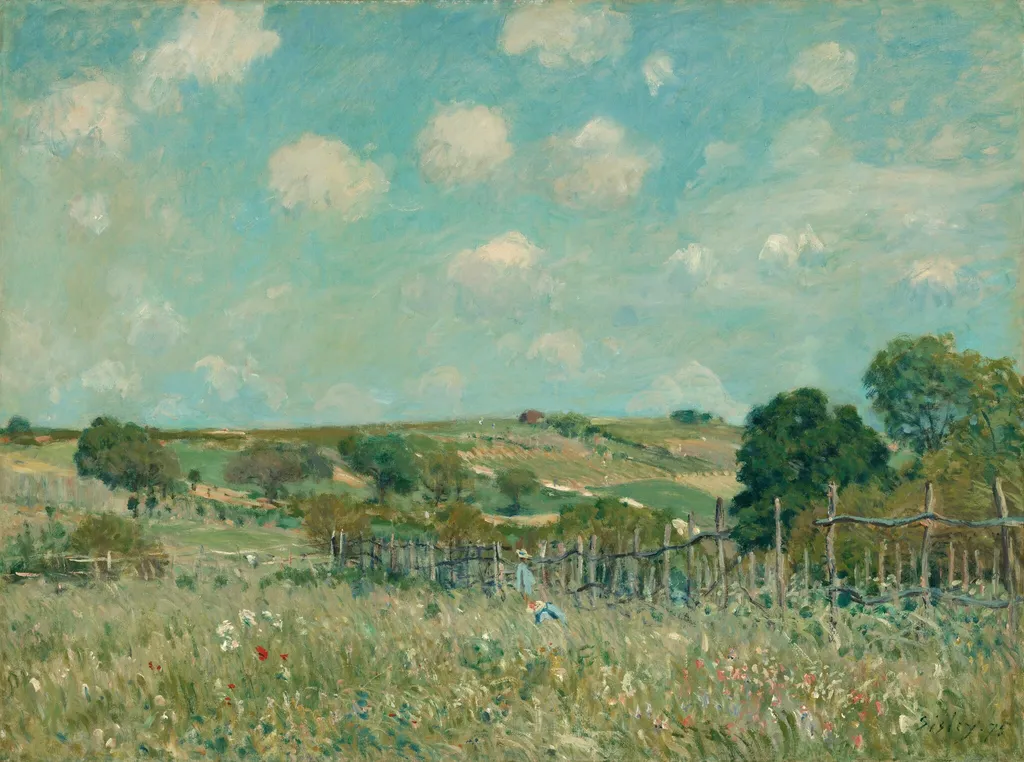
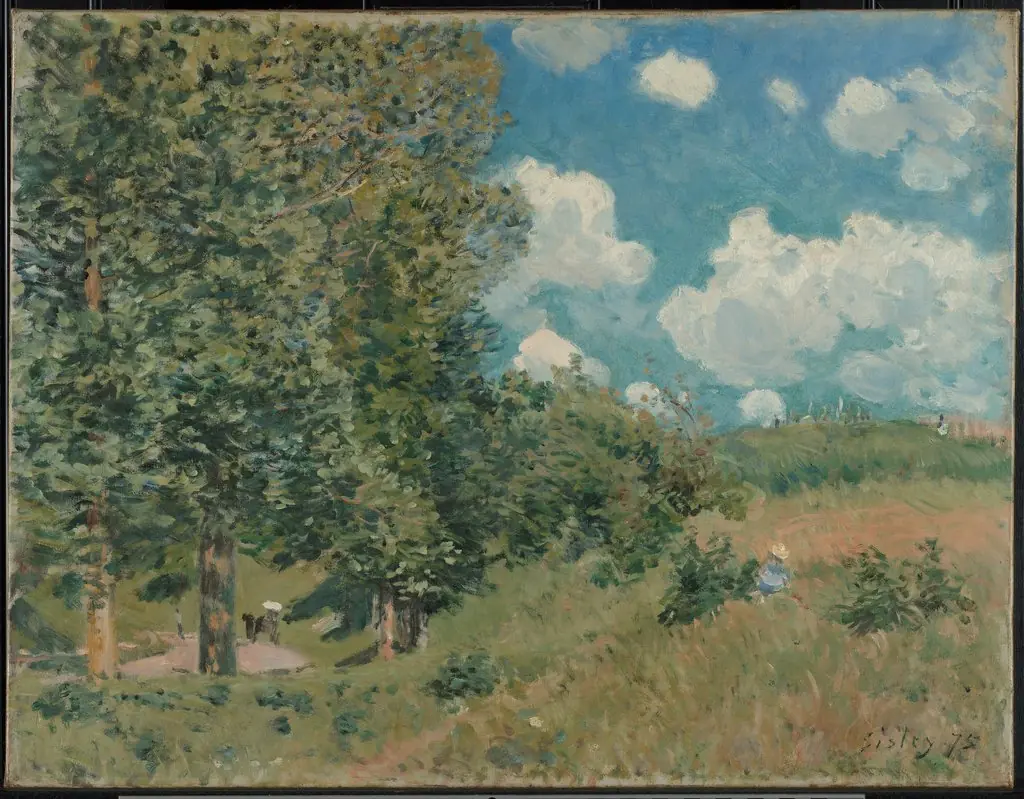
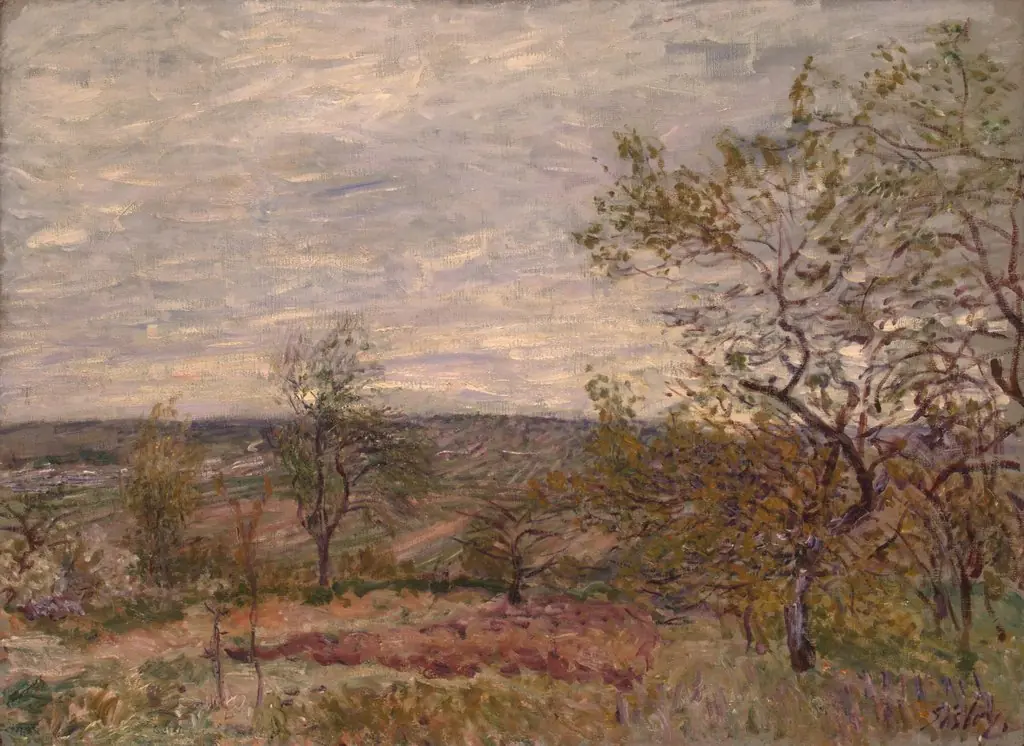
Meadow is an oil painting by the Impressionist artist Alfred Sisley. It dates from 1875 and is held in the collection of the National Gallery of Art.
- Inscription
- Inscribed:lower right: Sisley.75
About this work
Subject & Meaning
Beyond, cultivated fields climb the flanks of distant hills beneath a blue sky edged with white clouds.
Alfred Sisley's 1875 painting Meadow depicts a pastoral landscape near Louveciennes, the same locale Pierre-Auguste Renoir painted that year in Path Through Tall Herbs. According to the catalogue of Count Armand Doria's collection, the scene shows a meadow "enamelled in flowers", daisies, poppies, and cornflowers, where two young girls in blue aprons and straw hats trimmed with red and blue ribbons gather blooms. To the right stands a wooden fence, behind which clusters of trees raise their blonde foliage.
Beyond, cultivated fields climb the flanks of distant hills beneath a blue sky edged with white clouds. The composition embodies the Impressionist interest in unembellished rural life, capturing an ordinary moment of childhood in the open countryside rather than staging a symbolic or allegorical subject. The painting's iconography is therefore naturalistic: flowering meadow, gathering children, and receding agricultural terrain serve as a record of seasonal landscape near Louveciennes.
Technique & Style
Meadow is an oil on canvas painting measuring about 54.9 cm by 73 cm, created in 1875 by Alfred Sisley. It portrays a sunlit meadow dotted with daisies, poppies and cornflowers, where two children in blue aprons gather flowers beside a wooden fence and a stand of trees, set against a distant horizon under a blue sky. Sisley's loose brushwork and delicate handling of light produce an Impressionist atmosphere that emphasizes fleeting natural effects and a harmonious color palette.
The composition balances detailed flora with expansive landscape space, reflecting the artist's characteristic stylistic approach. The work remains in the National Gallery of Art's collection, listed as a French Impressionist landscape.
History & Provenance
Painted in 1875 near Louveciennes, Alfred Sisley's Meadow entered the collection of Comte Armand-François-Paul des Frisches Doria by 1877. Following Doria's death, the work was sold at the Galeries Georges Petit in Paris on May 4, 1899, to the dealer Durand-Ruel. It passed to Bernheim-Jeune in 1900 before being acquired by Jules Strauss of Paris.
At the Strauss sale at Hôtel Drouot on May 3, 1902, the painting was purchased by Joubert, potentially acting for Galeries Georges Petit. By 1933, the artwork belonged to Senator Antonio Santamarina in Buenos Aires. After appearing in a 1955 collection sale, it was acquired by Wildenstein and Co. in 1957.
On October 4, 1957, Wildenstein sold the piece to Ailsa Mellon Bruce, who bequeathed it to the National Gallery of Art in 1970.
The painting is held by the National Gallery of Art in Washington, D.C., where it resides in section 88, dedicated to French Impressionist landscapes. Prior to its acquisition by the National Gallery, the painting was lent to an exhibition in Buenos Aires in 1933 while in the collection of Senator Antonio Santamarina, and was included in the sale of the Santamarina collection at Adolfo Bullrich Y Cia in Buenos Aires on October 3–5, 1955. Earlier, it appeared in the Doria collection sale at the Galeries Georges Petit in Paris on May 4, 1899 (no. 224) and the Jules Strauss sale at the Hôtel Drouot in Paris on May 3, 1902 (no. 60).
Context
Meadow (1875) belongs to Alfred Sisley's Impressionist landscape production of the mid-1870s and is now installed in section 88 of the National Gallery of Art, dedicated to French Impressionist landscapes. Its subject, a flowering meadow near Louveciennes, was treated by Sisley in the same year that Pierre-Auguste Renoir painted the same view as Path Through Tall Herbs, situating the canvas within a cluster of Impressionist studies of the Louveciennes countryside. The work's early critical visibility is documented by its inclusion in the catalogue of Count Armand Doria's collection, which described the enamelled grasses, daisies, poppies, and cornflowers, the two young gatherers, and the distant hills under a cloud-edged sky.
Its subsequent passage through major Parisian dealers Durand-Ruel and Bernheim-Jeune, and later through Wildenstein in New York before entering the collection of Ailsa Mellon Bruce, reflects the transatlantic circulation of Sisley's oeuvre among leading collectors of Impressionism.
Overview
Alfred Sisley's 1875 oil on canvas painting, "Meadow," captures a sunlit landscape near Louveciennes. This work, now housed in the National Gallery of Art, Washington DC, exemplifies the artist's focus on natural light and atmospheric effects. It presents a vibrant scene of a field dotted with wildflowers and figures, reflecting the Impressionist interest in everyday outdoor environments.
Own this work as a print
Artist & collection

Artist
Alfred Sisley (; French:; 30 October 1839–29 January 1899) was a French-Born British Impressionist landscape painter who was born to British parents, but spent most of his life in France.