Artwork
Sugriva challenges his brother Vali, King of the Forest Dwellers, to a duel, folio 10 from the Kishkindha Kanda (Book of Kishkindha) of a Ramayana (Rama’s Journey)
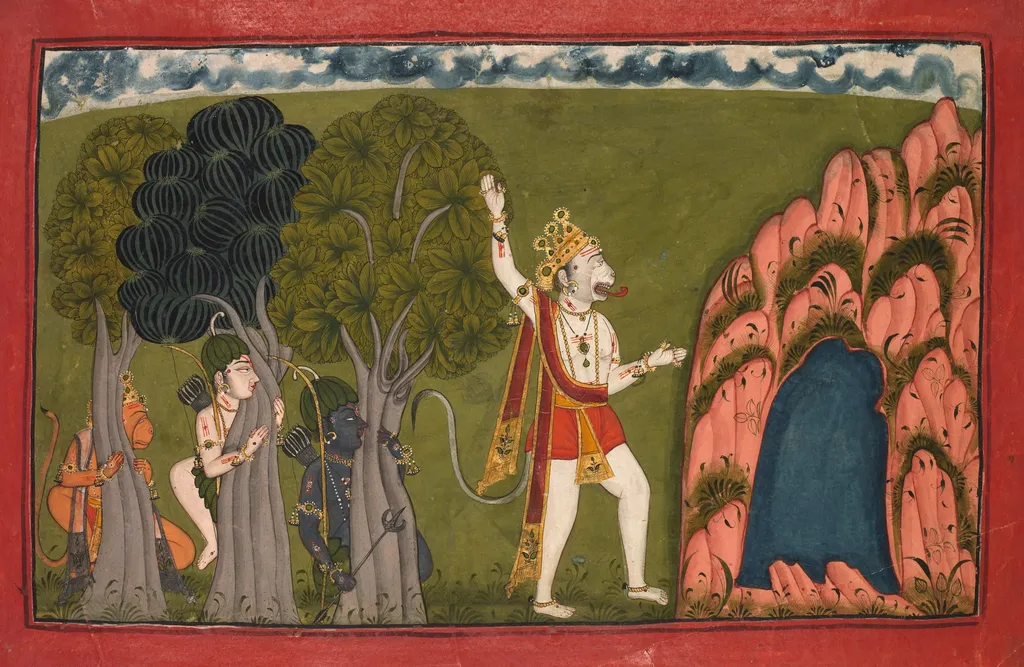
Sugriva challenges his brother Vali, King of the Forest Dwellers, to a duel, folio 10 from the Kishkindha Kanda (Book of Kishkindha) of a Ramayana (Rama’s Journey) is an unspecified painting. It dates from 1720 and is held in the collection of the Cleveland Museum of Art.
About this work
Subject & Meaning
As an illustration from a 1720 Ramayana manuscript, the painting shows the two monkey brothers confronting each other, likely set within a forest landscape.
The folio depicts Sugriva challenging his brother Vali, the king of the forest dwellers, to a duel, an episode taken from the Kishkindha Kanda (Book of Kishkindha) of the Ramayana. As an illustration from a 1720 Ramayana manuscript, the painting shows the two monkey brothers confronting each other, likely set within a forest landscape. The scene encapsulates the fraternal conflict that drives the narrative, highlighting themes of legitimacy, loyalty, and the quest for rightful rule that underlie the larger Rama story.
History & Provenance
The folio depicting Sugriva challenging his brother Vali is held in the collection of the Cleveland Museum of Art in Cleveland. The work is cataloged under the accession number 1973.103. While the painting dates to approximately 1720, the provided records do not list specific exhibitions or a detailed provenance trail beyond its acquisition by the museum.
Legacy
The folio belongs to the broad tradition of illustrated Indian epics, in which episodes of the Ramayana were rendered as serial manuscript paintings for devotional and courtly audiences. Its survival in a major museum collection contributes to the study of Ramayana imagery and Pahari manuscript painting.
Overview
The work depicts a dramatic confrontation in a forest setting, centered on a white‑skinned, crowned figure with a red sash who raises his arms in a challenging gesture. Behind him stands a dark‑skinned figure with a blue face and a serpentine tail, observing the scene. To the left a woman in green holds a branch while a child looks up at her, and to the right a group of red‑skinned, horned beings with large eyes sit on rocks, some bearing weapons.
Technique & Style
Executed in vivid pigments, the painting employs exaggerated proportions and bright, contrasting colors to heighten the narrative drama. Gold jewelry on the central figure and the use of red and blue tones for the secondary characters create visual hierarchy. The stylized, almost caricatured rendering of faces and bodies reflects a traditional Indian illustrative approach to epic storytelling.
Artist & collection

 Untitled
 Sita
Sita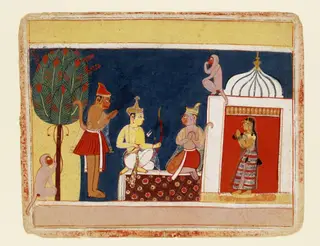 Hanuman and Rama
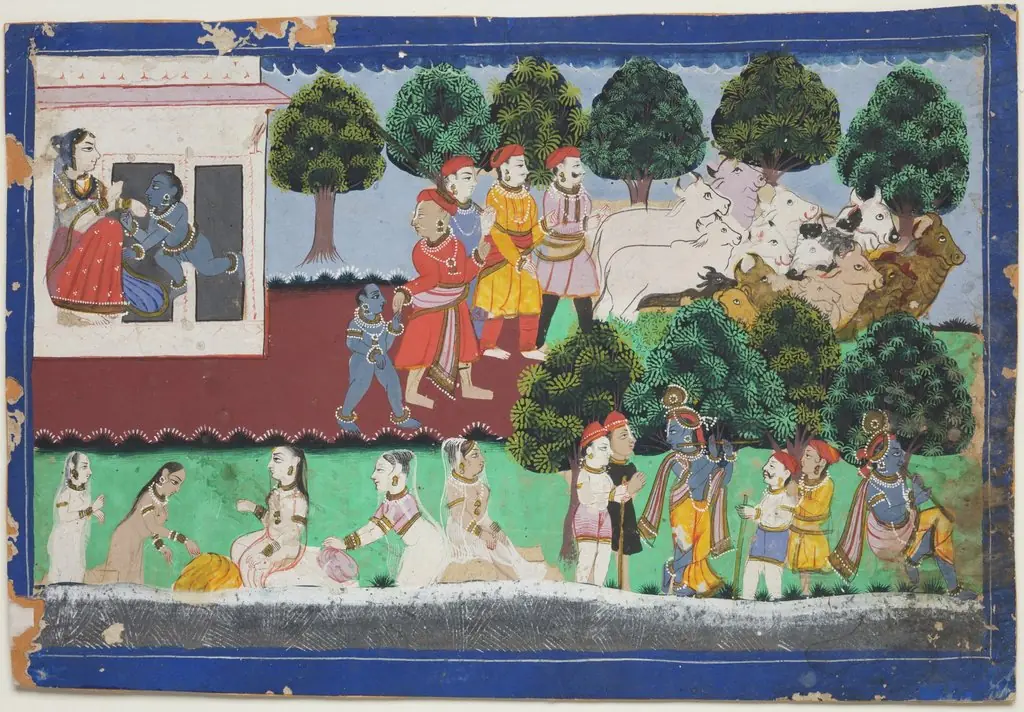 Scenes from Boyhood of Krishna
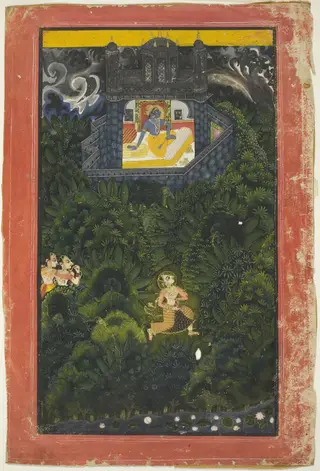 Abhisarika Nayika (Heroine Running to Meet her Lover)
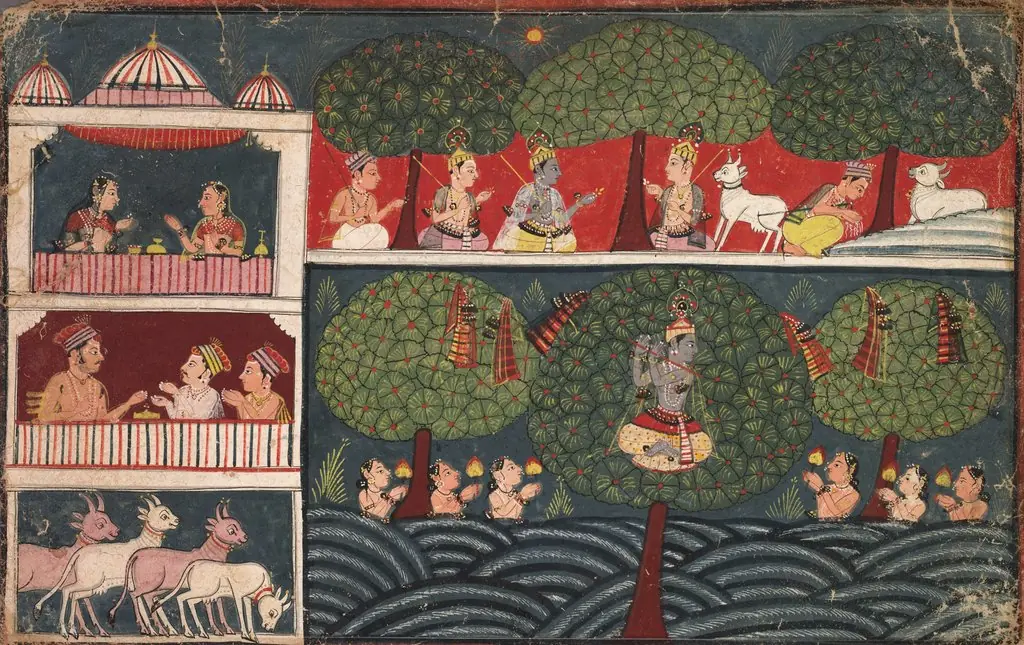 Krishna Steals the Clothes of the Milkmaids and Expounds on the Virtue of Trees, from a Braj Bhagavata Purana
 Rama and Ravana
 Illustrations to Life of Dhurva Maharaj: #20 God gives Dhurva his throne upon which he can fly anywhere
 Gajendra Moksha: The Salvation of the King of the Elephants
- Sugriva challenges his brother Vali, King of the Forest Dwellers, to a duel, folio 10 from the Kishkindha Kanda (Book of Kishkindha) of a Ramayana (Rama’s Journey)
 Rama and Lakshmana slay the demon giant Viradha, from Chapters 2 through 4 of the Aranya Kanda (Book of the Forest) of a Ramayana (Rama’s Journey)
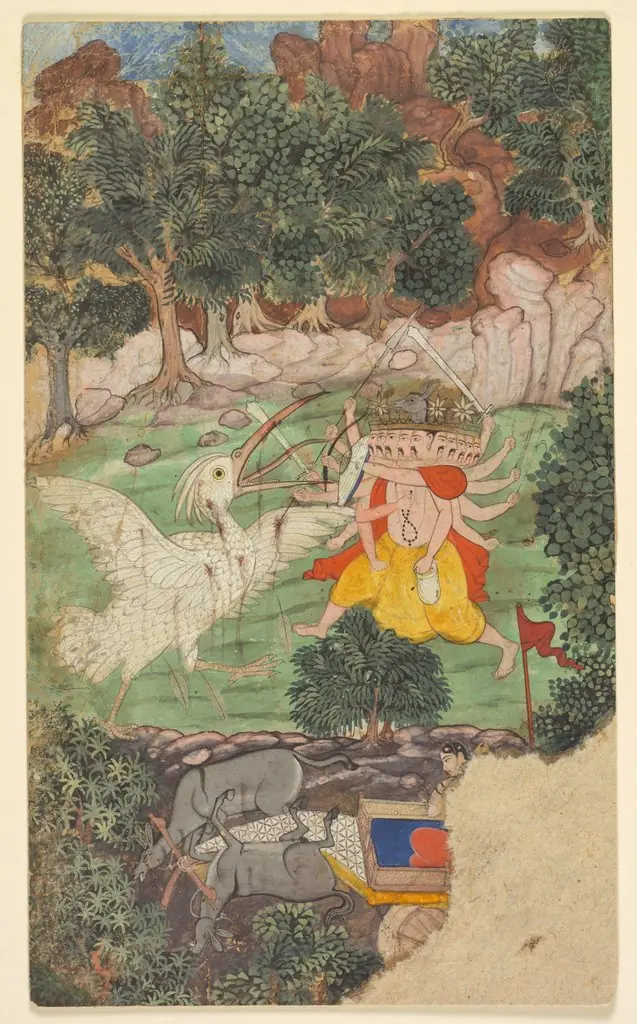 Battle of Ravana and Jatayu, from Chapters 50 and 51 of the Aranya Kanda (Book of the Forest) of Valmiki's Ramayana (Rama’s Journey); folio from the "Burnt" Ramayana