Artwork
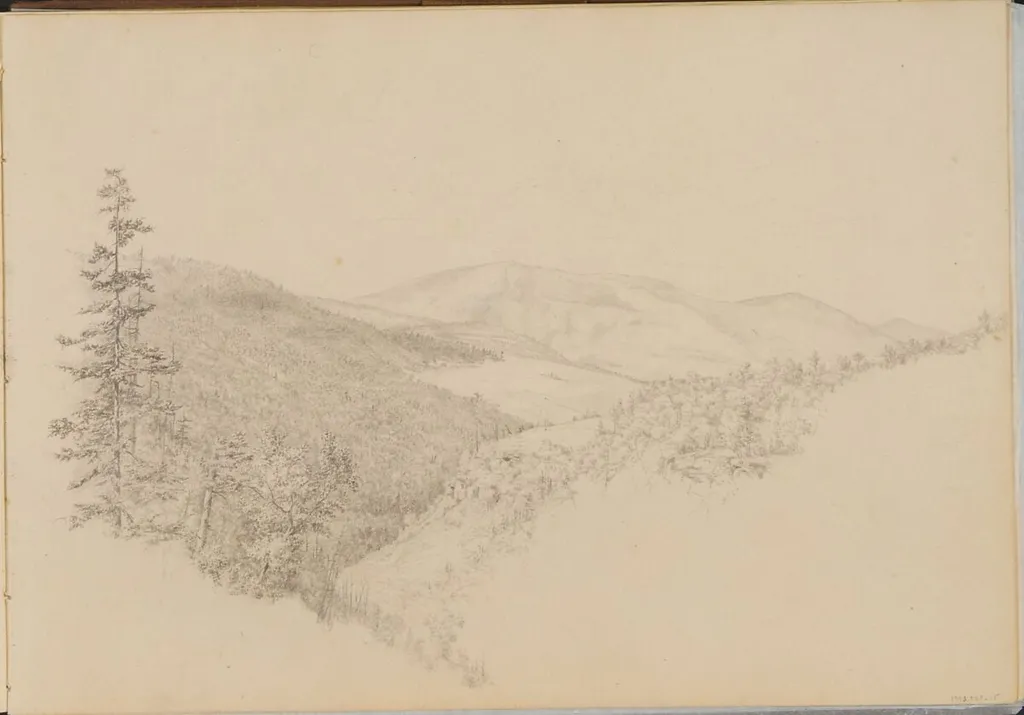
Kauterskill Clove (from Sketchbook of Landscape and Animal Subjects)
About this work
Subject & Meaning
The inclusion of trees flanking the valley reinforces this reading, anchoring the rugged terrain within a recognizable Eastern woodland setting.
Kauterskill Clove depicts a Catskills mountain landscape rendered in graphite, ink washes, and gouache. The composition centers on the clove itself, a steep, narrow mountain valley, framed by trees and rising terrain, consistent with the work's documented subjects of mountain, tree, and landscape. As a sketchbook study produced in 1860, the sheet functions as a preparatory observation of the American wilderness rather than a finished exhibition piece, capturing the topography and natural features of the region for later reference.
The choice of Kaaterskill Clove, a well-known Hudson Valley gorge celebrated in nineteenth-century American art and literature, situates the work within the broader tradition of Romantic landscape depiction, in which untamed mountain scenery conveyed the sublime character of the nation's interior. The inclusion of trees flanking the valley reinforces this reading, anchoring the rugged terrain within a recognizable Eastern woodland setting.
Technique & Style
Created in 1860, Kauterskill Clove is executed on off-white wove paper using a combination of graphite, ink washes, and gouache. The work measures 24.8 cm in height and 35.2 cm in width. As a landscape subject from a sketchbook, the piece depicts a mountain and tree, utilizing these layered media to define the topography and foliage.
The integration of dry graphite with fluid ink and opaque gouache allows for varied textural handling within the composition.
History & Provenance
The work Kauterskill Clove, a landscape depicting a mountain and tree, was created by Thomas Hewes Hinckley in 1860. Executed in graphite, ink washes, and gouache on off-white wove paper, the piece is part of the Sketchbook of Landscape and Animal Subjects. It currently resides in the collection of the Metropolitan Museum of Art within The American Wing.
The artwork measures 24.8 cm in height and 35.2 cm in width. No specific details regarding the original commission, the chain of ownership prior to the museum, or the precise date of acquisition are provided in the available records.
Kauterskill Clove is held by the Metropolitan Museum of Art, as indicated by both the institutional classification and the Wikidata record placing it in that collection.
The work is part of the museum's American Wing, the curatorial department under which the sheet is catalogued. Its dimensions, as recorded in the Wikidata entry, are 24.8 cm in height by 35.2 cm in width.
No exhibition history is documented in the available sources, and no specific accession number is provided.
Legacy
Thomas Hewes Hinckley's Kauterskill Clove (1860) influenced 19th-century American landscape painters through its atmospheric treatment of mountain scenery and tree forms, later cited in studies of Hudson River School pedagogy. The work's compositional approach informed regionalist artists in the early 20th century, particularly in documenting Appalachian topography. Its inclusion in The American Wing established a precedent for scholarly attention to American sketch-based landscapes.
Overview
Kauterskill Clove, drawn from Thomas Hewes Hinckley’s Sketchbook of Landscape and Animal Subjects, is a modestly sized work on off‑white wove paper. Executed around 1862, the piece combines graphite, ink washes, and gouache, presenting a tranquil mountain valley with a solitary farmhouse, sparse trees, and a distant peak.
Artist & collection


- Mountain landscape, sketch
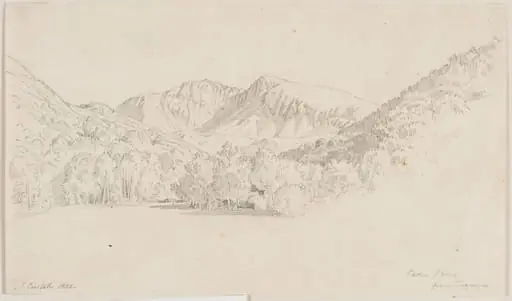 View of Cader Idris, Merioneth
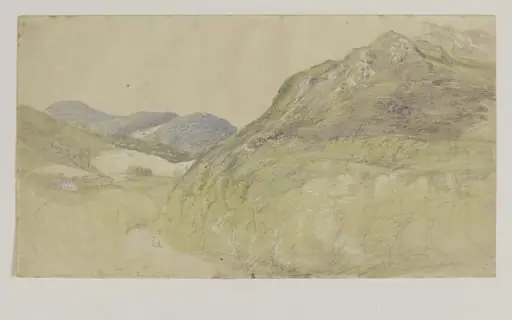 Near the Travellers Rest Inn, Dolgelly
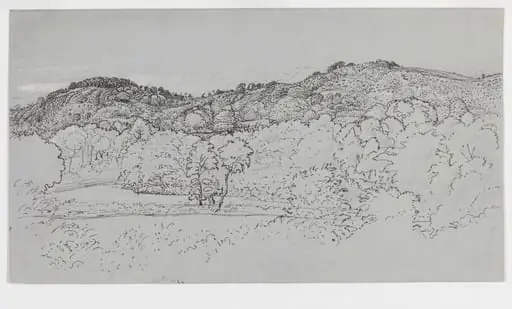 A wooded hillside at Underriver, near Sevenoaks, Kent
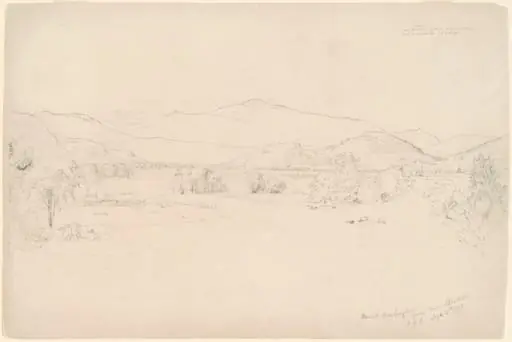 Study for "View of Mt. Washington"
 Mountain Landscape
 Macau, looking south-west along the peninsula
 Moab Hills, Dead Sea & Judean Desert
 Raven Hill
 Italian Mountain Landscape
 St. Beuno's Llan-y-cil, Llyn Tegid and the Aran Peak, Merionethshire
 Landscapes