Artwork
A priest and a pilgrim
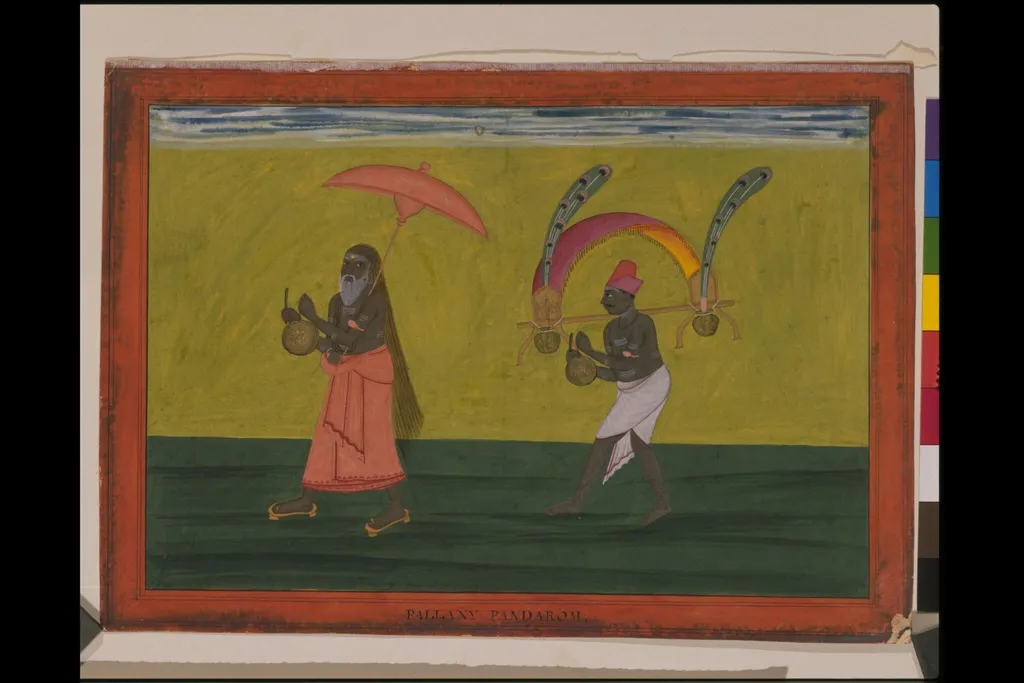
A priest and a pilgrim is a paint painting by the Rococo painting artist Unknown. It dates from 1770 and is held in the collection of the Victoria and Albert Museum. This work is one of a series of thirty‑six small paintings that depict the various castes and occupations of South India.
About this work
Overview
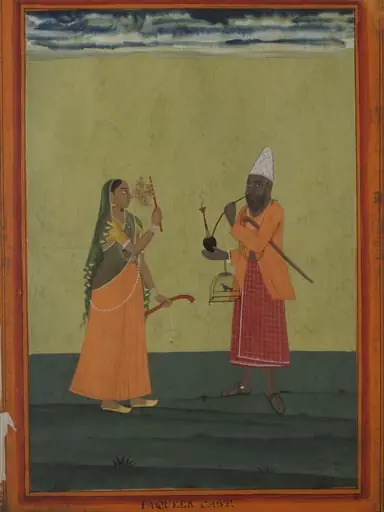
This work is one of a series of thirty‑six small paintings that depict the various castes and occupations of South India. Each panel presents a pair of figures identified by their dress and accessories, set against a dark green ground and framed by a red border topped with a stylised cloud motif.
Subject & Meaning
The particular panel shows a priest in white clerical robes standing beside a pilgrim, who holds a staff and wears a string of beads. The figures are intended to illustrate the religious roles of priest and pilgrim within the social hierarchy of the region.
Technique & Style
The painting employs a heavy, looped shadow that extends from the figures’ feet, creating a sense of depth. The background is rendered in dark green, while the figures are drawn with varying degrees of detail; this panel belongs to the group characterized by more detailed figures against a deep blue or green ground.
History & Provenance
All thirty‑six panels were mounted in a single album bearing a watermark dated 1799 and a bookplate belonging to Joseph Whatley, whose Latin motto "Pelle Timorem" (banish fear) appears on the cover. The album was later acquired by the Victoria and Albert Museum, where the paintings are now on display.
Context
The series was produced as a visual catalogue of South Indian social groups for a European audience, reflecting 18th‑century interest in ethnographic documentation. The English inscription on each border identifies the depicted caste or occupation, linking the image to its textual label.
Artist & collection