Artwork
Babur meeting with Sultan Ali Mirza at the Kohik River, from a Babur-nama (Memoirs of Babur)
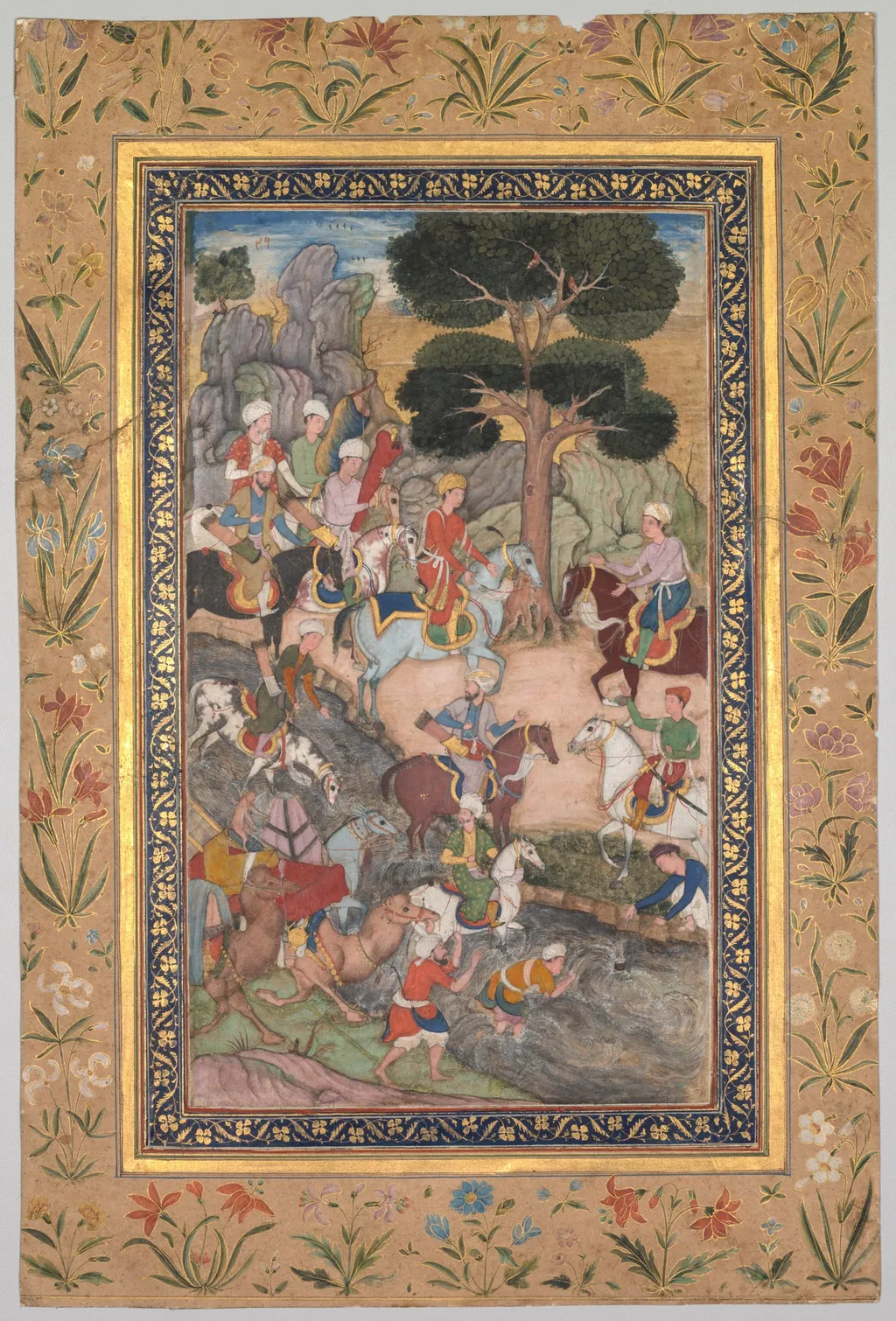
Babur meeting with Sultan Ali Mirza at the Kohik River, from a Babur-nama (Memoirs of Babur) is an unspecified painting. It dates from 1596 and is held in the collection of the Cleveland Museum of Art. The work depicts a lively riverbank encounter, with numerous horsemen gathered along the water’s edge.
About this work
Subject & Meaning
The scene emphasizes personal camaraderie and the transmission of royal authority, while the river setting underscores natural vitality and imperial order.
The miniature portrays Emperor Babur receiving the young prince Sultan Ali Mirza beside the Kohik River, a moment drawn from his own memoir. The scene emphasizes personal camaraderie and the transmission of royal authority, while the river setting underscores natural vitality and imperial order. Symbolic details such as the exchanged gifts and the attentive courtiers highlight the diplomatic nuance of Timurid court culture.
Together these elements convey both a literal episode and a broader statement about leadership, lineage, and the harmony between ruler and realm.
Technique & Style
The miniature depicts Babur meeting with Sultan Ali Mirza beside the Kohik River, rendered in opaque watercolor and gold leaf on paper. The composition employs a flattened perspective with intricate border patterns and fine line work characteristic of 16th-century Persian-influenced Mughal manuscript illumination. The painting measures 30 x 20 centimeters and shows minimal wear, preserving the vivid mineral pigments and delicate brushstrokes used in its creation.
The work exemplifies formal stylization through its symbolic spatial arrangement and emphasis on narrative detail rather than naturalistic depth. Gold leaf accents highlight key figures, while the restricted palette of lapis lazuli blue, vermilion, and earth tones demonstrates the technical mastery of manuscript painters. This piece reflects the Safavid artistic legacy adapted within early Mughal court aesthetics, with its handling preserved through controlled museum conservation practices.
History & Provenance
The painting dates to 1590 and belongs to the Cleveland Museum of Art, where it is identified by the accession number 1971.85. It was created as an illustrated page for a manuscript of the Babur-nama (Memoirs of Babur), the autobiographical account of the Mughal emperor Babur. The work entered the Cleveland Museum of Art's collection in 1971, as indicated by the accession number, and has remained there since. The artist is not identified by name in the available records.
The painting depicts the historical meeting between Babur and Sultan Ali Mirza at the Kohik River, a scene drawn from the narrative of the memoirs. Its production in 1590 places it within the early phase of Mughal manuscript painting under Emperor Akbar, during which illustrated copies of the Babur-nama were commissioned and produced in large numbers.
The painting is held in the collection of the Cleveland Museum of Art, located in Cleveland. It is cataloged under the accession number 1971.85. The work has been part of the museum's holdings since its acquisition, though specific details regarding its exhibition history are not provided in the available records.
Overview
The work depicts a lively riverbank encounter, with numerous horsemen gathered along the water’s edge. Figures in vivid attire mingle with more modestly dressed riders, while a few onlookers stand near the shore. The composition is framed by ornamental borders rendered in gold, blue and red, adding a decorative finish to the scene.
Context
Illustrations in the Babur‑nama served both as visual records of the emperor’s campaigns and as didactic tools, reinforcing his legitimacy and the cultural sophistication of his court. The scene reflects the broader artistic milieu of the early Mughal period, where Persian miniature conventions merged with local Central Asian motifs.
Artist & collection

 Akbar
Akbar Mu'nim Khan
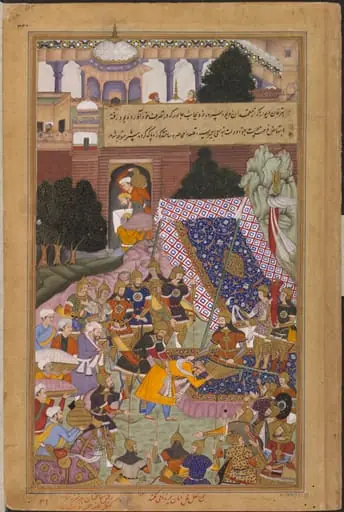 Tarkhan Divana and Husain Quli Khan
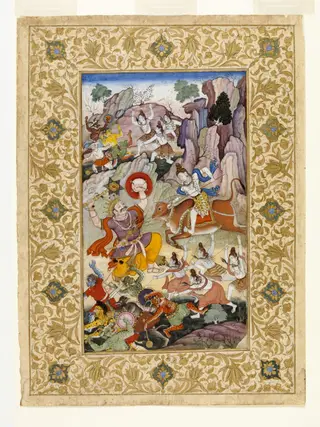 Shiva and Andhaka
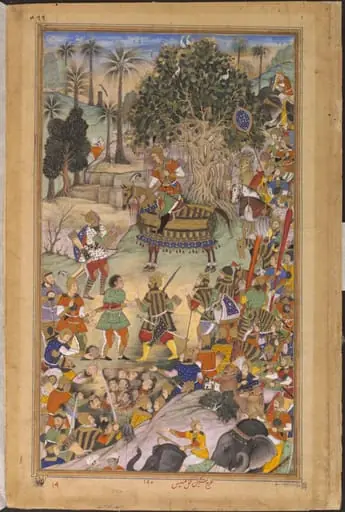 Muhammad Husain Mirza and Akbar
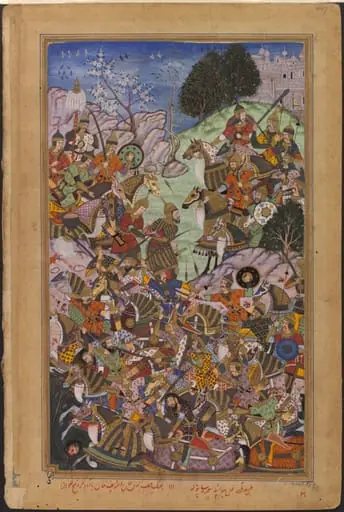 Sultan Adam
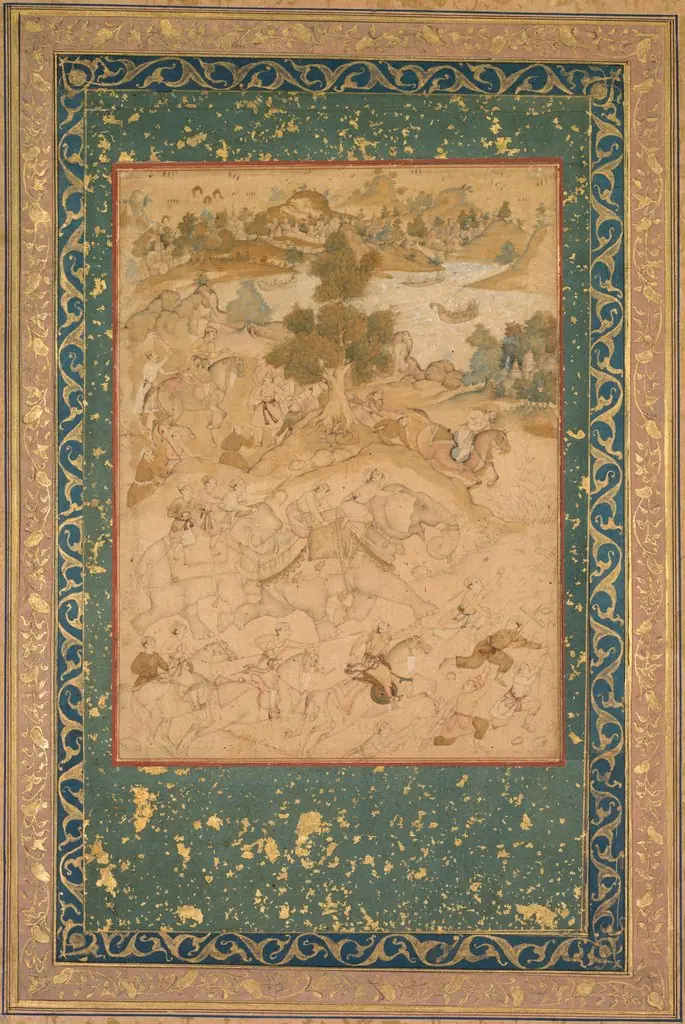 Akbar supervising the capture of wild elephants at Malwa in 1564, painting 90 from an Akbar-nama (Book of Akbar) of Abu’l Fazl (Indian 1551–1602)
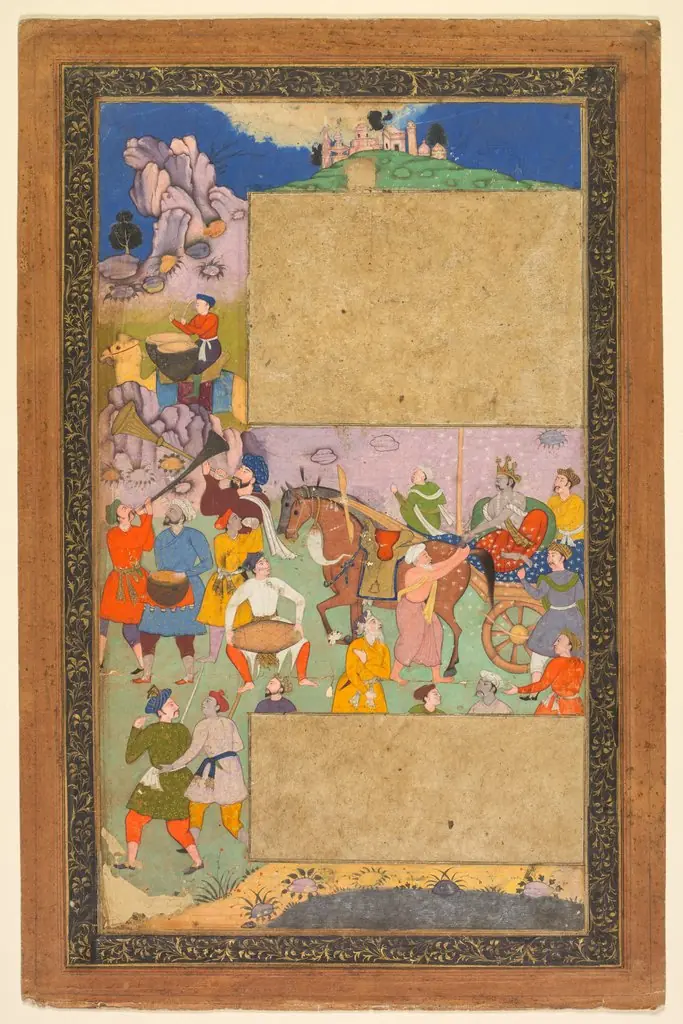 A charioteer riding through a rocky landscape with an entourage of footmen and musicians, page from a Razm-nama (Book of Wars) adapted from the Sanskrit Mahabharata and translated into Persian by Mir Ghiyath al-Din Ali Qazvini, known as Naqib Khan (P
 Prince Riding in Chariot Drawn by Goats
 A charioteer riding through a rocky landscape with an entourage of footmen and musicians, page from a Razm-nama (Book of Wars) adapted from the Sanskrit Mahabharata and translated into Persian by Mir Ghiyath al-Din Ali Qazvini, known as Naqib Khan (Persian, d. 1614)