Artwork
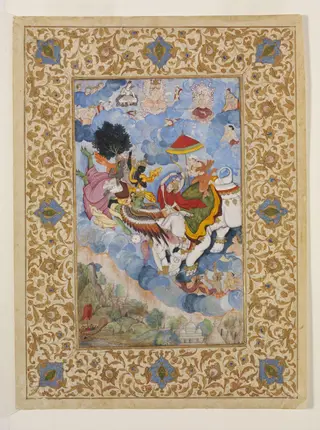
A charioteer riding through a rocky landscape with an entourage of footmen and musicians, page from a Razm-nama (Book of Wars) adapted from the Sanskrit Mahabharata and translated into Persian by Mir Ghiyath al-Din Ali Qazvini, known as Naqib Khan (P
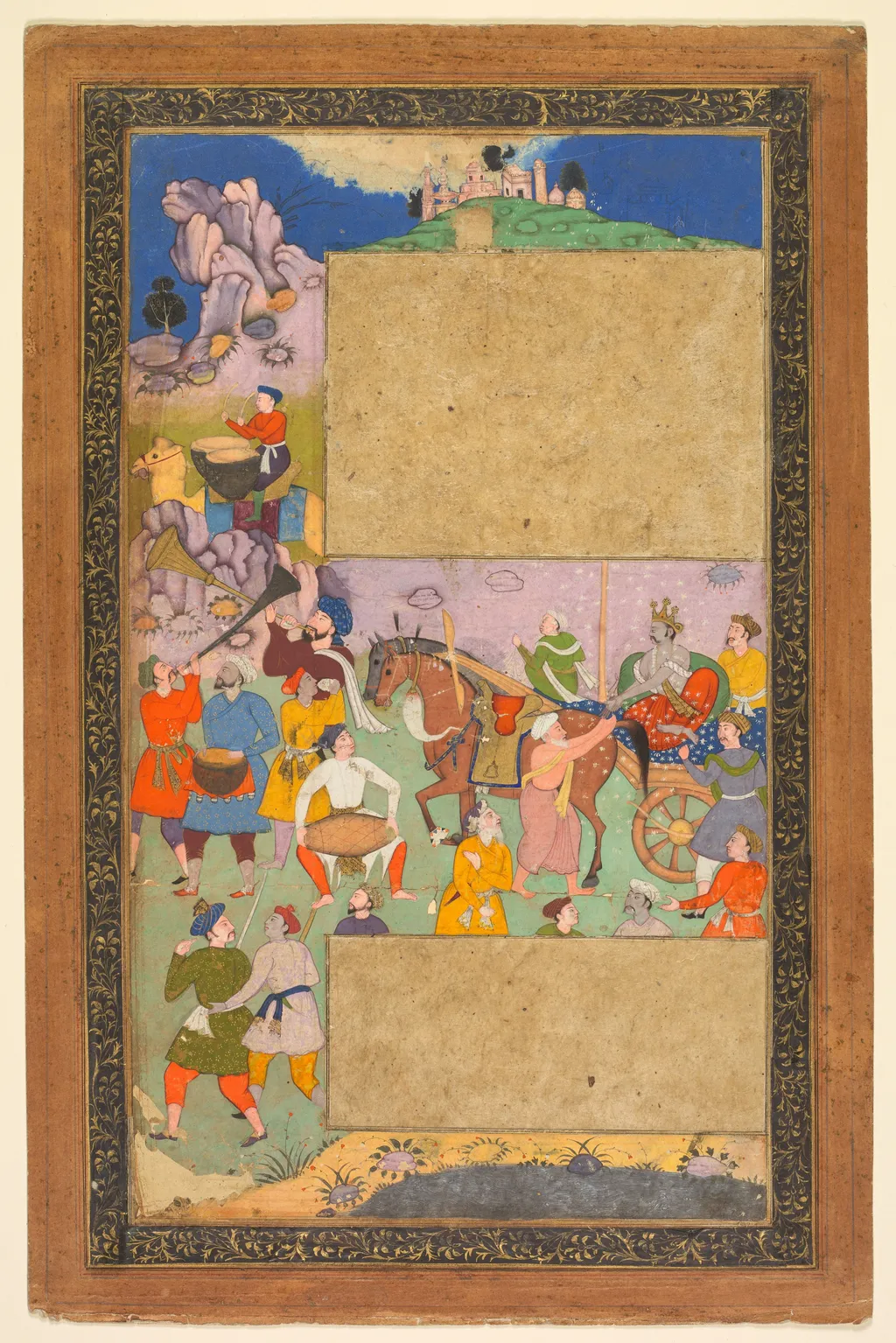
A charioteer riding through a rocky landscape with an entourage of footmen and musicians, page from a Razm-nama (Book of Wars) adapted from the Sanskrit Mahabharata and translated into Persian by Mir Ghiyath al-Din Ali Qazvini, known as Naqib Khan (P is an unspecified painting by the Mughal Painting artist Yusuf Ali. It dates from 1616 and is held in the collection of the Cleveland Museum of Art.
About this work
Subject & Meaning
The scene combines narrative detail with decorative patterning, emphasizing the martial and ceremonial context of the epic.
The miniature shows a charioteer navigating a rugged terrain, accompanied by foot soldiers and musicians, illustrating a pivotal episode from the Razm-nama, a Persian rendering of the Mahabharata commissioned by the Mughal court. The scene combines narrative detail with decorative patterning, emphasizing the martial and ceremonial context of the epic.
Symbolically, the charioteer embodies the role of a divine guide, steering the cosmic chariot of destiny, while the entourage of armed attendants and instrumentalists conveys the collective strength and harmony required for victory. The rocky setting underscores the challenges faced by heroic figures, and the inclusion of music reflects the cultural prestige of the manuscript within the Mughal artistic tradition.
History & Provenance
The miniature was created in 1616 in the Mughal Empire by Yusuf Ali, who adapted a scene from the Razm-nama, a Persian translation of the Sanskrit Mahabharata rendered by Mir Ghiyath al-Din Ali Qazvini, also known as Naqib Khan. The work entered the collection of the Cleveland Museum of Art, where it remains on view.
Context
Yusuf Ali, an Indian painter active in the early 1600s, created a page from the Razm-nama depicting a charioteer navigating a rocky landscape with an entourage of footmen and musicians, a scene drawn from the Persian adaptation of the Mahabharata translated by Mir Ghiyath al-Din Ali Qazvini. Executed in 1616, the work exemplifies Mughal artistic engagement with Persian literary sources and illustrates the cross-cultural transmission of South Asian epic narratives. The painting is housed in the Cleveland Museum of Art, where it is catalogued under its 2013 acquisition (2013.322).
Overview
This 1616 illustrated page, created by the Indian artist Yusuf Ali, forms part of a Razm‑nama, a Persian‑language book of wars derived from the Sanskrit epic Mahabharata. The manuscript was translated into Persian by Mir Ghiyath al‑Din Ali Qazvini, known as Naqib Khan. The work is now in the collection of the Cleveland Museum of Art.
Technique & Style
Yusuf Ali employs a vivid palette of reds, blues and greens against a muted, greenish terrain. The image is divided horizontally: a sparse, rocky upper section and a densely populated lower register filled with riders, infantry and instrumentalists. An empty chariot occupies the central axis, creating a visual pause amid the surrounding activity.
Own this work as a print
Artist & collection

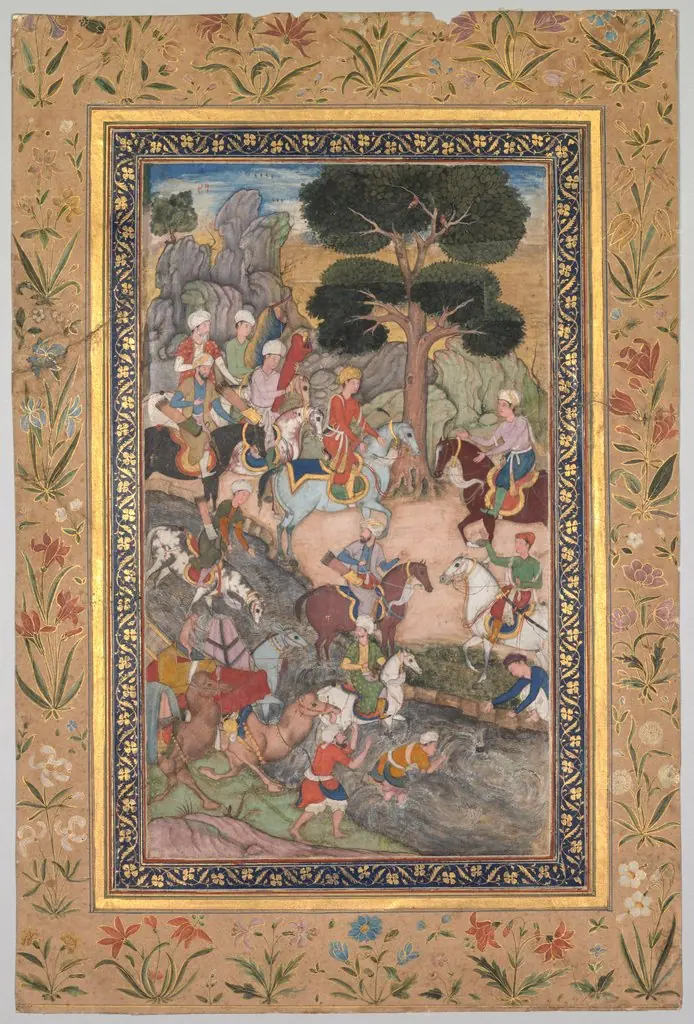 Babur meeting with Sultan Ali Mirza at the Kohik River, from a Babur-nama (Memoirs of Babur)
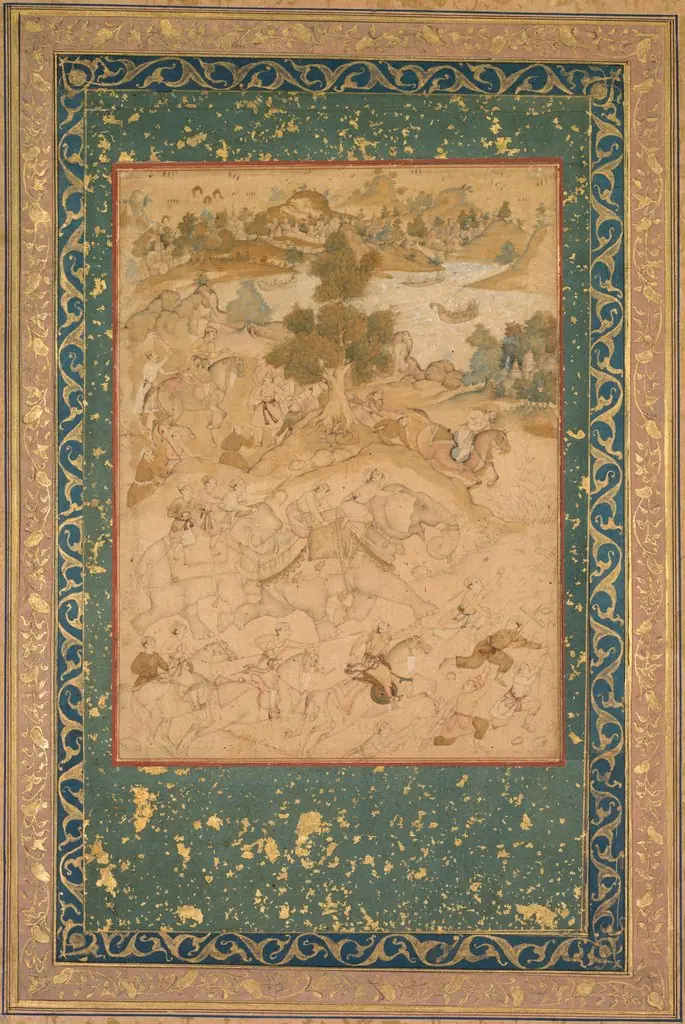 Akbar supervising the capture of wild elephants at Malwa in 1564, painting 90 from an Akbar-nama (Book of Akbar) of Abu’l Fazl (Indian 1551–1602)
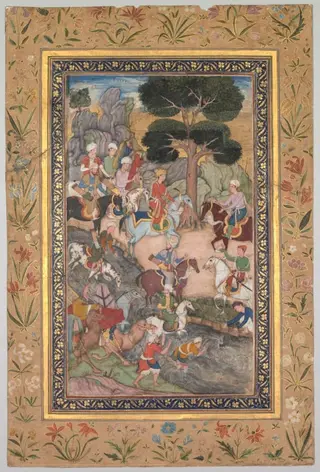 Babur meeting with Sultan Ali Mirza at the Kohik River, from a Babur-nama (Memoirs of Babur)
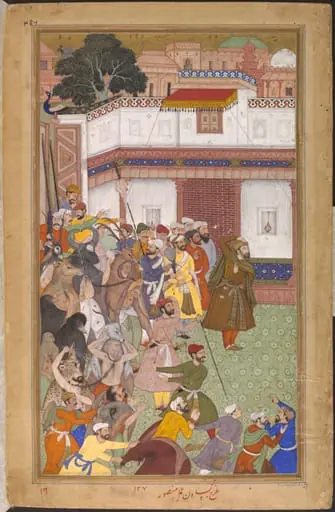 Husain Quli and Akbar
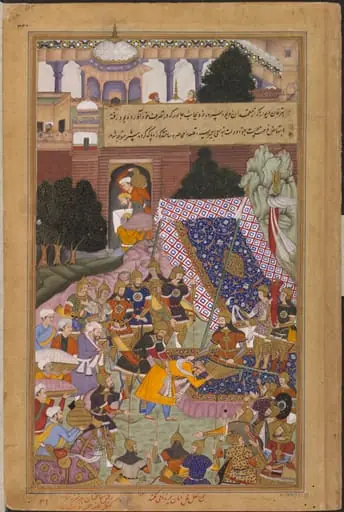 Tarkhan Divana and Husain Quli Khan
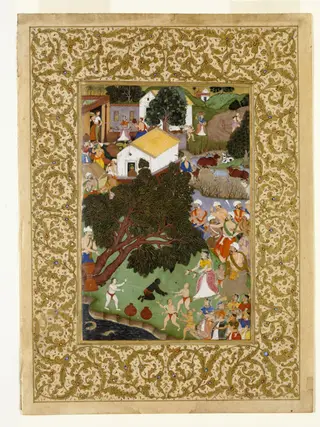 Krishna
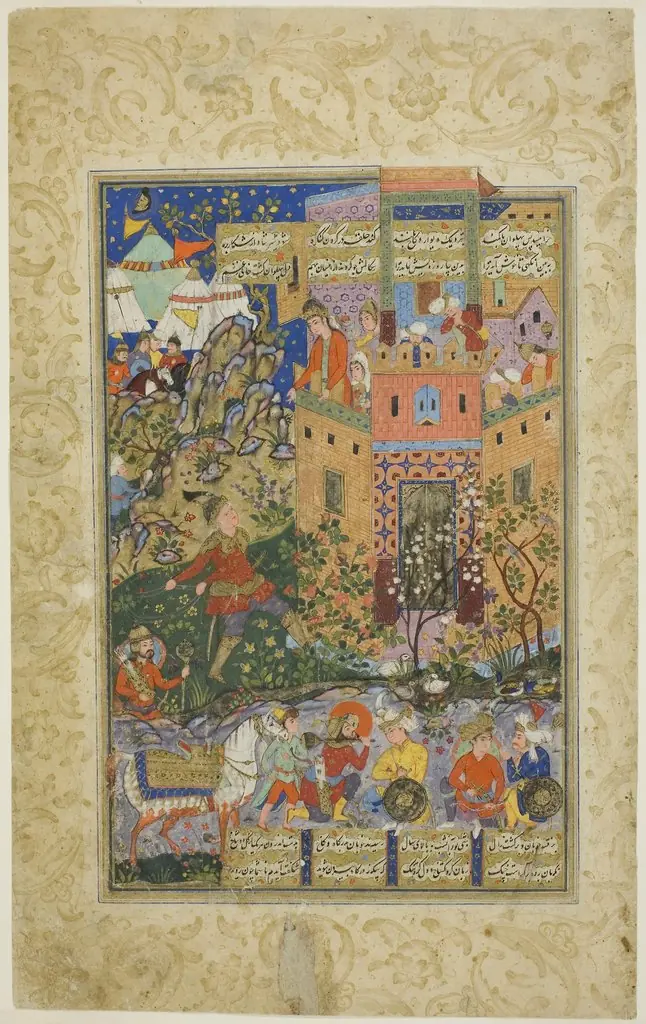 Zal Climbing to Rudaba, page from a copy of the Shahnama of Firdausi
- A charioteer riding through a rocky landscape with an entourage of footmen and musicians, page from a Razm-nama (Book of Wars) adapted from the Sanskrit Mahabharata and translated into Persian by Mir Ghiyath al-Din Ali Qazvini, known as Naqib Khan (Persian, d. 1614)
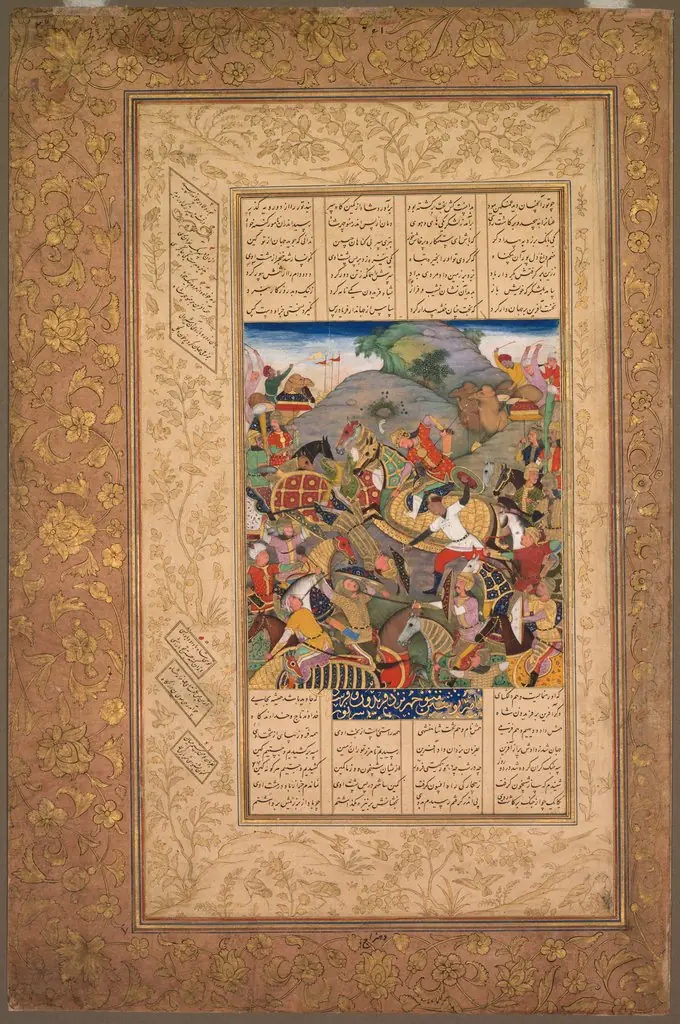 Battle between Manuchihr and Tur, from a Shah-nama (Book of Kings) of Firdausi (Persian, c. 934–1020)
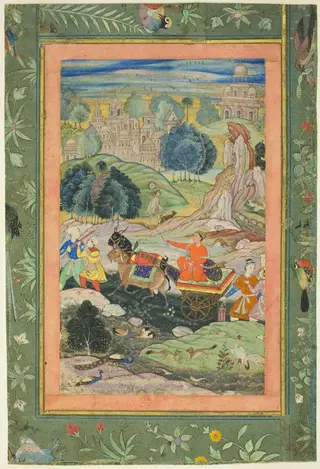 Prince Riding in Chariot Drawn by Goats
 Battle between Manuchihr and Tur, from a Shah-nama (Book of Kings) of Firdausi (Persian, c. 934–1020)
 Krishna and Indra