Artwork
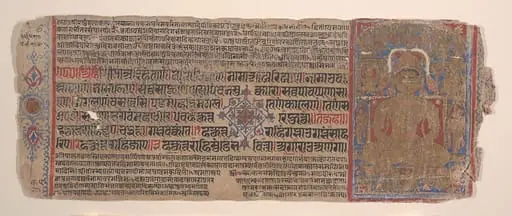
Brahman Rishabhadatta's speech, folio 5 from a Kalpa-sutra
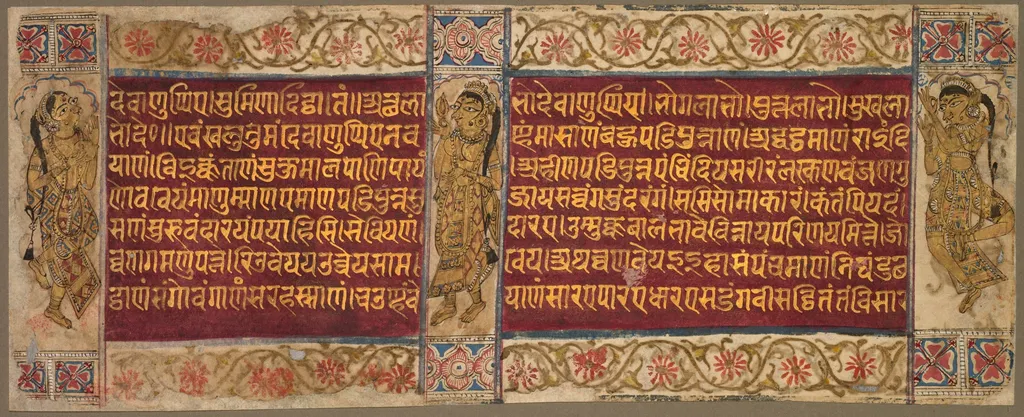
Brahman Rishabhadatta's speech, folio 5 from a Kalpa-sutra is an unspecified painting. It dates from 1549 and is held in the collection of the Cleveland Museum of Art. The work, titled “Brahman Rishabhadatta’s speech, folio 5 from a Kalpa‑sutra,” is a painted manuscript page.
About this work
History & Provenance
The work is a folio from a Kalpa-sutra manuscript attributed to Brahman Rishabhadatta, created in 1549 and cataloged as a painting.
Brahman Rishabhadatta's speech, folio 5 from a Kalpa-sutra is classified as a painting created in 1549. It was commissioned within a Jain manuscript tradition and drawn from a Kalpa-sutra manuscript. The work entered the collection of the Cleveland Museum of Art, where it has been housed since its acquisition.
The painting is attributed to an unknown artist working in the 16th century, reflecting the stylistic conventions of Jain manuscript illumination from that period.
The painting is held by the Cleveland Museum of Art with accession number 1979.23. It was exhibited in the museum's 1979 exhibition of Indian Paintings.
The work is a folio from a Kalpa-sutra manuscript attributed to Brahman Rishabhadatta, created in 1549 and cataloged as a painting.
Overview
The work, titled “Brahman Rishabhadatta’s speech, folio 5 from a Kalpa‑sutra,” is a painted manuscript page. It presents two upright figures in simple robes, their elongated arms framing a central block of red text rendered in gold lettering, all set within a decorative border of swirling motifs and modest floral designs.
Subject & Meaning
The two figures appear to be participants in a didactic scene, their serene, expressionless faces suggesting a focus on the spoken or written instruction contained in the gold script. The text likely conveys a passage from the Kalpa‑sutra, a Buddhist treatise on monastic discipline.
Technique & Style
The painting employs a limited palette of reds, blues, earthy tones, and gold. Gold leaf or pigment is applied to the script, creating a dense, compact visual narrative. The surrounding border combines geometric shapes with stylized floral elements, typical of South Asian manuscript illumination.
Artist & collection

- Celestial Dancers, folio 5 (recto), from Brahman Rishabhadatta's speech, from a Kalpa-sutra
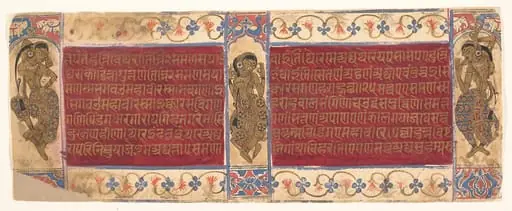 Untitled
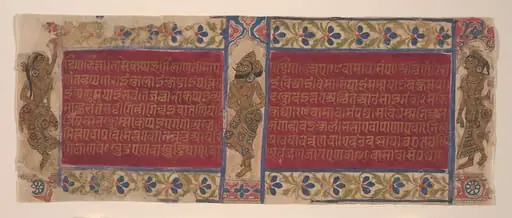 Untitled
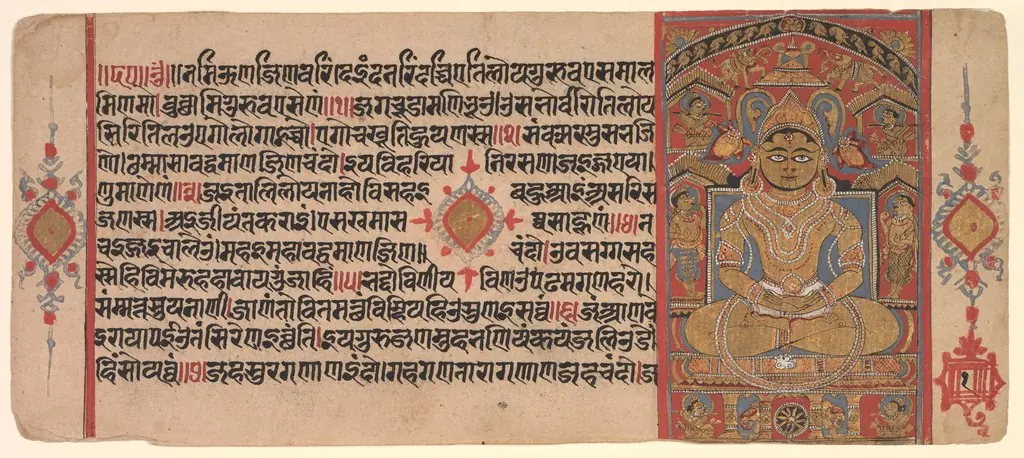 Seated Jina Rishabha Enshrined, from a Jain Manuscript: Kalpa-Sutra
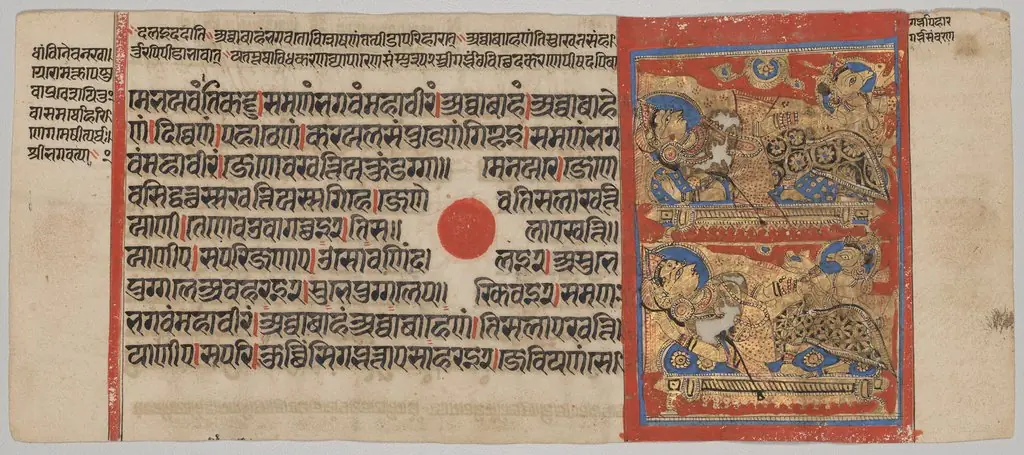 Transfer of the Embryo of Mahavira, from a Kalpa-sutra
 Untitled
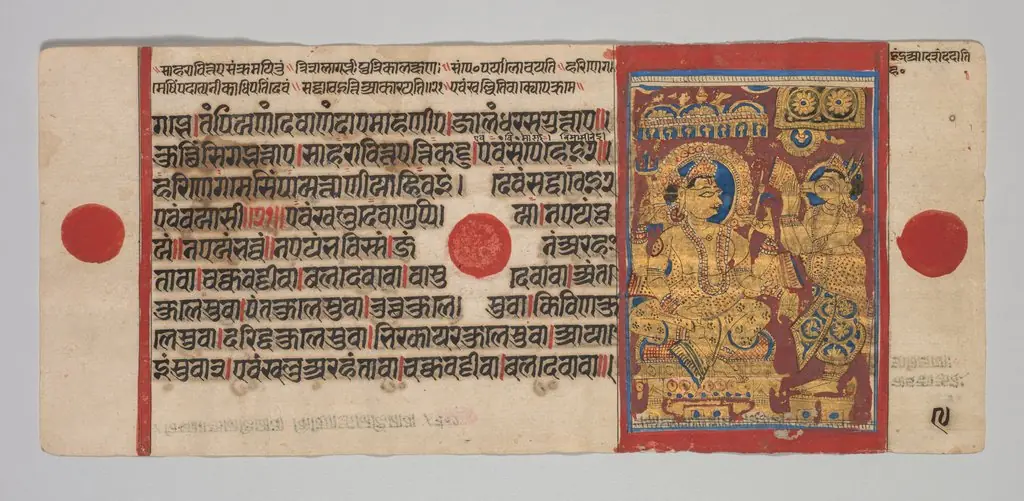 Kalpa-sutra Manuscript with 24 Miniatures: Sakra Summons Harinegamesin
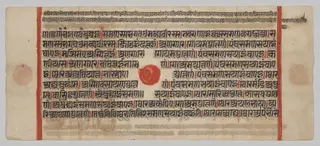 Text, Folio 58 (recto), from a Kalpa-sutra
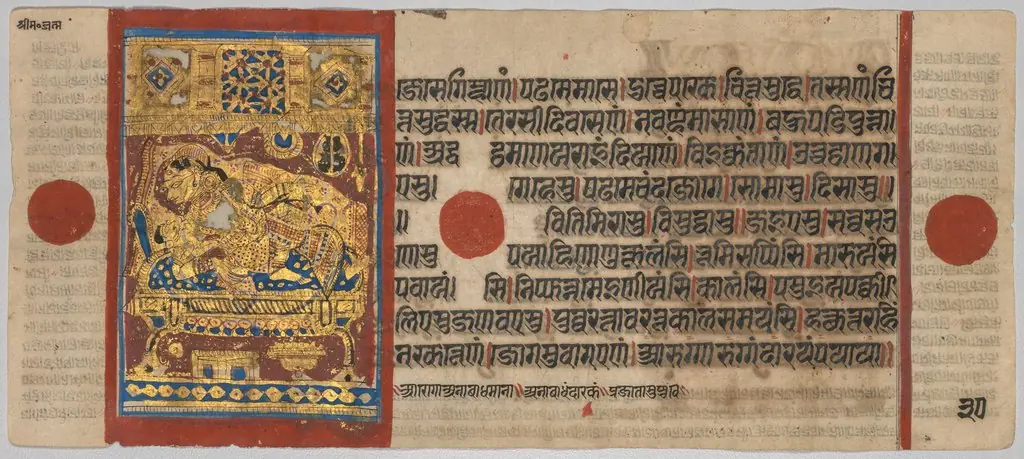 Kalpa-sutra Manuscript with 24 Miniatures: Birth of Rsabhanatha
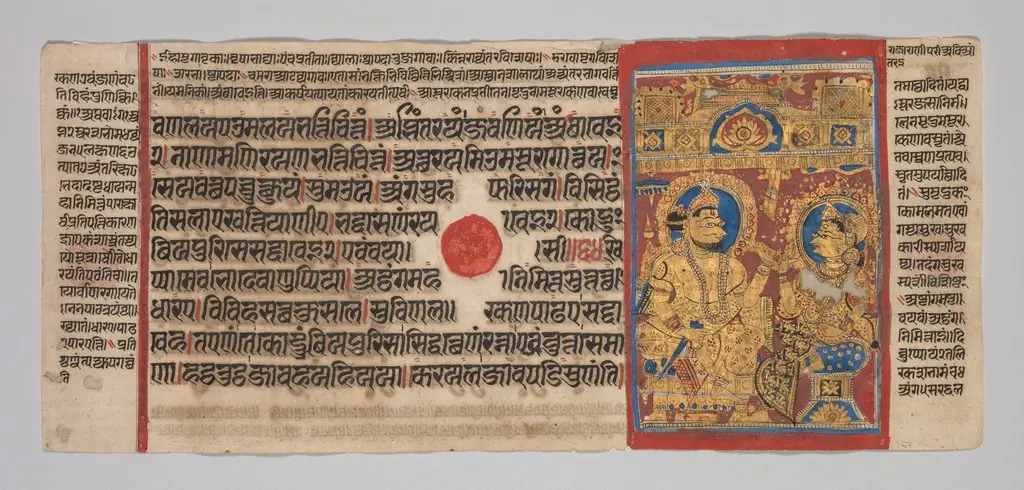 Kalpa-sutra Manuscript with 24 Miniatures: Siddhartha Hears the Recitation of Trisala's Dreams
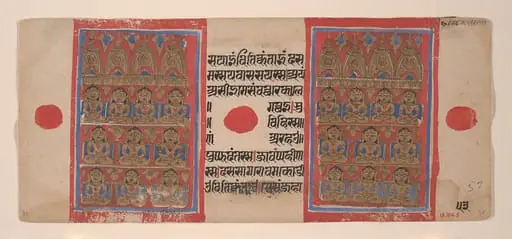 Untitled
 Untitled