Artwork
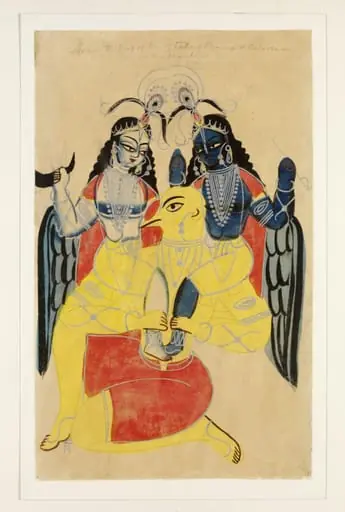
Garuda Carrying Balarama and Krishna (verso), from a Kalighat album
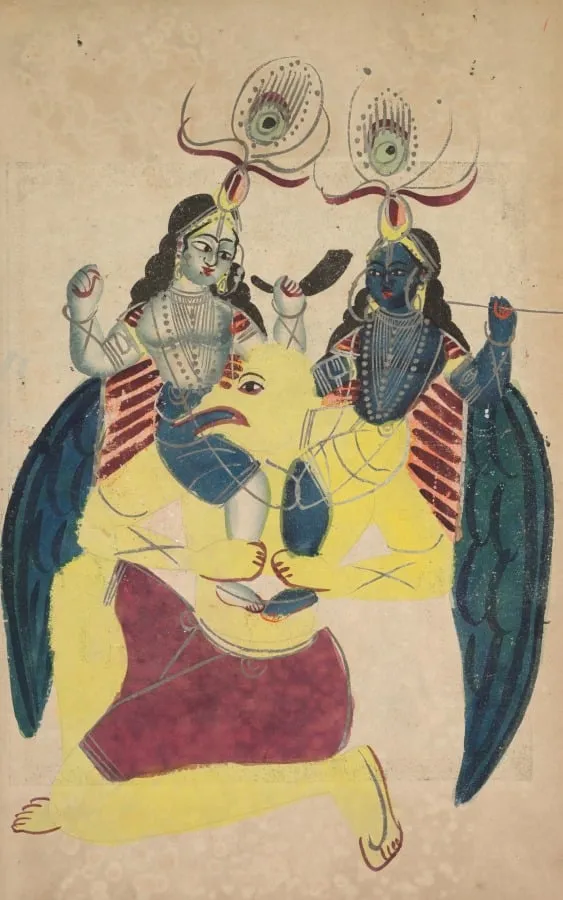
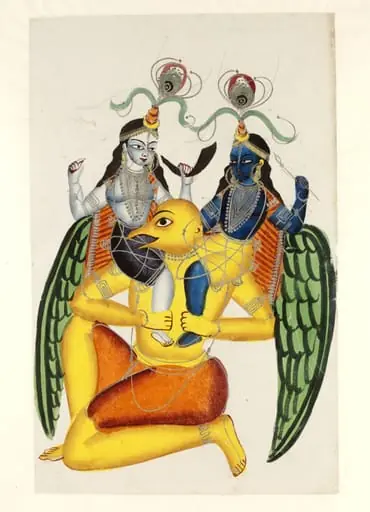
Garuda Carrying Balarama and Krishna (verso), from a Kalighat album is an unspecified painting by the Bengal School artist Unknown. It dates from 1890 and is held in the collection of the Cleveland Museum of Art. The work portrays Garuda, the mythic mount of Vishnu, rendered as a kneeling figure with a human torso and an eagle’s head.
- Accession no.
- 2003.134.b
About this work
Overview
The work portrays Garuda, the mythic mount of Vishnu, rendered as a kneeling figure with a human torso and an eagle’s head. He bears the two brothers, Balarama on his right shoulder and Krishna on his left, each rendered in contrasting skin tones and simple attire.
Subject & Meaning
Garuda’s role as Vishnu’s carrier is emphasized by his supportive stance, while the presence of Balarama and Krishna highlights their divine lineage. The composition underscores the protective function of the vehicle, linking the celestial narrative to devotional practice.
Technique & Style
Executed in a flat, bright palette, the painting relies on solid blocks of color and clean, decisive outlines. Minimal shading and the absence of depth convey a sense of immediacy, characteristic of works produced rapidly for a popular market.
History & Provenance
Originating from the bustling Kalighat market in Kolkata, the piece was created for pilgrims visiting the nearby Kali temple. Artists there produced affordable, quickly rendered images to meet the demand of travelers seeking devotional souvenirs.
Context
Kalighat paintings emerged in the 19th‑century as a vernacular art form, blending traditional iconography with a brisk, commercial aesthetic. This work exemplifies the genre’s focus on accessible religious imagery, catering to everyday worshippers rather than elite patrons.
Artist & collection