Artwork
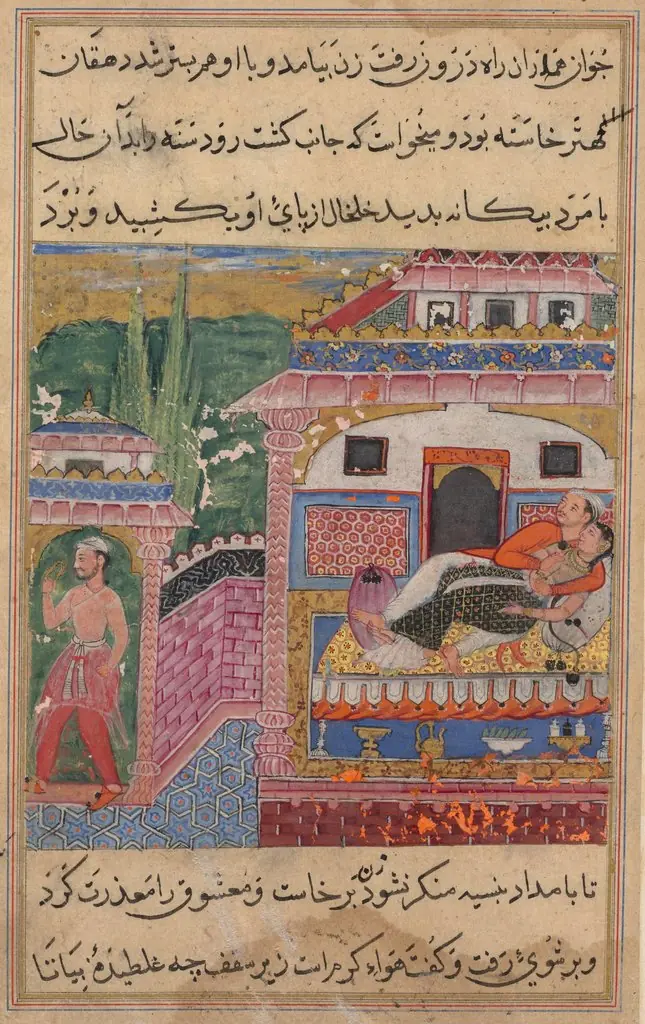
Habbaza’s sister, who is sent to console her, discovers the disguised Arab in her place, from a Tuti-nama (Tales of a Parrot): Twenty-fourth Night
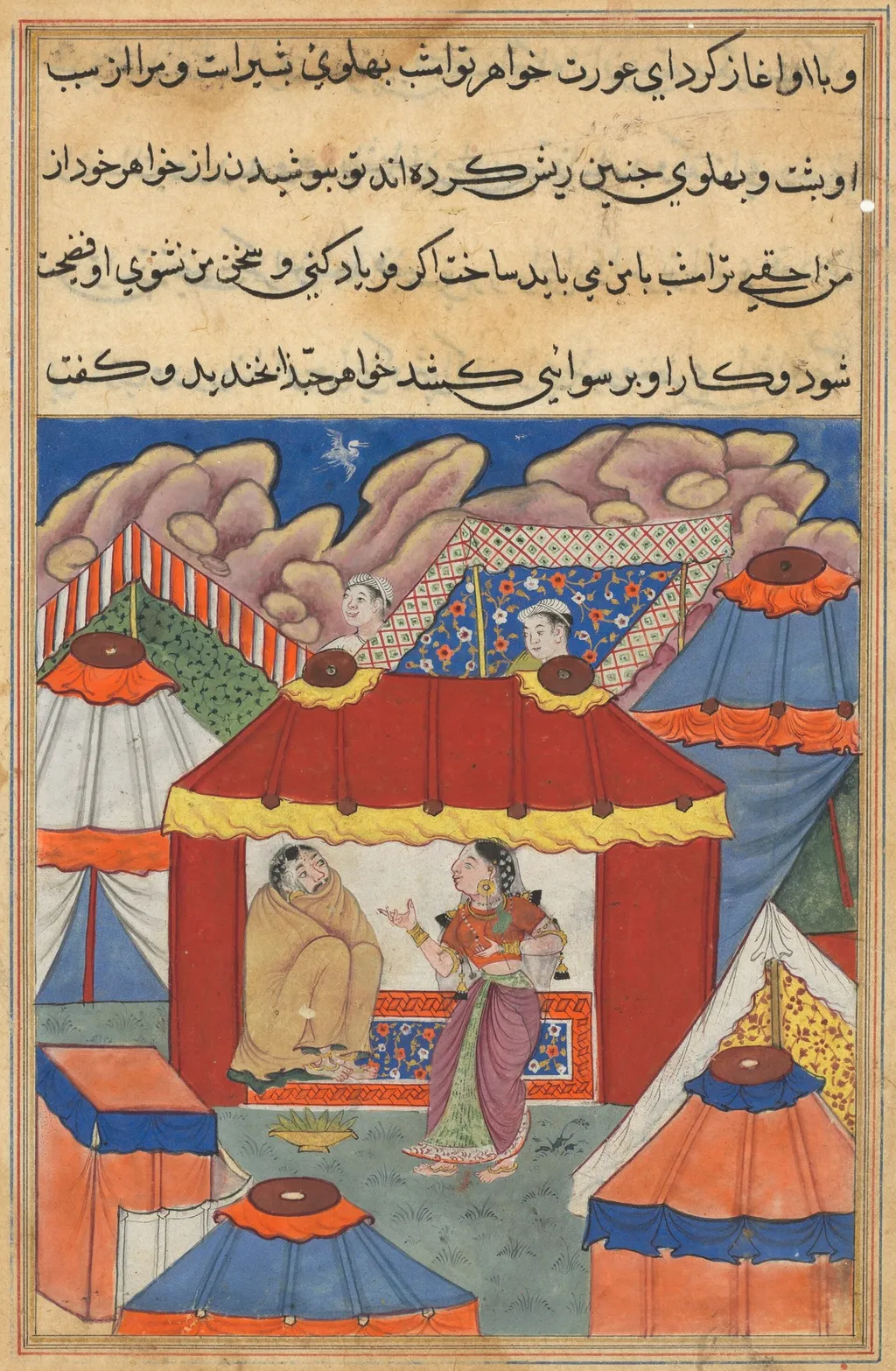
Habbaza’s sister, who is sent to console her, discovers the disguised Arab in her place, from a Tuti-nama (Tales of a Parrot): Twenty-fourth Night is an unspecified painting. It dates from 1560 and is held in the collection of the Cleveland Museum of Art. The work depicts an interior scene set within a vividly colored red tent trimmed in yellow.
About this work
Subject & Meaning
The painting illustrates the scene from the Twenty‑fourth Night of the Tuti‑nama in which Habbaza’s sister, sent to console her, discovers the disguised Arab occupying her place. As a Mughal miniature dated to 1560, it exemplifies the narrative illustration style of the empire’s mid‑16th‑century manuscript tradition, conveying themes of mistaken identity, familial duty, and the moral lessons typical of the Tuti‑nama parables.
History & Provenance
It was created in 1560 in the Mughal Empire and has not been recorded in major exhibition histories beyond its inclusion in the museum’s permanent collection.
Created in 1560 within the Mughal Empire, this painting is attributed to an unknown artist. The work, identified in museum records as 1962.279.170.b, entered the collection of the Cleveland Museum of Art in 1962. No specific details regarding the original commissioner or the ownership chain prior to its acquisition by the Cleveland institution are provided in the available records.
The piece is classified as a painting and illustrates a scene from the twenty-fourth night of the Tuti-nama.
The painting is held in the Cleveland Museum of Art, where it is accessioned as 1962.279.170.b. It was created in 1560 in the Mughal Empire and has not been recorded in major exhibition histories beyond its inclusion in the museum’s permanent collection.
Context
The painting depicting Habbaza’s sister discovering the disguised Arab in her place originates from the Mughal imperial workshop and is dated to 1560. It illustrates a narrative from the Tuti-nama, a Persian illustrated manuscript composed in the early 17th century but drawing on earlier storytelling traditions. The work belongs to a broader tradition of Persian miniature painting that flourished under Mughal patronage, blending Persian compositional principles with Indian visual sensibilities.
Its presence in the collection of the Cleveland Museum of Art underscores its significance within the corpus of surviving Mughal-era miniatures.
Scholars have examined the piece as part of the Cleveland Museum’s Mughal painting holdings, highlighting its role in understanding cross-cultural artistic exchange within the Persianate world. The attribution to an anonymous artist working within the Mughal imperial atelier reflects the collaborative and often unattributed nature of workshop production during this period. The painting’s composition and narrative detail contribute to discussions on narrative illustration in Islamic manuscript culture, particularly in how emotional and dramatic moments are rendered through gesture and spatial arrangement.
Overview
The work depicts an interior scene set within a vividly colored red tent trimmed in yellow. A woman dressed in green stands beside a seated man, cradling an infant, while outside three additional tents, red, orange, and blue, are arranged beneath a sky dotted with soft clouds. The composition is dominated by bold hues of red, blue, and gold, and the fabrics are richly patterned.
Technique & Style
Executed in a flat, decorative manner, the painting employs strong, saturated colors and stylized patterns that emphasize surface ornamentation over naturalistic depth. The use of bold outlines and simplified forms aligns with a manuscript illustration tradition, while the vivid palette and patterned textiles reflect a decorative aesthetic typical of Persian narrative art.
Artist & collection

- Habbaza’s sister, who is sent to console her, discovers the disguised Arab in her place, from a Tuti-nama (Tales of a Parrot): Twenty-fourth Night
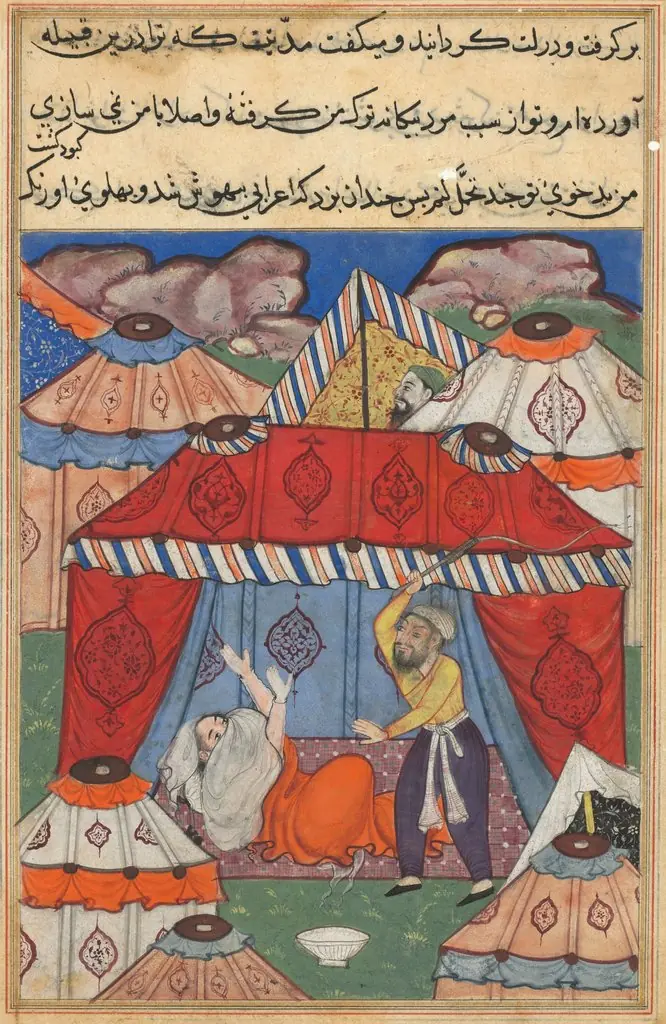 The disguised Arab, substituting for Habbaza, is whipped by her husband for refusing a bowl of milk, from a Tuti-nama (Tales of a Parrot): Twenty-fourth Night
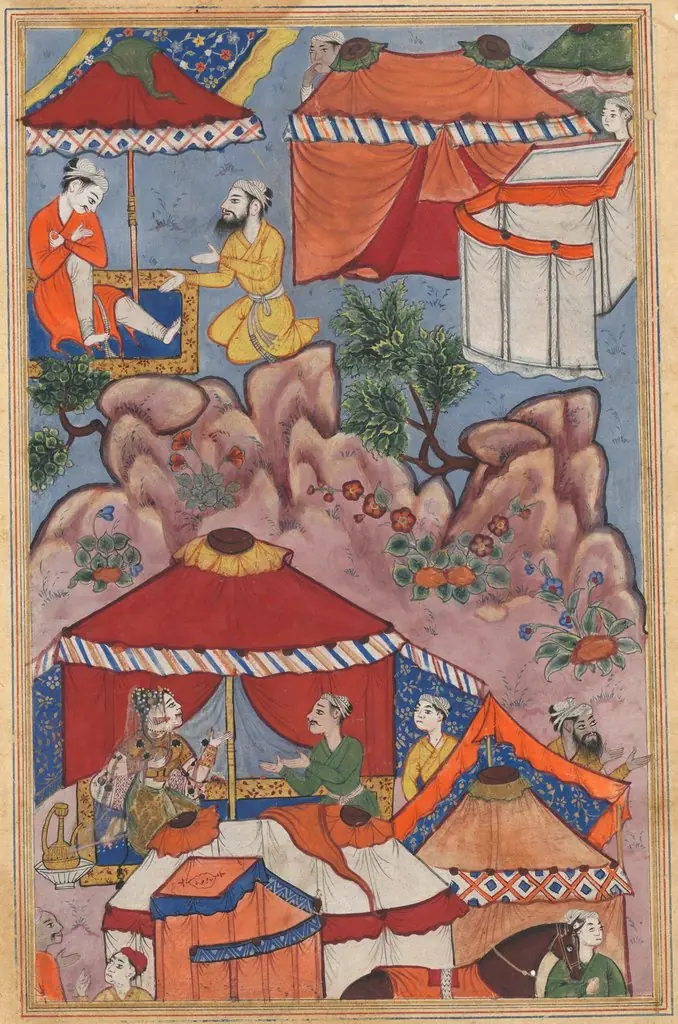 Bashir confides his love for Habbaza to an Arab friend, and sends him to her with a message, from a Tuti-nama (Tales of a Parrot): Twenty-fourth Night
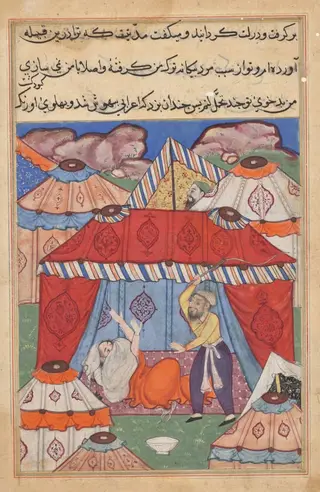 The disguised Arab, substituting for Habbaza, is whipped by her husband for refusing a bowl of milk, from a Tuti-nama (Tales of a Parrot): Twenty-fourth Night
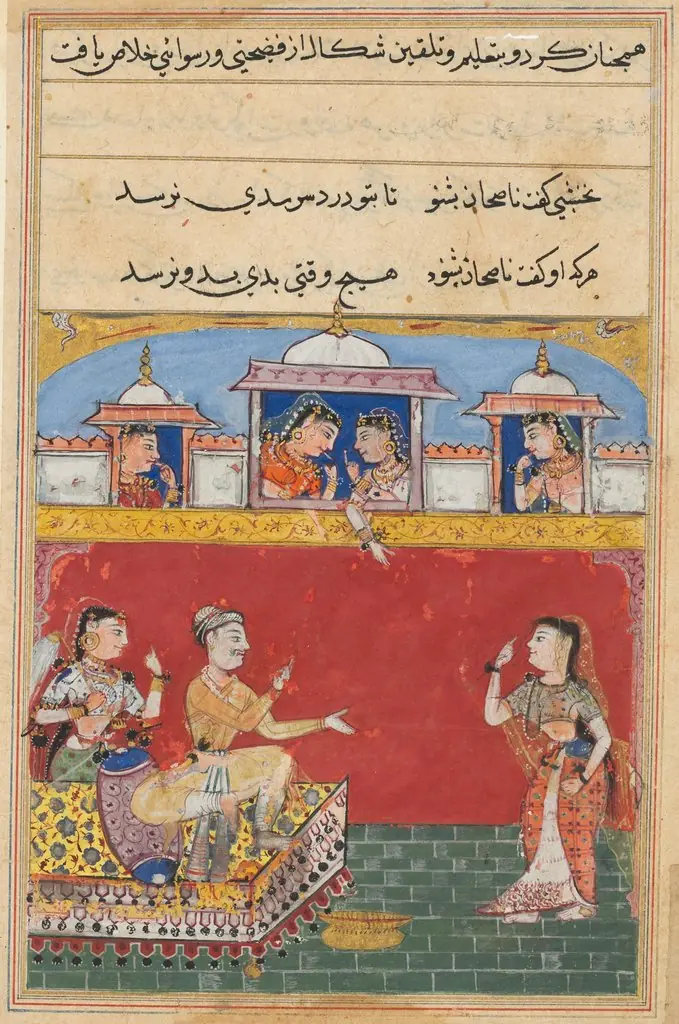 The daughter-in-law returns from her misadventure, feigning insanity, from a Tuti-nama (Tales of a Parrot): Sixteenth Night
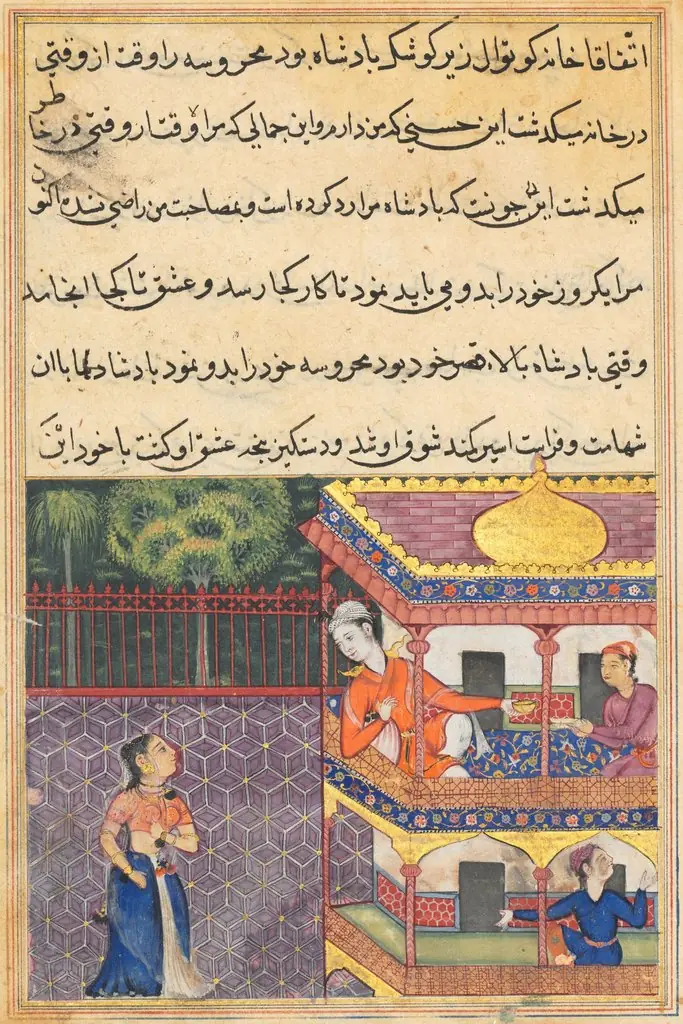 The king of Zabul sees Mahrusa from his palace balcony, from a Tuti-nama (Tales of a Parrot): Thirty-sixth Night
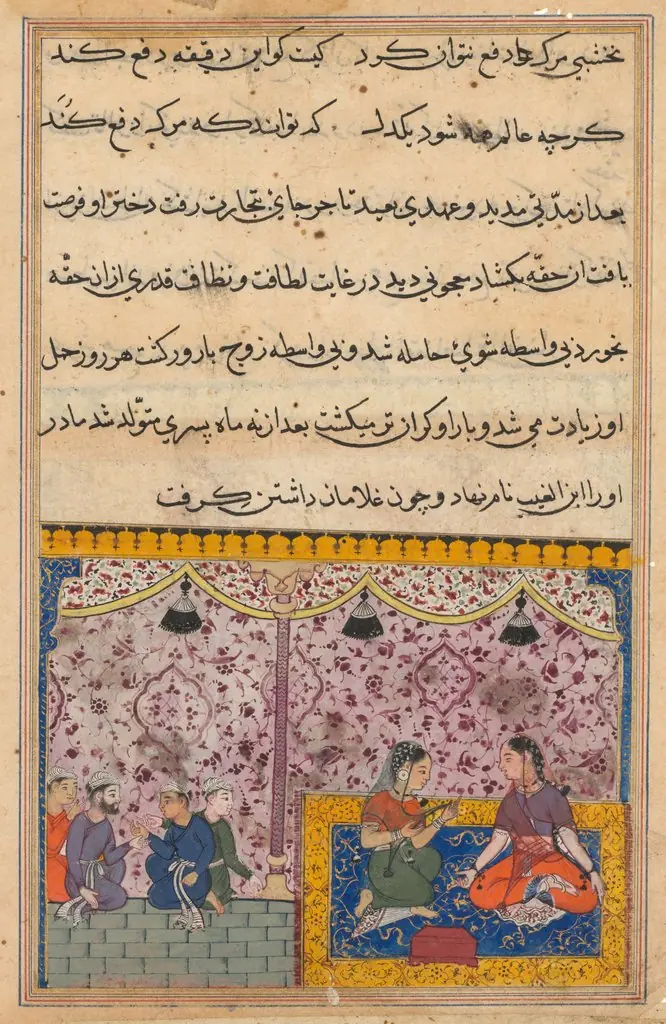 The merchant’s daughter gives birth to a son as a result of eating out of the box. The clever child recognizes the false gems from true, from a Tuti-nama (Tales of a Parrot): Twenty-third Night
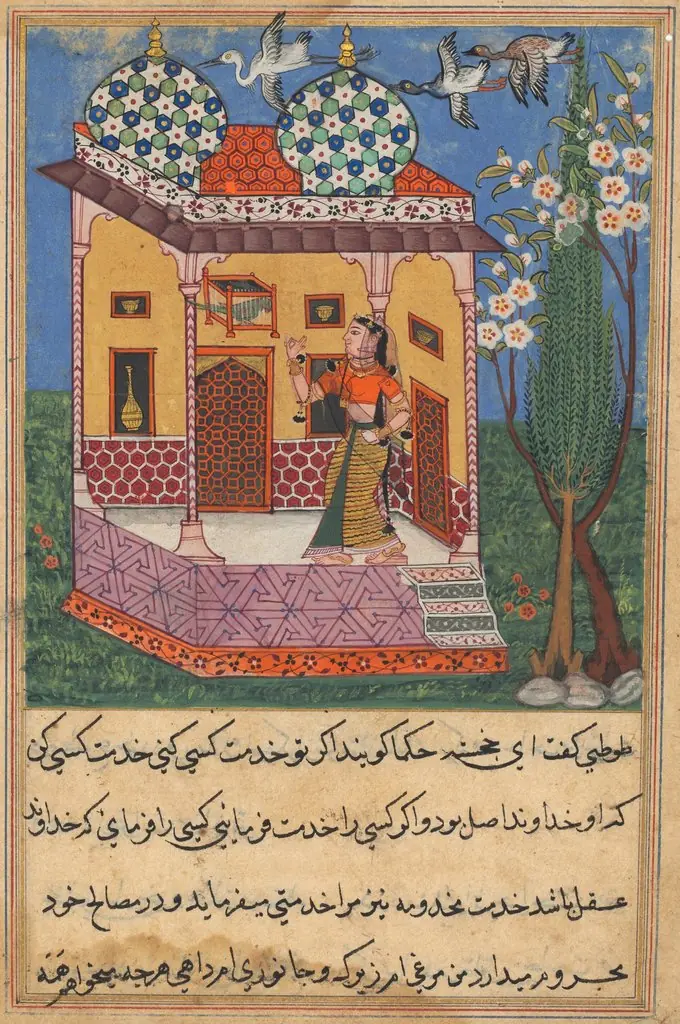 The Parrot Addresses Khujasta at the Beginning of the Twenty-sixth Night, from a Tuti-nama (Tales of a Parrot)
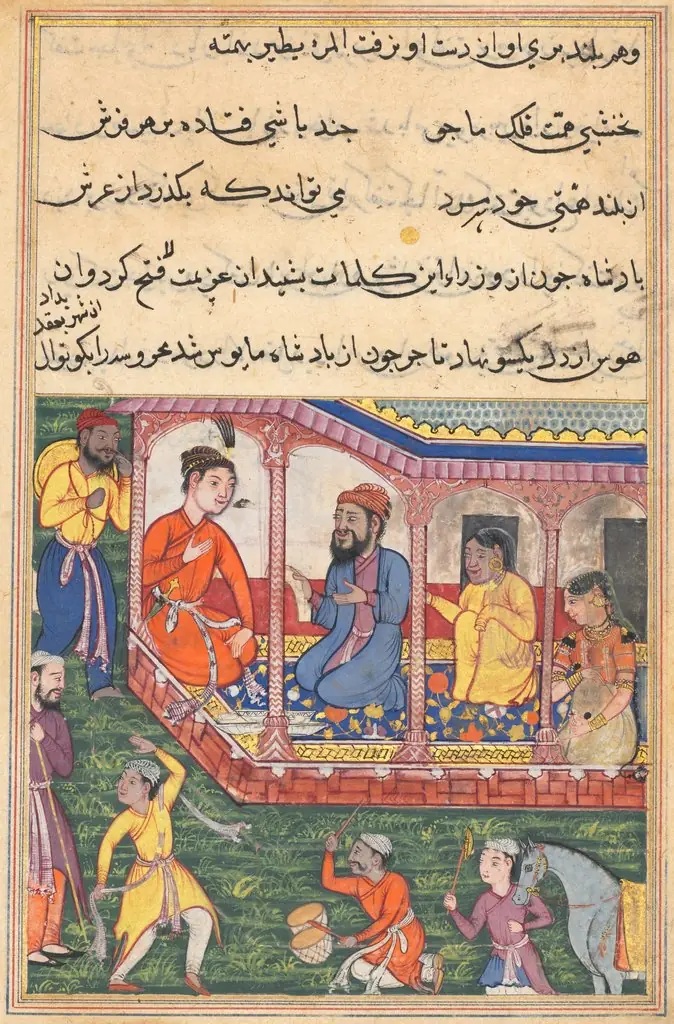 Mahrusa’s marriage to the prefect of the city, from a Tuti-nama (Tales of a Parrot): Thirty-sixth Night
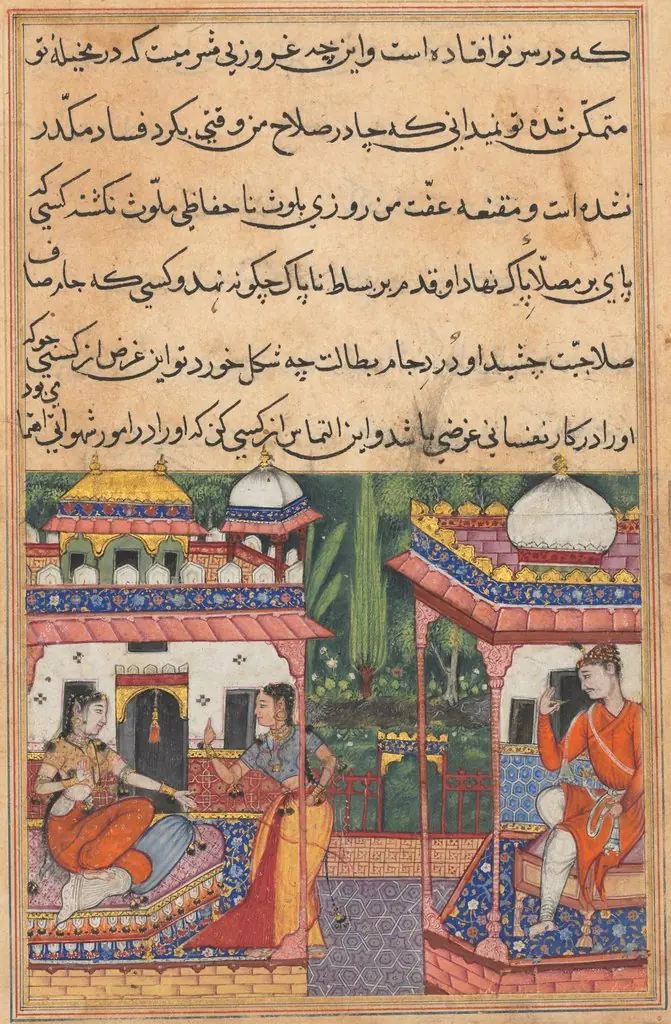 Kaiwan sends a message of love to Khurshid, wife of his brother Utarid who is away on a journey, from a Tuti-nama (Tales of a Parrot): Thirty-second Night
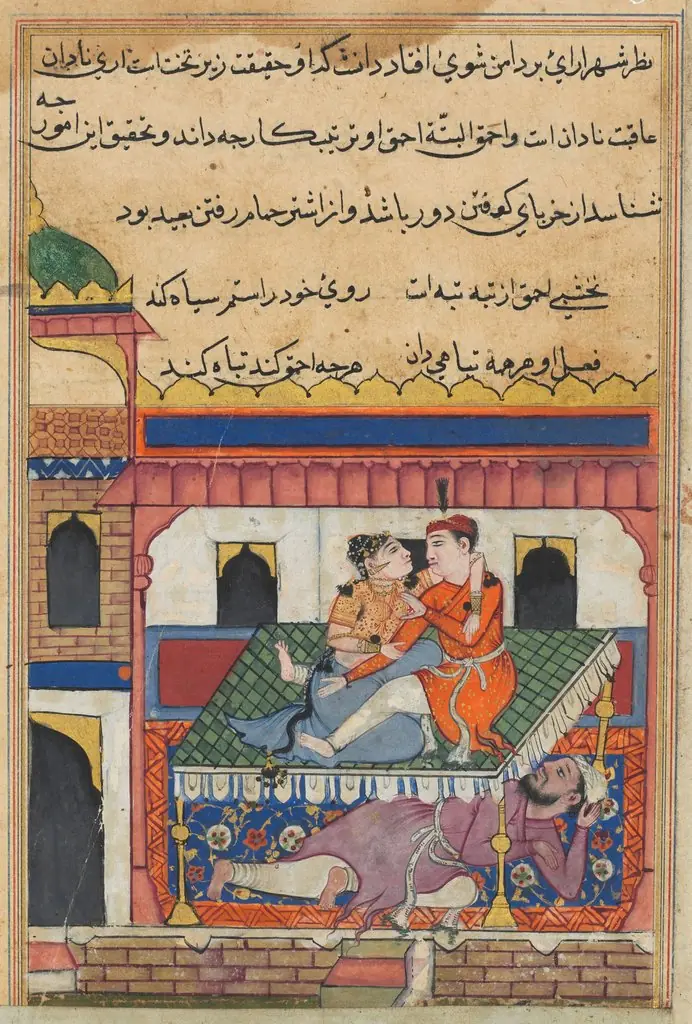 Shahr-Arai and her lover dallying on a bed beneath which is concealed her husband, from a Tuti-nama (Tales of a Parrot): Fortieth Night
 The deceitful wife persuades her husband to sleep in the same place where she had previously slept with her lover, from a Tuti-nama (Tales of a Parrot): Eighth Night