Artwork
Habbaza’s sister, who is sent to console her, discovers the disguised Arab in her place, from a Tuti-nama (Tales of a Parrot): Twenty-fourth Night
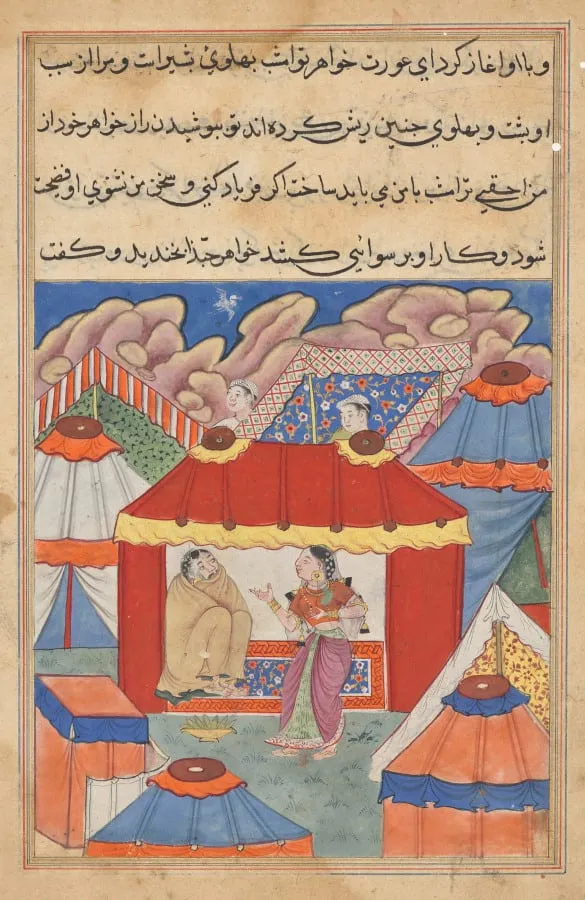
Habbaza’s sister, who is sent to console her, discovers the disguised Arab in her place, from a Tuti-nama (Tales of a Parrot): Twenty-fourth Night is an unspecified painting by the Mughal Painting artist Unknown. It dates from 1560 and is held in the collection of the Cleveland Museum of Art.
- Accession no.
- 1962.279.170.b
- Credit line
- Gift of Mrs. A. Dean Perry
About this work
The story is wild: a man disguised as a woman gets beaten, then the sister who comes to help falls for him instead.
You see a woman in a striped robe kneeling beside a man on a bed, her hand reaching toward his bruised face.
This painting comes from a book of parrot tales told in Akbar’s court. The story is wild: a man disguised as a woman gets beaten, then the sister who comes to help falls for him instead. The artist packed the drama into a small space, using bright colors and sharp details to show every emotion.
To see more paintings like this, look up Mughal India, court of Akbar (reigned 1556–1605).
Overview
The miniature portrays a dramatic moment from the twenty‑fourth night of the Tuti‑nama, a collection of parrot tales associated with Emperor Akbar’s court. A woman in a striped robe kneels beside a bruised man lying on a bed, her hand reaching toward his wounded face. The scene captures the instant when Habbaza’s sister discovers that the figure she believes to be her sibling is actually an Arab man in disguise.
Subject & Meaning
In the narrative, Habbaza’s husband has violently punished the Arab who temporarily assumes Habbaza’s identity while she meets her lover. When Habbaza’s sister arrives to tend to the injured woman, she recognizes the deception and, rather than reporting it, initiates her own illicit liaison with the disguised man. The composition thus explores themes of disguise, betrayal, and the complex dynamics of desire within a confined domestic space.
Technique & Style
Executed in the Mughal miniature tradition, the painting employs vivid pigments and meticulous line work to delineate facial expressions and textile patterns. The artist uses sharp detailing to emphasize the bruises on the man's face and the texture of the striped robe, while the compact composition concentrates the emotional intensity within a limited pictorial field, a hallmark of courtly narrative art of the period.
History & Provenance
The work originates from a manuscript of the Tuti‑nama, a Persian‑influenced anthology compiled for the court of Emperor Akbar (reigned 1556–1605). Such illustrated books were produced by imperial workshops in Delhi and Agra, reflecting the syncretic artistic milieu of Mughal India, where Persian literary themes were rendered in a distinctly Indian visual language.
Context
Mughal court paintings often illustrated literary episodes to convey moral or entertaining stories to elite audiences. This scene exemplifies the fusion of Persian narrative content with Indian artistic techniques, illustrating the cultural exchange that defined Akbar’s reign. The emphasis on courtly intrigue and elaborate costume aligns with the broader aesthetic priorities of the era’s manuscript illumination.
Artist & collection









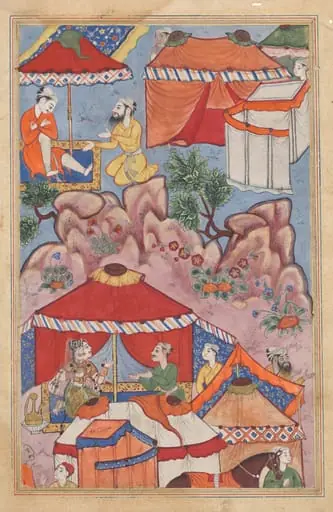
- Bashir confides his love for Habbaza to an Arab friend, and sends him to her with a message, from a Tuti-nama (Tales of a Parrot): Twenty-fourth Night
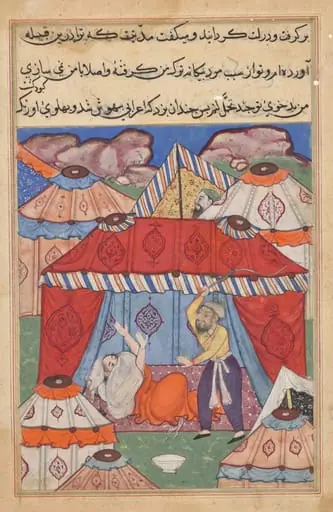 The disguised Arab, substituting for Habbaza, is whipped by her husband for refusing a bowl of milk, from a Tuti-nama (Tales of a Parrot): Twenty-fourth Night
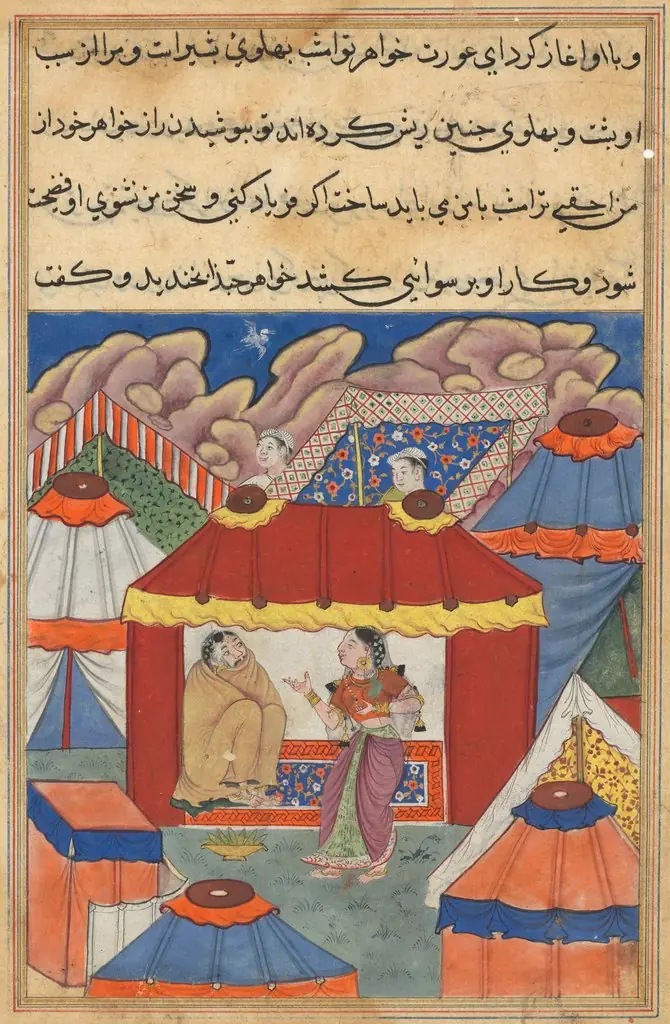 Habbaza’s sister, who is sent to console her, discovers the disguised Arab in her place, from a Tuti-nama (Tales of a Parrot): Twenty-fourth Night
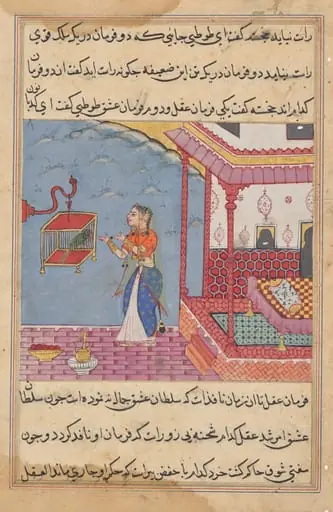 The Parrot Addresses Khujasta at the Beginning of the Twenty-Fourth Night, from a Tuti-nama (Tales of a Parrot)
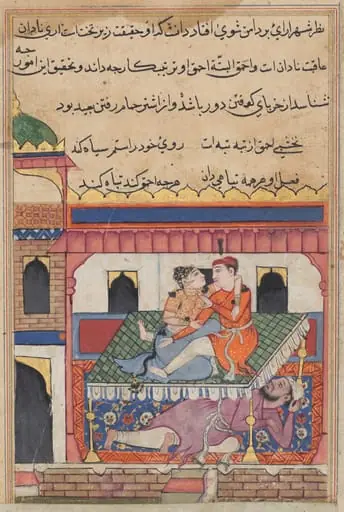 Shahr-Arai and her lover dallying on a bed beneath which is concealed her husband, from a Tuti-nama (Tales of a Parrot): Fortieth Night
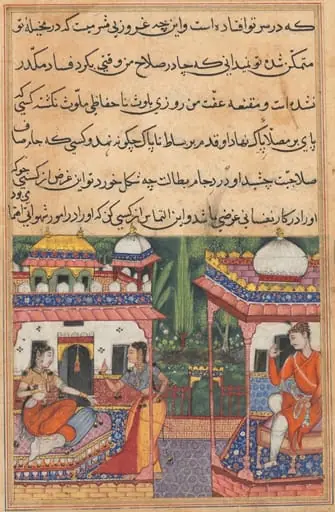 Kaiwan sends a message of love to Khurshid, wife of his brother Utarid who is away on a journey, from a Tuti-nama (Tales of a Parrot): Thirty-second Night
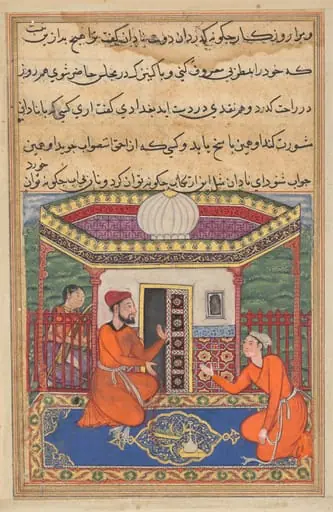 The young man of Baghdad solicits advice from a friend as his slave girl, who is adept at music, awaits, from a Tuti-nama (Tales of a Parrot): Forty-eighth Night
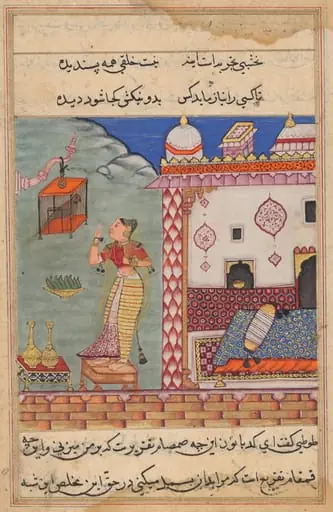 The Parrot Addresses Khujasta at the Beginning of the Twenty-seventh Night, form a Tuti-nama (Tales of a Parrot)
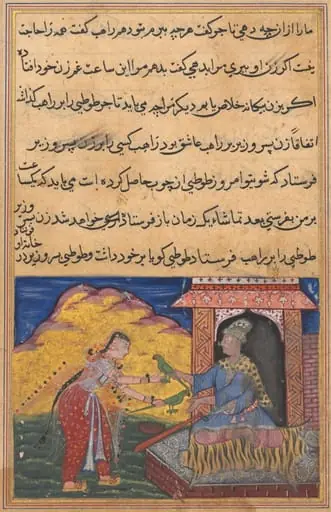 The wife of the son of the vizier brings the magic wooden parrot to her lover, the monk, who exchanges it for the replica, from a Tuti-nama (Tales of a Parrot): Tenth Night