Artwork
Hevajra Mandala
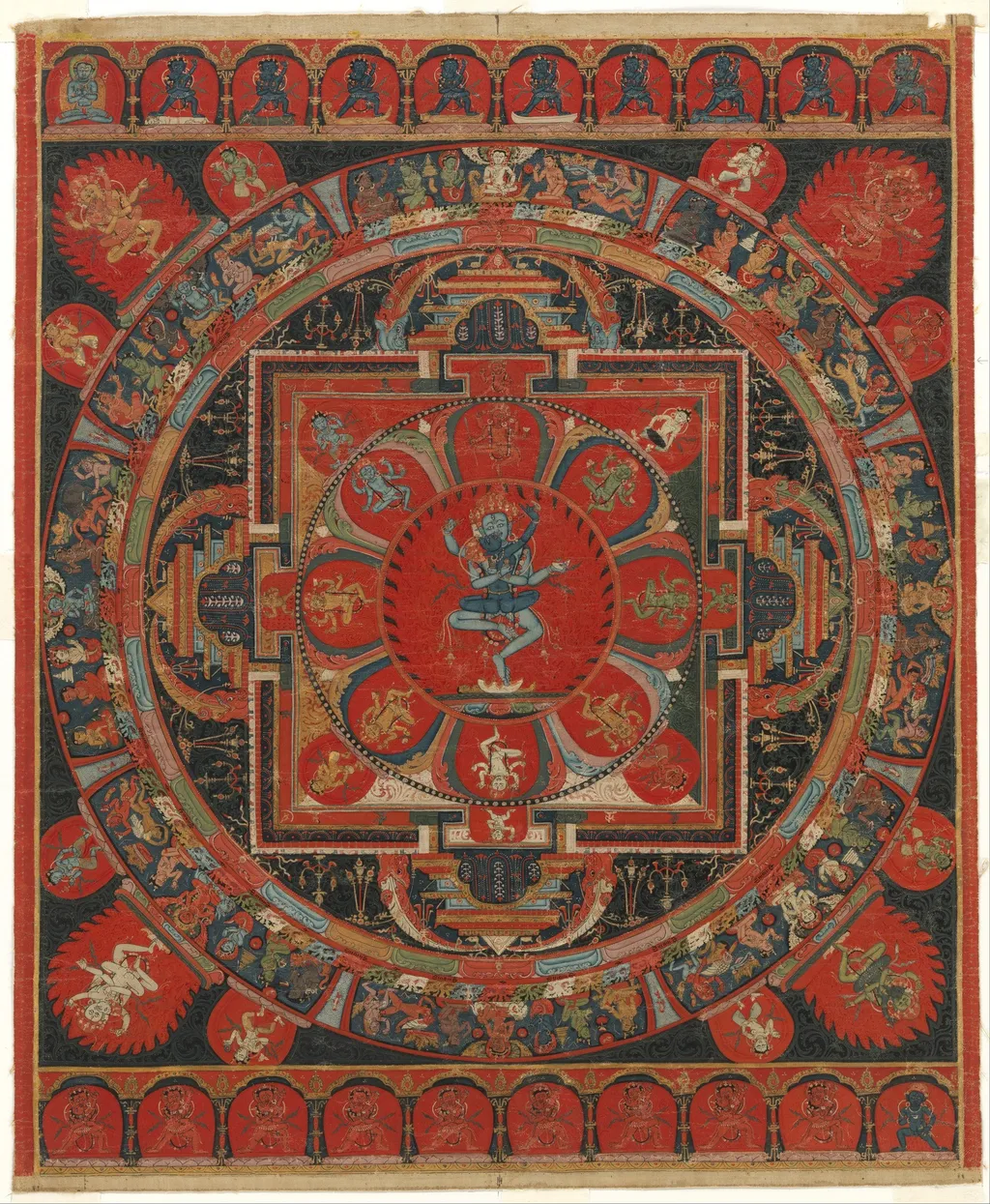
Hevajra Mandala is an unspecified painting. It dates from 1449 and is held in the collection of the Metropolitan Museum of Art.
About this work
Subject & Meaning
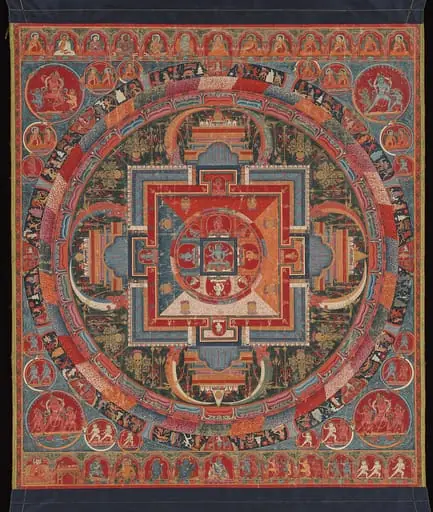
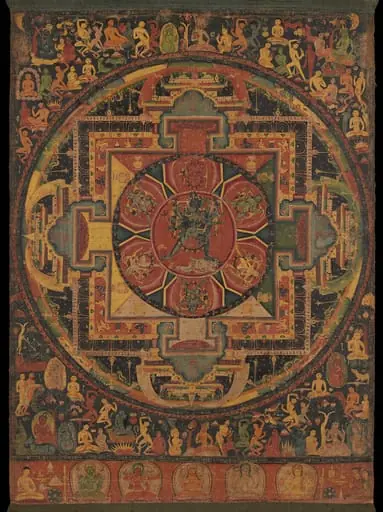
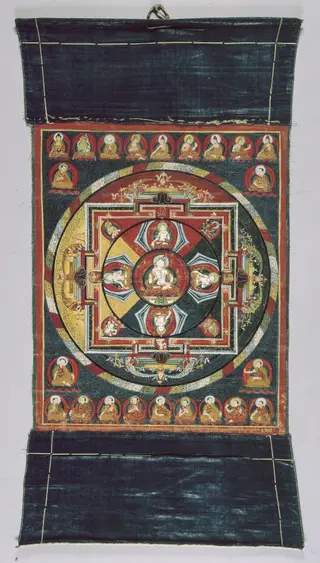
The Hevajra Mandala, created in 1449 in Tibet, is a religious painting that visually articulates complex tantric Buddhist concepts through its central iconography. The work depicts a divine couple, representing the deity Hevajra in union with his consort, a configuration that symbolizes the inseparable nature of wisdom and compassion within Vajrayana practice. As a mandala, the composition serves as a sacred diagram and meditative tool, guiding practitioners toward enlightenment by mapping the cosmic order and the deity's enlightened mind.
The painting's anonymous origin underscores its function as a devotional object rather than a vehicle for individual artistic expression, focusing entirely on the spiritual significance of the depicted deities and their symbolic arrangement.
History & Provenance
The painting entered the museum’s collection in 2015 through a gift from a donor whose identity is not specified in the museum’s records.
Created in Tibet in 1449, this religious painting is attributed to an anonymous artist. The work, identified as inventory number 2015.551, entered the collection of the Metropolitan Museum of Art, where it is currently held. While the specific circumstances of its original commission and the intermediate ownership chain prior to its museum acquisition are not detailed in the available records, the piece is firmly dated to the mid-15th century based on its inception year.
The Hevajra Mandala is held by the Metropolitan Museum of Art, New York, where it is recorded as accession number 2015.551. The painting entered the museum’s collection in 2015 through a gift from a donor whose identity is not specified in the museum’s records.
Context
The Hevajra Mandala, dated 1449 and classified as a religious painting, exemplifies Tibetan Vajrayana art of the fifteenth century. Executed by an anonymous master, the work depicts a divine couple within a mandala framework, reflecting the ritual complexity of Himalayan Buddhist practice. Its inclusion in the Metropolitan Museum of Art’s collection underscores scholarly recognition of the piece as a key example of trans‑regional religious imagery, informing studies of Tibetan painting techniques and iconography.
The mandala’s provenance from Tibet and its stylistic affinities with contemporary thangka traditions provide context for understanding the diffusion of Buddhist visual culture across Himalayan trade routes.
Overview
This painting, titled Hevajra Mandala, presents a vibrant and intricate circular composition densely populated with numerous small figures. At its core, a blue-skinned, four-armed male figure is prominently featured amidst swirling patterns. The artwork conveys the impression of a meticulously mapped sacred space, characterized by its structured arrangement and detailed visual elements.
Technique & Style
The painting is characterized by its dense visual information and a bright palette, with red and black predominating in the background. Intricate, swirling patterns surround the central figure, contributing to the work's overall busy aesthetic. Each corner of the circular design incorporates distinct miniature scenes, populated by various human, animal, and fantastical forms, adding layers of narrative detail.
Artist & collection

- Mandala of Vasudhara
 Vasudhara Mandala
 Mandala
 Mandala
 Mandala of Chakrasamvara and Vajravarahi
 Mandala of the Buddhist Deity Chakrasamvara
 Mandala of Chakrasamvara and Vajravarahi
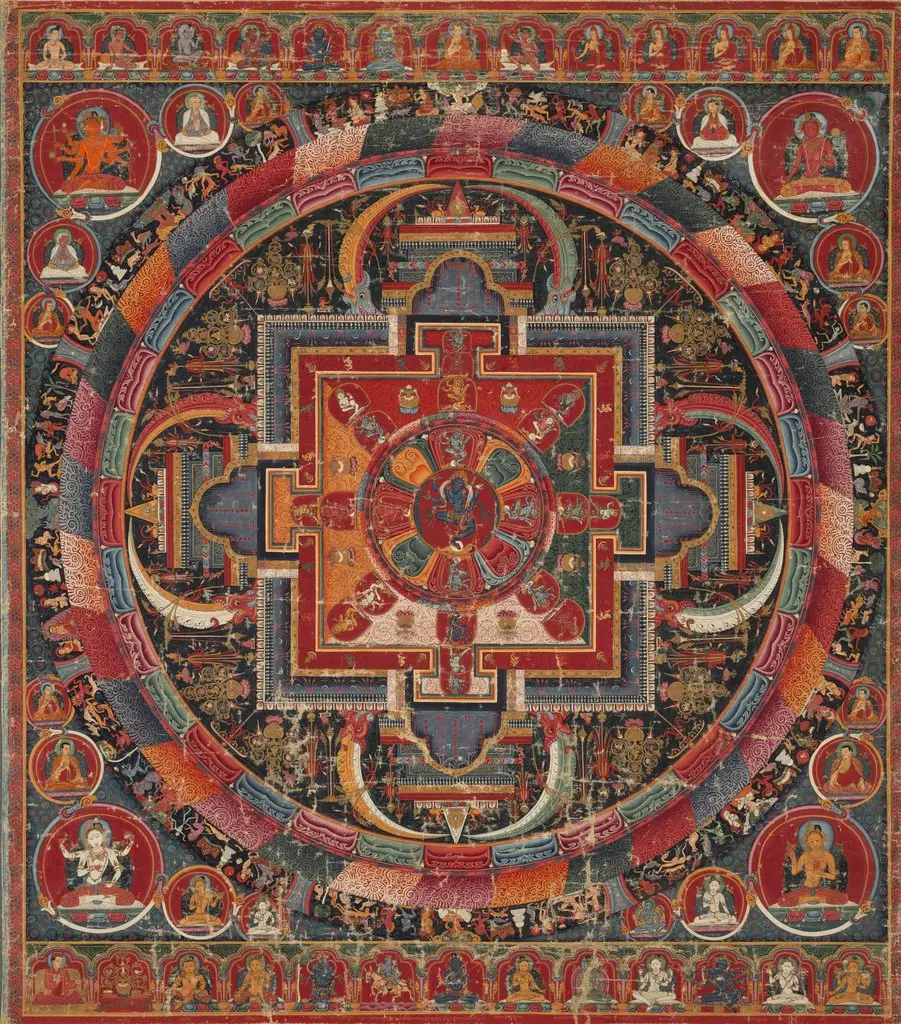 Twenty-three Deity Nairatma Mandala
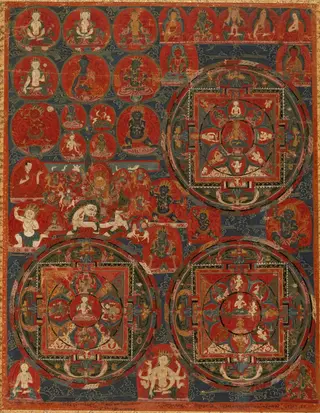 Three Mandalas
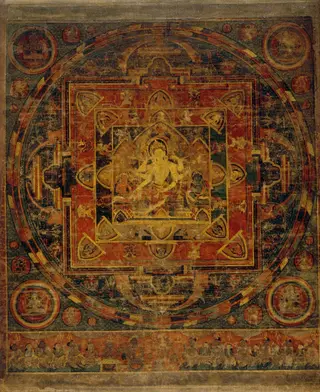 Mandala of Vasudhara
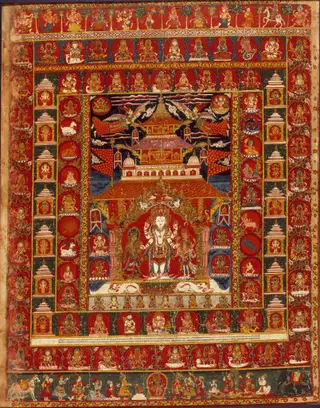 Mandala of Vishnu
 Painted Banner (Thangka) of Vajrasattva Mandala