Artwork
Kristus i templet
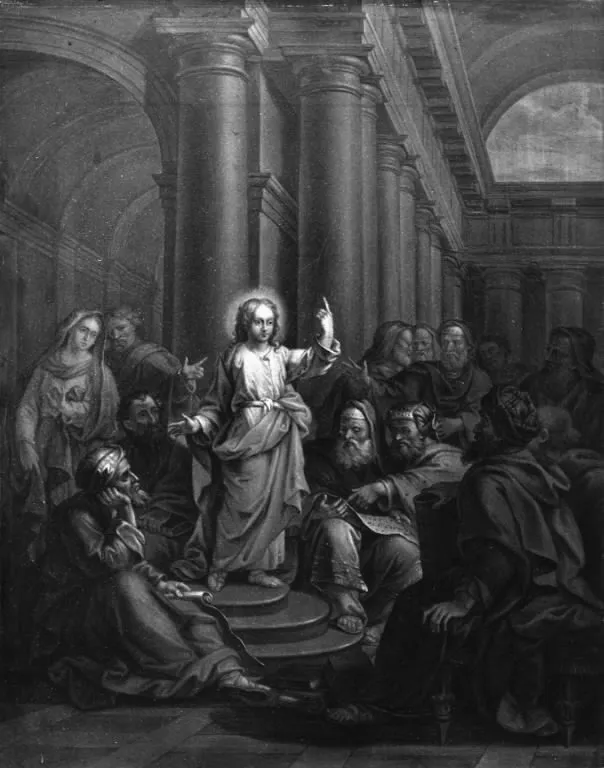
Kristus i templet is an unspecified painting. It dates from 1829 and is held in the collection of the Statens Museum for Kunst.
About this work
Subject & Meaning
Kristus i templet, dated 1829, is classified as a religious painting whose subject is the episode of Jesus Christ in the Second Temple.
Kristus i templet, dated 1829, is classified as a religious painting whose subject is the episode of Jesus Christ in the Second Temple. The Wikidata record identifies the depicted figures and setting explicitly as Jesus Christ and the Second Temple, anchoring the iconography to the New Testament account in which Christ expels the money-changers and teaches in the Jerusalem sanctuary.
The choice of a monumental canvas, measuring 302 cm in height by 242 cm in width, lends the scene a ceremonial gravity appropriate to its temple setting, allowing the artist to render the architectural interior and the central figure of Christ at a scale suited to devotional viewing. Held by the Statens Museum for Kunst, the work belongs to the genre of religious art and represents a late-Neoclassical Danish treatment of a scriptural subject long favored in European painting.
History & Provenance
Kristus i templet was created in 1829, as established by its documented inception date. The painting has been part of the collection of Statens Museum for Kunst, Copenhagen, where it is currently held. No specific commissioning details or earlier ownership history are recorded in the available sources.
The work is attributed to an unidentified artist associated with the museum's inventory under the designation 'KMS 164 Ubekendt.' Its dimensions are 302 by 242 centimeters, consistent with its classification as a large-scale religious painting.
Overview
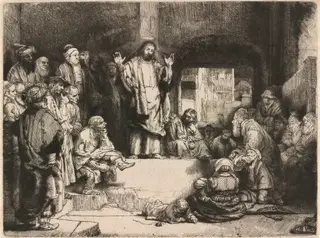
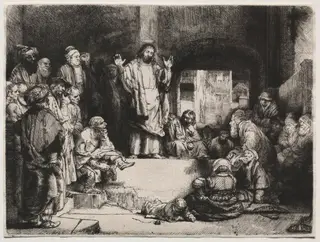
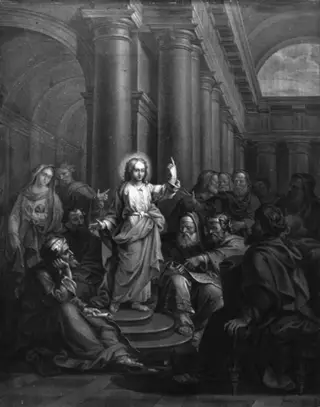
The work titled Kristus i templet presents a monochrome composition set within an expansive stone interior, defined by towering columns and arched windows. Central to the scene is a youthful figure with arms outstretched and a finger pointing upward, surrounded by kneeling and leaning figures whose gazes are directed toward him. The arrangement creates a focal hierarchy that emphasizes the central figure against a darker surrounding crowd.
Technique & Style
Executed in black and white, the painting employs a pronounced chiaroscuro effect, with a concentrated beam of light illuminating the central figure while the peripheral characters recede into shadow. This contrast of illumination and darkness heightens the three‑dimensionality of the architectural space and underscores the spiritual focus on the illuminated Christ, a hallmark of dramatic tonal modeling.
Context
The setting evokes a temple or sacred hall, suggested by the monumental columns and arched openings that frame the scene. Such an environment situates the narrative within a classical architectural tradition, aligning the depicted teaching moment with historic notions of sacred space. The work’s monochrome palette and dramatic lighting align it with a broader tradition of religious compositions that prioritize narrative clarity over color.
Artist & collection