Artwork
Leaf from a Jain Manuscript: Kalpa-sutra (recto)

Leaf from a Jain Manuscript: Kalpa-sutra (recto) is an unspecified painting. It dates from 1290 and is held in the collection of the Cleveland Museum of Art. The object is a narrow fragment of paper from a Jain manuscript, specifically a leaf of the Kalpa‑sutra.
About this work
Subject & Meaning
The Cleveland Museum of Art holds this leaf in its collection, preserving its significance as a 13th-century artifact of Jain manuscript tradition.
The recto leaf from the Kalpa-sutra manuscript depicts a Jain religious scene, reflecting core Jain principles of non-violence and reverence for spiritual texts. The iconography centers on a revered Jain figure or symbolic element associated with the Kalpa-sutra, a foundational scripture detailing the lives of tirthankaras, emphasizing the path to liberation. This work embodies the Jain tradition's emphasis on asceticism and sacred narrative through its devotional visual language.
The painting, created in 1279 in Gujarat, exemplifies regional religious artistry and was produced within a cultural context that prioritized spiritual storytelling. Its classification as religious art underscores its role in Jain devotional practice, where such illustrated manuscripts served as tools for meditation and scriptural study.
The Cleveland Museum of Art holds this leaf in its collection, preserving its significance as a 13th-century artifact of Jain manuscript tradition.
Technique & Style
The recto leaf of the Kalpa-sutra manuscript was painted on paper using traditional Indian pigments and ink, typical of Jain religious manuscripts from 13th-century Gujarat. Executed circa 1279, it features fine line work and restrained earth-tone washes characteristic of the period's devotional painting style. The support remains stable with minimal handling damage, preserving the delicate brushstrokes and iconographic precision of the original composition.
The artwork's formal qualities include flattened spatial perspective, rhythmic line modulation, and symbolic use of color to convey narrative hierarchy, reflecting broader stylistic conventions of Jain manuscript illumination. Its condition is documented as intact, with no significant pigment loss or structural degradation noted in the Cleveland Museum of Art's conservation records.
History & Provenance
The leaf was created in 1279 in Gujarat, India, according to the Cleveland Museum of Art's records. It is classified as a religious painting and forms part of a Jain manuscript of the Kalpa-sutra.
The work is now held in the Cleveland Museum of Art, where it is catalogued under accession number 1971.118.1.a. The accession number indicates that the leaf entered the collection in 1971, though the specific circumstances of its acquisition and prior ownership history are not documented in the available sources.
Context
The recto leaf of the Kalpa-sutra, painted circa 1279 in Gujarat, exemplifies Jain religious manuscript production. Its creation during the late 13th century reflects regional artistic traditions centered in western India, particularly Gujarat, where Jain patronage supported the copying and illumination of sacred texts. This folio, part of a dispersed manuscript, was later acquired by the Cleveland Museum of Art, which contextualizes it within its broader collection of South Asian religious art.
Scholarly attention to such fragments underscores their significance in tracing the evolution of Jain pictorial narrative and devotional aesthetics, though the anonymity of the artist remains consistent with manuscript practices of the period.
Legacy
The recto leaf of the Kalpa-sutra manuscript, produced in 1279 in Gujarat, established a precedent for Jain devotional illustration that resonated through later manuscript traditions in western India. Its compositional clarity and narrative sequencing influenced subsequent Jain and broader Indian religious paintings, particularly in the stylization of figures and marginal decorative motifs that appear in later 14th- and 15th-century Jain texts housed in collections such as the Cleveland Museum of Art. The work's presence in the museum's collection since 1971 has facilitated scholarly attention to its role in shaping visual narratives of Jain cosmology, reinforcing its reputation as a benchmark for Jain manuscript art and inspiring contemporary reinterpretations of Jain iconography.
Overview
The object is a narrow fragment of paper from a Jain manuscript, specifically a leaf of the Kalpa‑sutra. The sheet is aged, yellowed and bears the signs of wear such as fine cracks and stains. Its dimensions are modest, and it is divided into vertical columns by thin red lines that organize the text.

Artist & collection

- Leaf from a Jain Manuscript: Kalpa-sutra
 Leaf from a Jain Manuscript: Kalpa-sutra (verso)
 Leaf from a Jain Manuscript: Kalpa-sutra: The Monk Gautama, Enthroned (recto)
 Folio (recto) from a Kalpa-sutra and Story of Kalakacharya of Devachandra: Text
 Leaf from a Jain Manuscript: The Story of Kalakacharya of Devachandra: Text (recto)
 Leaf from a Jain Manuscript: Kalpa-sutra: Enthroned Monk (recto); Leaf from a Jain Manuscript: Kalpa-sutra: Text (verso)
 Leaf from a Jain Manuscript: The Story of Kalakacharya of Devachandra: Brahmanshanti Yaksha (verso)
 Leaf from a Jain Manuscript: Kalpa-sutra: Text (verso)
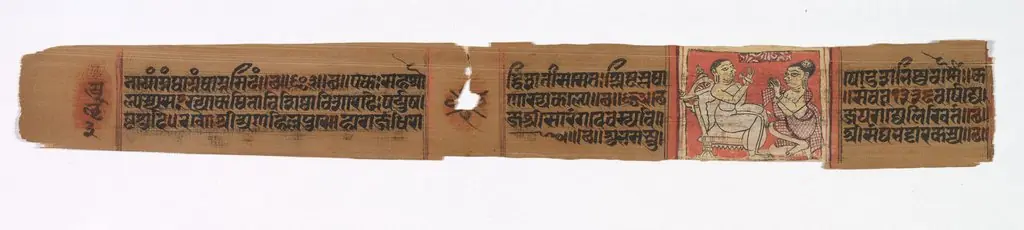 Leaf from a Jain Manuscript: Colophon page, Kalpa-sutra and The Story of Kalakacharya of Devachandra: Monk Teaching Lay Disciple
 Monk Holding a Flower: Folio 2 (recto), from a Kalpa-sutra and Story of Kalakacharya
 Text: Folio 2 (verso), from a Kalpa-sutra
 A Monk Preaching: Folio 2 (recto), from a Kalpa-sutra
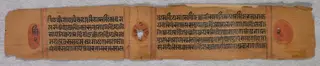 Text: Folio 2 (verso), from a Kalpa-sutra
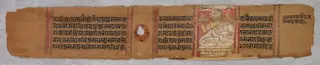 A Monk Preaching: Folio 2 (recto), from a Kalpa-sutra
 Leaf from a Jain Manuscript: The Story of Kalakacharya of Devachandra: Text (recto); Leaf from a Jain Manuscript: The Story of Kalakacharya of Devachandra: Brahmanshanti Yaksha (verso)