Artwork
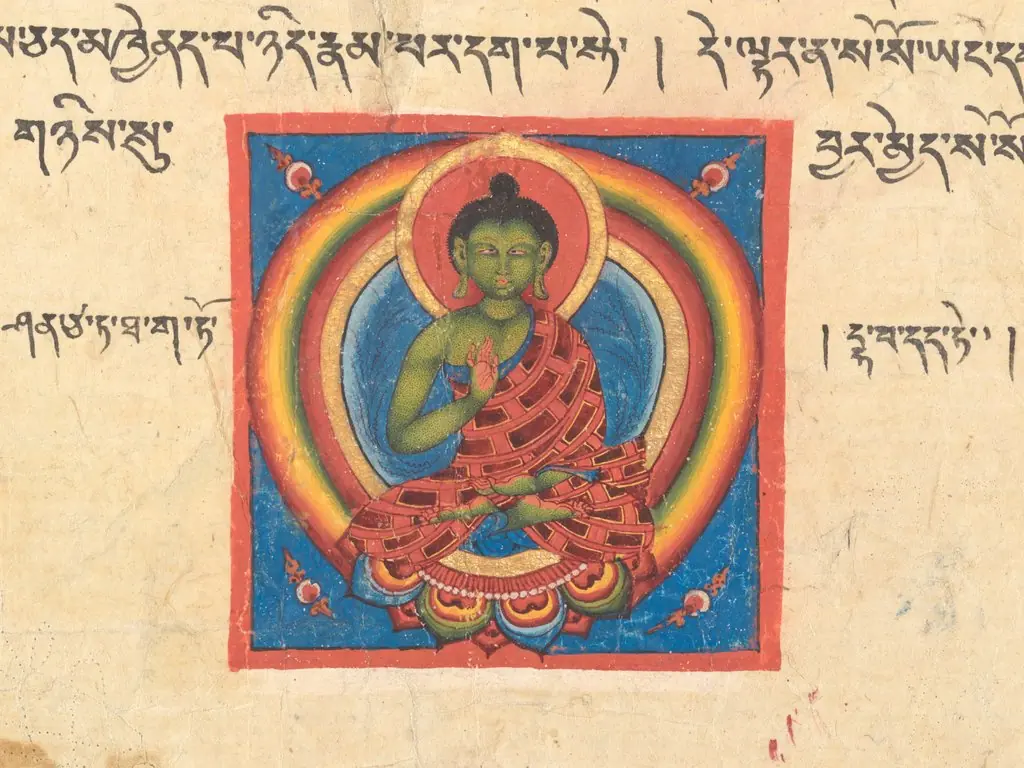
Text, folio 4 (recto), from a Manuscript of the Perfection of Wisdom in Eight Thousand Lines (Ashtasahasrika Prajnaparamita-sutra)

Text, folio 4 (recto), from a Manuscript of the Perfection of Wisdom in Eight Thousand Lines (Ashtasahasrika Prajnaparamita-sutra) is an unspecified painting. It dates from 1119 and is held in the collection of the Cleveland Museum of Art.
About this work
History & Provenance
This folio from a manuscript of the Perfection of Wisdom in Eight Thousand Lines was created in 1119 at Vikramaśīla University.
This folio from a manuscript of the Perfection of Wisdom in Eight Thousand Lines was created in 1119 at Vikramaśīla University. The work is classified as a religious painting produced by an unknown artist. It currently resides in the collection of the Cleveland Museum of Art, where it is catalogued under the accession number 1938.301.4.a.
The specific circumstances of its original commission and the details of its ownership history prior to entering the museum's collection are not documented in the available records.
Context
Created in 1119 at Vikramaśīla University, this folio exemplifies the religious manuscript production of the late Pala period. The work is attributed to an unknown artist, reflecting the anonymity typical of monastic scriptoria where individual identity was subordinate to the sacred text. As a visual component of the Ashtasahasrika Prajnaparamita-sutra, the folio serves a liturgical function rather than a purely aesthetic one, embodying the doctrinal emphasis on emptiness central to Mahayana Buddhism.
Its preservation in the Cleveland Museum of Art allows scholars to study the specific iconographic and calligraphic conventions of early 12th-century Indian Buddhist art. The manuscript remains a significant artifact for understanding the transmission of Buddhist philosophy and the artistic practices of one of the most important monastic universities in ancient India.
Overview
This folio, designated as folio 4 (recto), originates from a manuscript of the Ashtasahasrika Prajnaparamita-sutra, also known as the Perfection of Wisdom in Eight Thousand Lines. The artwork combines painted imagery with textual elements. It features three circular illustrations depicting seated figures, interspersed with columns of script. The overall composition reflects a traditional format for illuminated religious texts, serving both didactic and devotional purposes.
Subject & Meaning
The manuscript fragment presents a visual and textual exposition of Buddhist teachings. The red-robed figures, depicted in a cross-legged posture with serene expressions, likely represent Buddhist teachers or revered saints, embodying spiritual wisdom. The accompanying text, written in an ancient script, presumably Sanskrit, elaborates on the principles of the Prajnaparamita-sutra, a foundational Mahayana Buddhist scripture concerning the nature of reality and enlightenment.
Technique & Style
The artwork employs a distinctive visual style, characterized by three circular painted sections set against a dark blue-green ground. The figures are rendered with simplicity, their calm faces conveying a meditative state. Gold and brown script columns separate these painted roundels.
The physical condition of the folio, with its worn and slightly torn edges, indicates its age and historical use as a scroll or part of a larger codex.

Artist & collection

 Text, folio 186 (recto), from a Manuscript of the Perfection of Wisdom in Eight Thousand Lines (Ashtasahasrika Prajnaparamita-sutra)
 Fragment of a Prajnaparamita Sutra manuscript folio
 Perfection of Wisdom in Eight Thousand Lines: Ashtasahasrika Prajnaparamita: Top Cover
 Prajnaparamita flanked by a white female figure and a white bodhisattva, folio 90 (recto), from a Manuscript of the Perfection of Wisdom in Eight Thousand Lines (Ashtasahasrika Prajnaparamita-sutra)
 Perfection of Wisdom in Eight Thousand Lines: Ashtasahasrika Prajnaparamita: Decorated Leaf
 Perfection of Wisdom in Eight Thousand Lines: Ashtasahasrika Prajnaparamita
 Perfection of Wisdom in Eight Thousand Lines: Ashtasahasrika Prajnaparamita: Decorated Leaf
 Perfection of Wisdom in Eight Thousand Lines: Ashtasahasrika Prajnaparamita: Decorated Leaf (recto)
 Perfection of Wisdom in Eight Thousand Lines: Ashtasahasrika Prajnaparamita: Back Cover
- Text, Folio 5 (recto), from a Manuscript of the Perfection of Wisdom in Eight Thousand Lines (Ashtasahasrika Prajnaparamita-sutra)
 Text, folio 3 (recto), from a Manuscript of the Perfection of Wisdom in Eight Thousand Lines (Ashtasahasrika Prajnaparamita-sutra)
 Text, Folio 8 (recto), from a Manuscript of the Perfection of Wisdom in Eight Thousand Lines (Ashtasahasrika Prajnaparamita-sutra)