Artwork
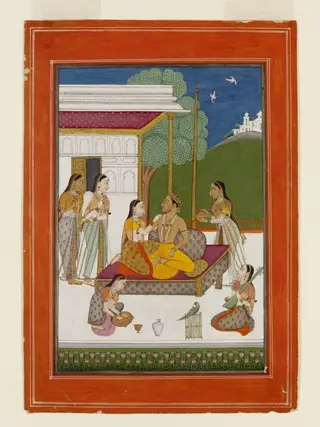
Raja with his Beloved
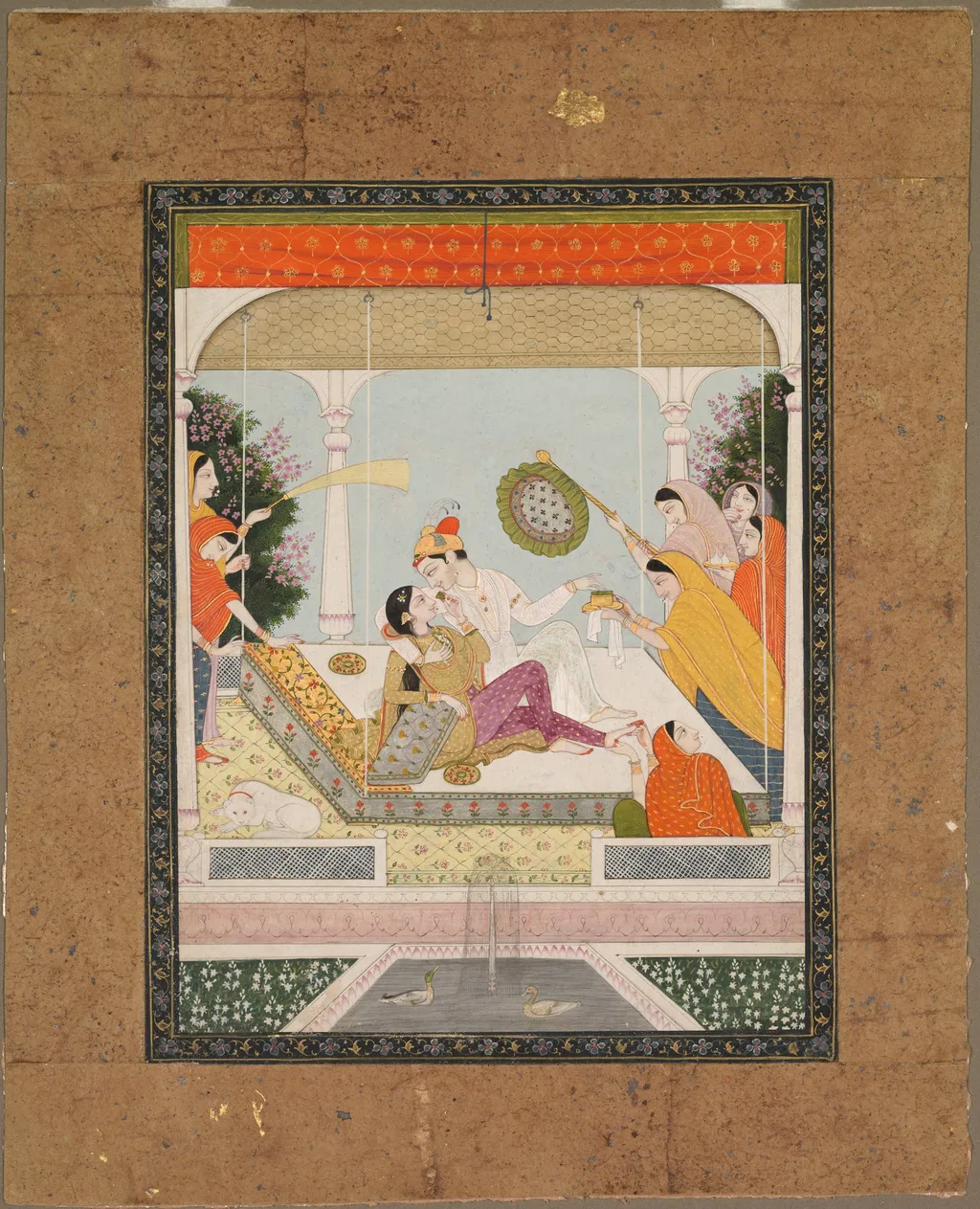
Raja with his Beloved is an unspecified painting. It dates from 1798 and is held in the collection of the Cleveland Museum of Art.
About this work
History & Provenance
It was created in 1795 and has been part of the museum’s collection since its acquisition, remaining on view within the institution’s South Asian art galleries.
Raja with his Beloved is a painting dated to 1795 and attributed to an unknown artist. The work is recorded in the Cleveland Museum of Art’s collection under accession number 1989.336, where it is located in Cleveland. Its inception date is given as 1795-01-01, and it is classified as a painting.
No earlier ownership, commission, or exhibition history is documented in the sources. It remains part of the museum’s permanent collection.
The painting Raja with his Beloved is housed in the Cleveland Museum of Art, where it is accessioned under inventory number 1989.336. It was created in 1795 and has been part of the museum’s collection since its acquisition, remaining on view within the institution’s South Asian art galleries. The work was featured in the 1993 exhibition "India: Art and Culture," highlighting its significance within the museum’s South Asian holdings.
Context
The work entered the Cleveland Museum of Art collection in 1795 and has been discussed in scholarly literature regarding its stylistic significance within late 18th-century painting. Its attribution to an unknown artist is noted in catalog records, and it is studied as part of broader movements in European art of the period. The painting is held at the Cleveland Museum of Art.
Overview
The work portrays a seated ruler and his consort reclining on an elaborately decorated platform, attended by several servants in vivid attire. An ornate border with a red stripe and gold detailing frames the scene, while beyond the interior a garden with pink blossoms and a small pool populated by ducks is visible beneath an arched roof.
Subject & Meaning
The central figures, a male sovereign holding a fan and a relaxed female companion, suggest a private, leisurely moment within a courtly setting. The presence of attendants offering drink and fanning the ruler underscores themes of royal privilege and the cultivated intimacy of the royal household.
Technique & Style
The composition employs bold, saturated hues, predominantly reds, yellows, and greens, applied in intricate patterns across furniture, walls, and textiles. Fine detailing in the ornamental border and the decorative motifs of the platform reflect a meticulous approach to surface decoration, while the use of perspective places the garden scene beyond the interior space.
Artist & collection

- Raja with his beloved
 Krishna Awaiting Radha in a Palace
 Radha and Krishna
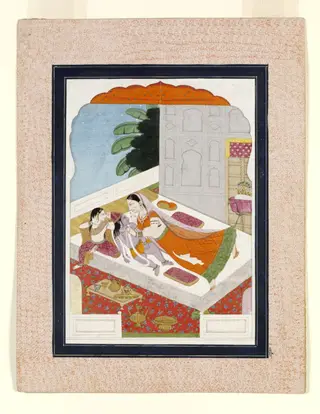 Josoda, Krishna and Balarama
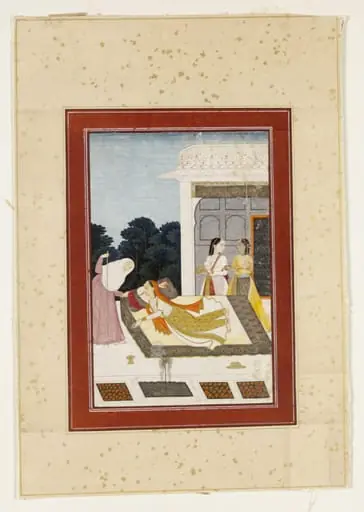 Prositapatika Nayika
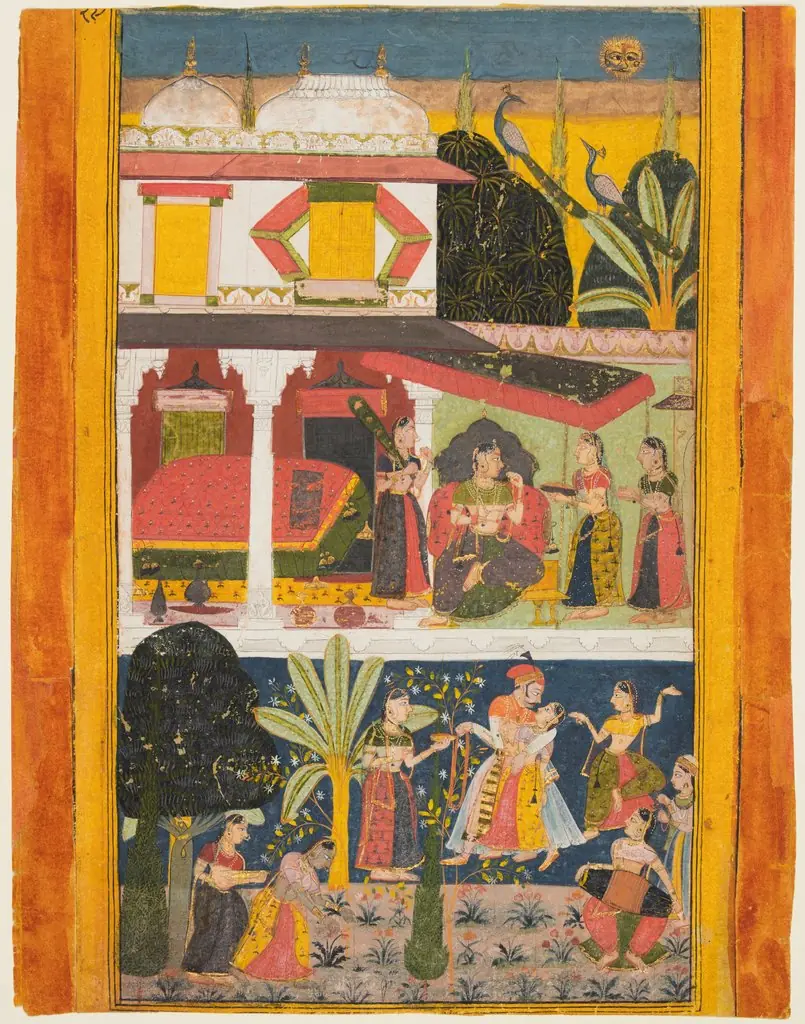 A Heroine and Her Paramour: Malavi Ragini, from a Ragamala
 A Heroine and Her Paramour: Malavi Ragini, from a Ragamala
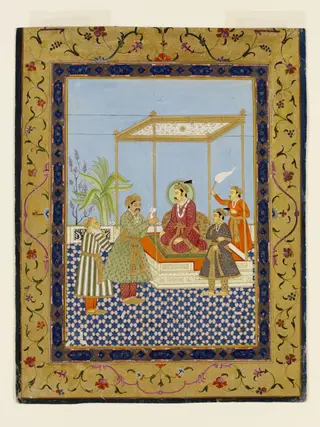 Akbar
Akbar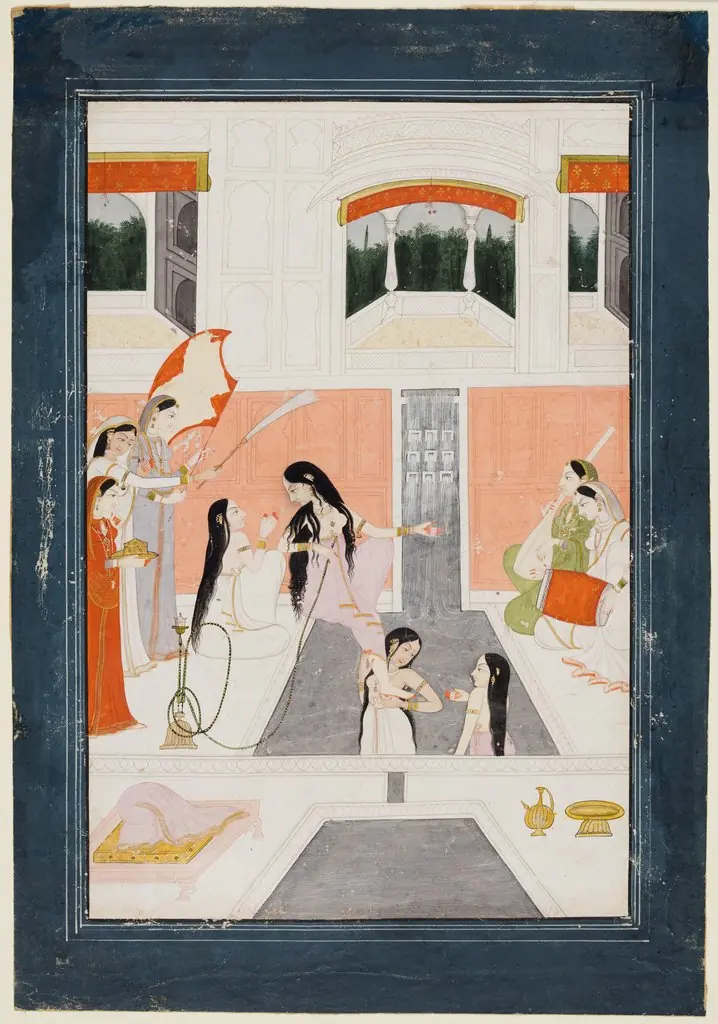 Palace Women Enjoy Music by the Side of a Water Cascade
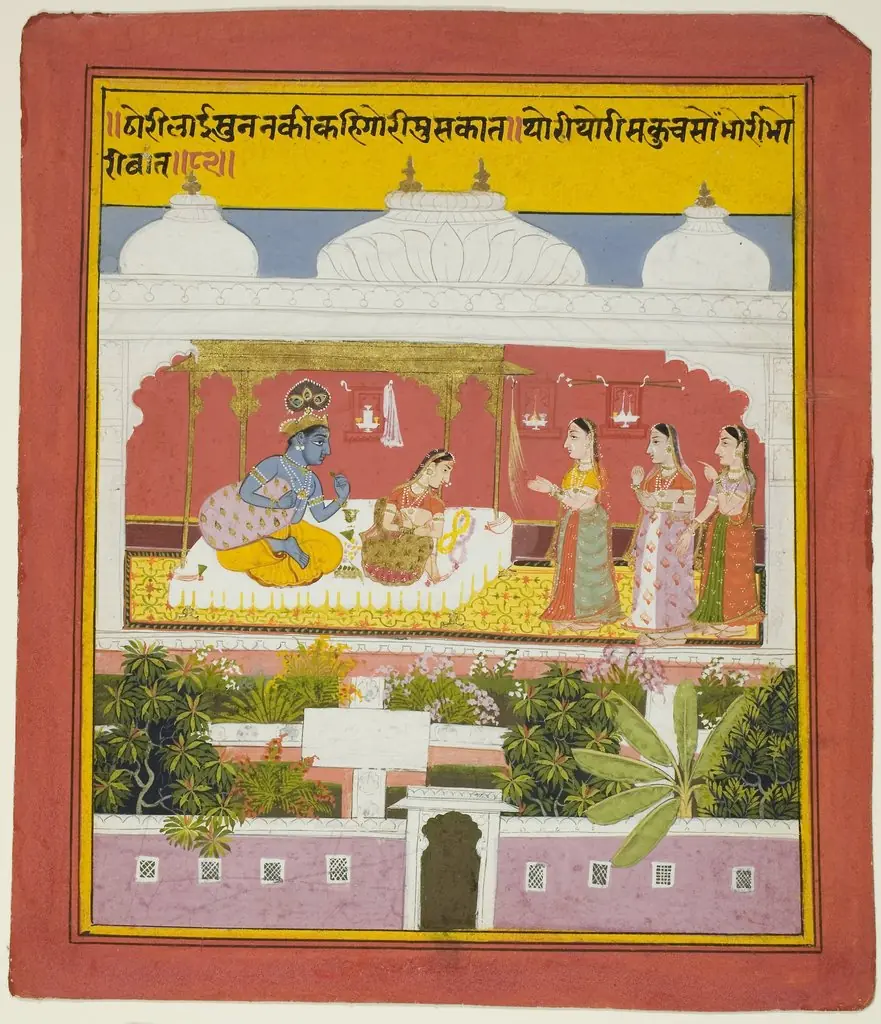 Krishna and Radha in a Pavilion, page from a copy of the Sat Sai Seven Hundred Verses)
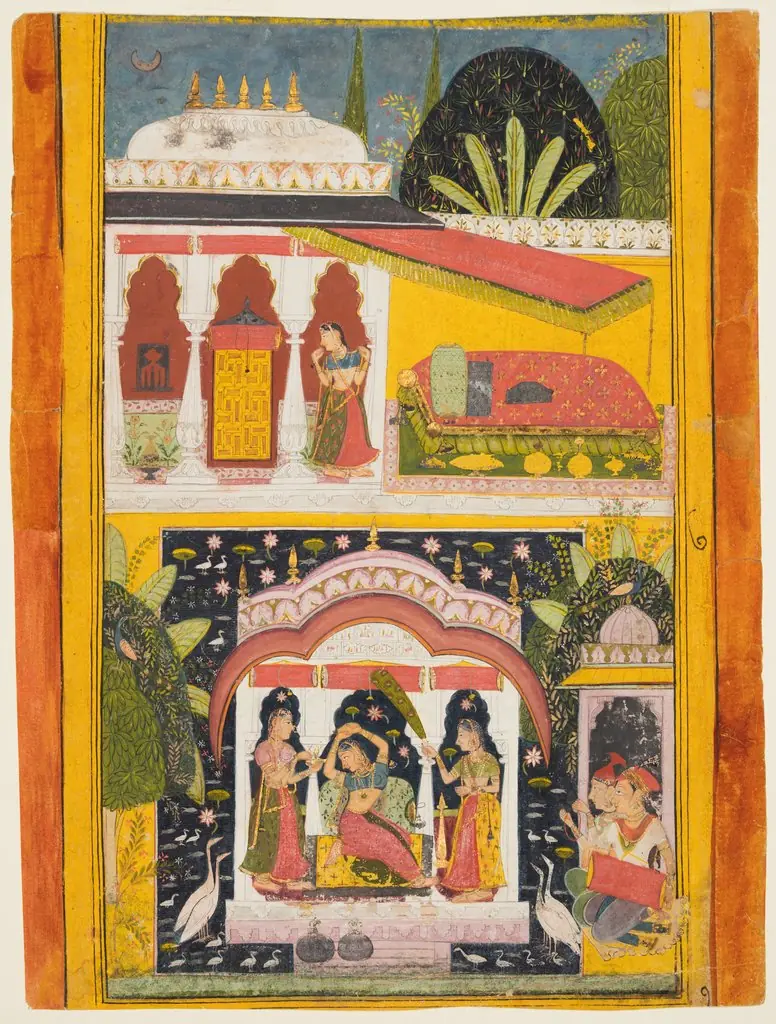 A Royal Woman in a Pavilion: Desavarari Ragini of Dipak, from a Ragamala
 Bhairava Raga