Artwork
Seven Leaves from a Manuscript of the Gandavyuha-sutra (Scripture of the Supreme Array)
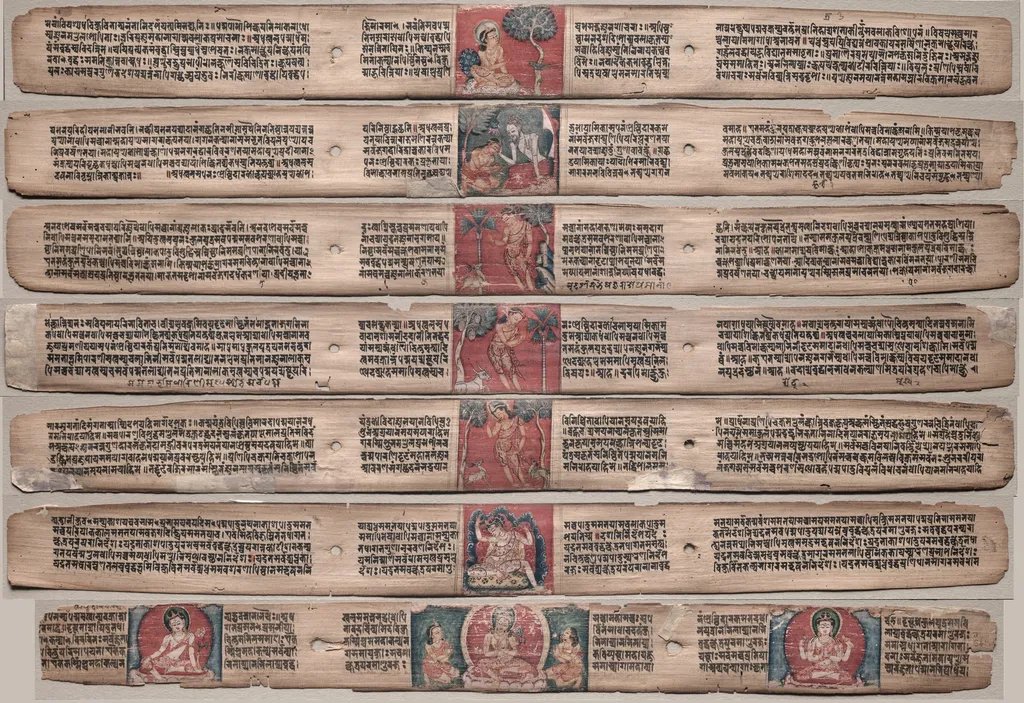
Seven Leaves from a Manuscript of the Gandavyuha-sutra (Scripture of the Supreme Array) is an unspecified painting. It dates from 1100 and is held in the collection of the Cleveland Museum of Art.
About this work
Subject & Meaning
As a religious painting in the Cleveland Museum of Art collection, the work functions as a visual exegesis of the scripture's teachings.
The Seven Leaves from a Manuscript of the Gandavyuha-sutra (Scripture of the Supreme Array) depict narrative scenes drawn from the Buddhist Gandavyuha-sutra, a text that describes the hierarchical cosmos of the Buddha's realm. The iconography includes conventional Buddhist figures, bodhisattvas, celestial beings, and symbolic motifs, characteristic of 11th-century Nepalese religious painting. The visual program symbolizes the supreme cosmic order and the path toward enlightenment outlined in the sutra, conveying the doctrinal concept of a layered, divine universe.
As a religious painting in the Cleveland Museum of Art collection, the work functions as a visual exegesis of the scripture's teachings.
History & Provenance
The seven leaves were executed in Nepal around 1099, as indicated by the Gandavyuha-sutra's colophons and the dating associated with the manuscript in museum records. The Cleveland Museum of Art acquired the leaves in 1955 as part of an anonymous gift (accession 1955.49), placing them in a public collection where they remain housed. No documented patron or workshop is recorded for these folios, and the artist is listed as unknown in both museum documentation and the corresponding Wikidata entry.
Overview
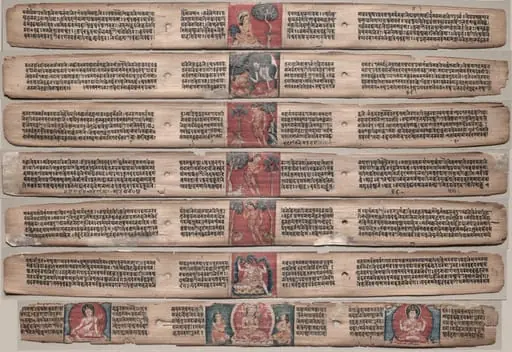
This artwork comprises seven individual leaves extracted from an ancient manuscript of the Gandavyuha-sutra, also known as the Scripture of the Supreme Array. Presented as a horizontal sequence, each leaf integrates distinct painted imagery with accompanying textual passages. These fragments offer insight into the visual and literary traditions of their origin, functioning both as illustrative components and carriers of narrative.
Technique & Style
The paintings demonstrate a refined artistic approach, characterized by intricate designs and precise linear work. Artists employed a limited palette, primarily utilizing red and black inks to establish visual depth and contrast within the compositions. The meticulous execution of fine lines and detailed forms across these leaves indicates a high degree of skill and careful craftsmanship, typical of illuminated manuscripts from this period.
Artist & collection

- Seven Leaves from a Manuscript of the Gandavyuha-sutra (Scripture of the Supreme Array)
 Text, folio 73 (verso) from a Gandavyuha-sutra (Scripture of the Supreme Array)
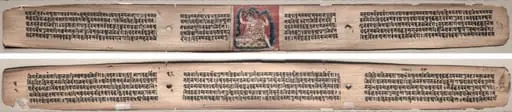 Folio 22 from a Gandavyuha-sutra (Scripture of the Supreme Array): Samantabhadra spinning clouds of things (recto); Text (verso)
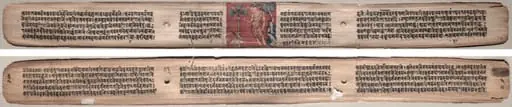 Folio 73 from a Gandavyuha-sutra (Scripture of the Supreme Array): Sudhana and an antelope (recto); text (verso)
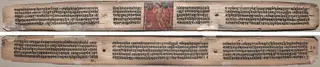 Folio 37 from a Gandavyuha-sutra (Scripture of the Supreme Array): Sudhana and a pair of antelopes (recto); text (verso)
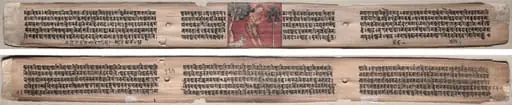 Folio 115 from a Gandavyuha-sutra (Scripture of the Supreme Array): Sudhana and a buffalo (recto); text (verso)
 Text, folio 94 (verso) from a Gandavyuha-sutra (Scripture of the Supreme Array)
 Text, folio 37 (verso) from a Gandavyuha-sutra (Scripture of the Supreme Array)
 Text, Folio 130 (verso), from a Manuscript of the Perfection of Wisdom in Eight Thousand Lines (Ashtasahasrika Prajnaparamita-sutra)