Artwork
Untitled
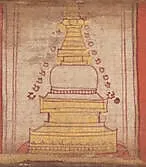
Untitled is an ink painting. It dates from 1149 and is held in the collection of the Metropolitan Museum of Art.
About this work
Subject & Meaning
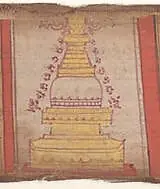
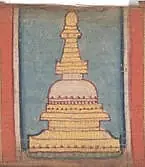
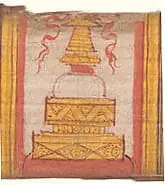
The work functions as a piece of religious art, with the stupa serving as the primary iconographic element representing the Buddhist faith.
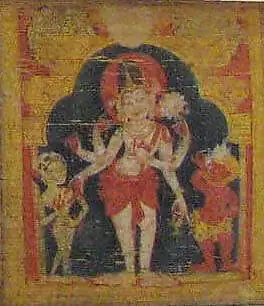
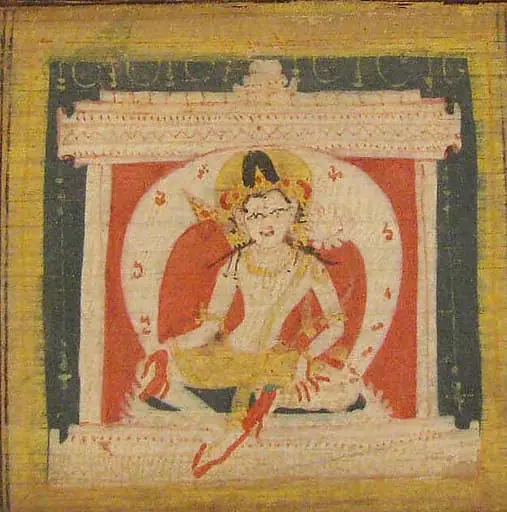
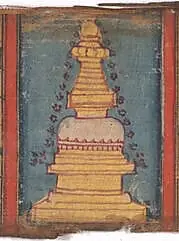
Created in India in 1149, this anonymous religious painting on palm leaf utilizes ink and color to depict a stupa, a monumental structure central to Buddhist tradition. The work functions as a piece of religious art, with the stupa serving as the primary iconographic element representing the Buddhist faith. Rather than illustrating a complex narrative scene, the image focuses on this architectural symbol, which traditionally houses relics and signifies the presence of the Buddha.
The depiction underscores the spiritual significance of the stupa within the context of 12th-century Indian Buddhism, presenting the structure itself as the embodiment of religious devotion and doctrinal meaning.
Technique & Style
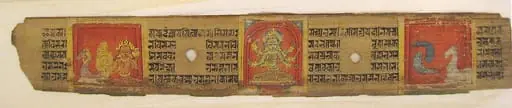
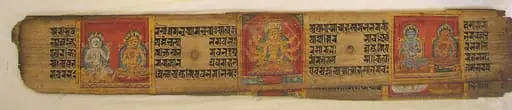
Executed in ink and color on palm leaf, this work belongs to a traditional South Asian manuscript painting format in which pigments and inks are applied to a prepared palm-leaf support. The religious subject matter, depicting a stupa within a Buddhist context, is rendered in the flat, linear idiom characteristic of twelfth-century Indian palm-leaf painting, where narrative imagery is organized in horizontal registers and defined by precise, calligraphic linework rather than modeled volume. The medium's narrow, elongated shape dictated the compact, frieze-like arrangement of figural and architectural elements. The work is held in the collection of the Metropolitan Museum of Art.
History & Provenance
Untitled is a Buddhist religious painting executed in ink and color on palm leaf in India around 1149. Attributed to an anonymous painter, it portrays a stupa and belongs to the genre of religious art, its creation tied to 12th‑century Indian Buddhist practice. The painting entered the collection of the Metropolitan Museum of Art, where it is catalogued under accession number 1985.400.12 and its place of origin is recorded as India.
No record of a specific commission survives, the artist's identity remains unknown, and the sources do not document a specific exhibition history beyond its inclusion in the permanent collection.
Context
Dating to 1149, this ink and color painting on palm leaf was produced in India by an anonymous artist and classified as a religious work depicting Buddhist subjects including stupas. Its presence in the Metropolitan Museum of Art situates it within the broader corpus of 12th‑century Indian Buddhist manuscript painting, where devotional imagery and anonymity are key features. The work's genre and iconography reflect contemporary religious artistic practices and contribute to the historical understanding of Buddhist visual culture in South Asia.
Overview
This untitled painting, rendered in ink and color on a palm leaf, originates from a Buddhist manuscript created in eastern India approximately eight centuries ago. It represents a single page from a larger sacred text, illustrating the visual and textual traditions of the period. The artwork's small scale and delicate medium are characteristic of the devotional literature it once comprised.
Artist & collection