Artwork
Untitled
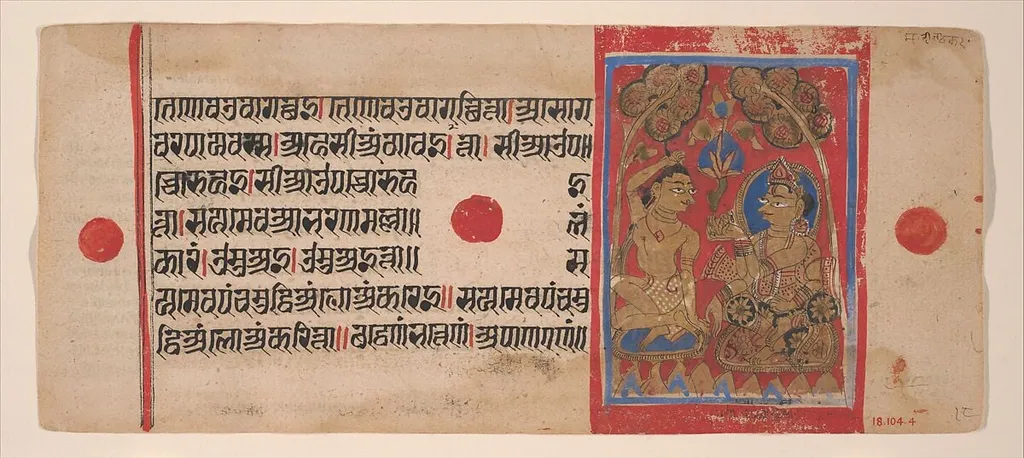
Untitled is a watercolor painting. It dates from 1461 and is held in the collection of the Metropolitan Museum of Art.
About this work
Look up other works from India (Gujarat) to see more of this delicate, gold-dusted style.
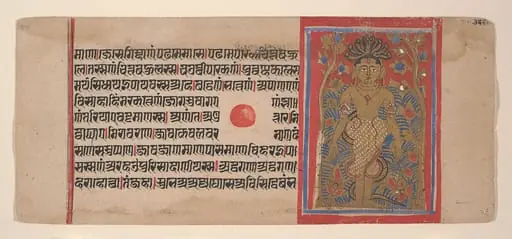
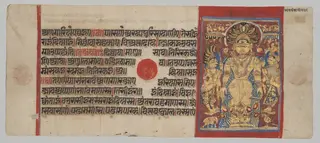
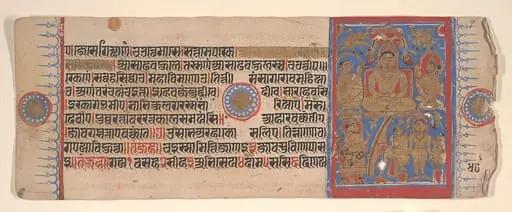
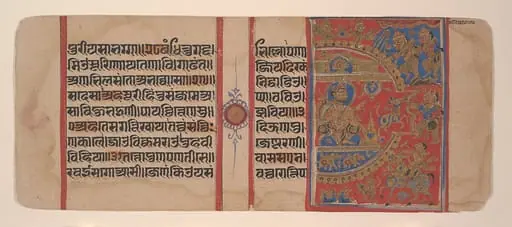
A man in a red robe sits on a low stool, holding a book. His face is calm, his turban neatly tied. Gold leaf shimmers behind him, and tiny flowers bloom in the border.
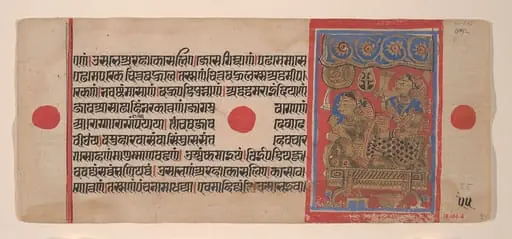
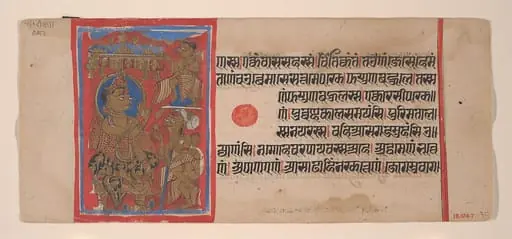
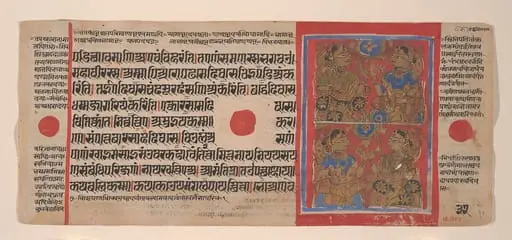
This painting comes from Gujarat, India, around 1461. It’s part of a Jain manuscript, religious texts meant to teach lessons. The artist used gold not just for beauty, but to show holiness. The style is quiet, almost like a private moment.
Look up other works from India (Gujarat) to see more of this delicate, gold-dusted style.
Subject & Meaning
The work is a religious painting created in India in 1461 that depicts a single man. Executed in ink, opaque watercolor, and gold on paper, the piece belongs to the genre of religious art. While the specific identity of the male figure is not detailed in the available records, the inclusion of gold and the devotional classification indicate the subject holds spiritual significance within its cultural context.
The composition focuses entirely on this individual figure, presenting him as the central iconographic element of the artwork.
History & Provenance
The work is dated to 1461, with a more precise inception recorded as 20 October 1461, and was produced in India. Executed in ink, opaque watercolor, and gold on paper, it is classified as a religious painting and is attributed to an anonymous artist, with no documented commission details or named patron associated with its creation.
The painting is held in the collection of the Metropolitan Museum of Art, where it remains located. No further information is provided regarding its earlier ownership chain, prior collections, acquisition history, or circumstances of its transfer to the museum.
Context
The painting Untitled, dated 1461, is an ink and opaque watercolor work with gold on paper that portrays a man and belongs to the religious genre. It was produced in India and is part of the Metropolitan Museum of Art collection, where it is catalogued as a religious painting created on 1461-10-20 with dimensions 11.1 cm by 25.7 cm. Because the maker is anonymous, scholarly discussion situates the piece within early Indian devotional art, using it to illustrate stylistic conventions and patronage practices of the period. Critical commentary therefore emphasizes contextual interpretation rather than evaluation of a known artist.
Overview
This untitled painting, created in Gujarat, India, around 1461, employs ink, opaque watercolor, and gold on paper. It depicts a serene male figure in a red robe, seated on a low stool and holding a book. Originally an illustration within a Jain religious manuscript, the artwork conveys a sense of quiet contemplation, characteristic of the delicate, gold-dusted style prevalent in the region during this period.
Technique & Style
Executed with ink and opaque watercolor, the painting is further distinguished by its extensive application of gold. Gold leaf shimmers behind the seated figure, contributing to an ethereal atmosphere, while tiny floral motifs adorn the border. This meticulous attention to detail and the luminous quality of the gold are hallmarks of the delicate, "gold-dusted" aesthetic common in Gujarati manuscript illumination of the mid-15th century.
Artist & collection