Artwork
Parshva Undergoes Physical Trials, Folio 46 (recto), from a Kalpa-sutra
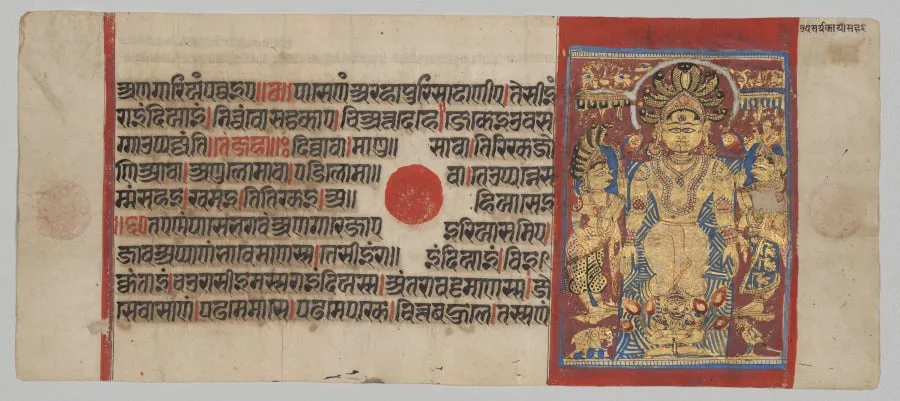
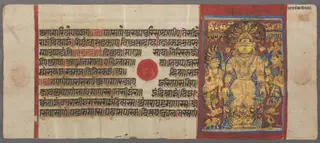
Parshva Undergoes Physical Trials, Folio 46 (recto), from a Kalpa-sutra is an unspecified painting by the Mughal Painting artist Unknown. It dates from 1500 and is held in the collection of the Cleveland Museum of Art. The folio depicts the Jain ascetic Parshva seated in a meditative pose, surrounded by rising waters that reach his shoulders.
- Accession no.
- 1932.119.46.a
- Credit line
- Edward L. Whittemore Fund
About this work
Look up more paintings from western india, gujarat, late 15th-early 16th century to see how artists told these spiritual stories.
You see a holy man standing in deep meditation while water rises to his shoulders. Snakes coil around him, their hoods forming a shelter over his head.
This painting tells a story from Jain scripture: even when storms tried to drown him, Parshva stayed calm. The snakes protected him so he could finish his practice and reach enlightenment. The gold waves aren’t realistic, they’re more like a pattern to show the danger he overcame.
Look up more paintings from western india, gujarat, late 15th-early 16th century to see how artists told these spiritual stories.
Overview
The folio depicts the Jain ascetic Parshva seated in a meditative pose, surrounded by rising waters that reach his shoulders. Serpents coil around his body, their hoods forming a protective canopy above his head, while a pair of regal snakes appear to offer reverence. The composition is rendered on a blue field with abstract gold lines suggesting the flood.
Subject & Meaning
The scene illustrates a narrative from the Kalpa‑sūtra in which Parshva endures a storm without breaking his concentration. The serpents, traditionally symbols of danger, become guardians, shielding him so that he can complete his meditation and attain liberation. The white lower garment he wears signals affiliation with the Jain sect that permits white robes for its mendicants.
Technique & Style
Executed in miniature painting technique, the work employs a limited palette of ultramarine and gold. The gold lines are stylized rather than naturalistic, functioning as decorative motifs that convey the surge of water. The serpents are rendered with elongated bodies and exaggerated hoods, creating a rhythmic pattern that integrates with the surrounding abstract background.
Context
Created in western India, likely Gujarat, during the transition from the late 15th to early 16th century, the manuscript reflects a period when Jain artists combined devotional narrative with courtly aesthetics. Such illustrations served both didactic and ritual purposes, reinforcing doctrinal teachings through vivid visual storytelling.
Legacy
This folio exemplifies the Jain tradition of using richly colored miniatures to depict spiritual trials, influencing later manuscript production in the region. Its iconography of protective serpents and the use of gold to denote elemental forces have been echoed in subsequent Jain and Hindu illustrated texts.
Artist & collection









- Birth of Parshva, Folio 45 (recto), from a Kalpa-sutra
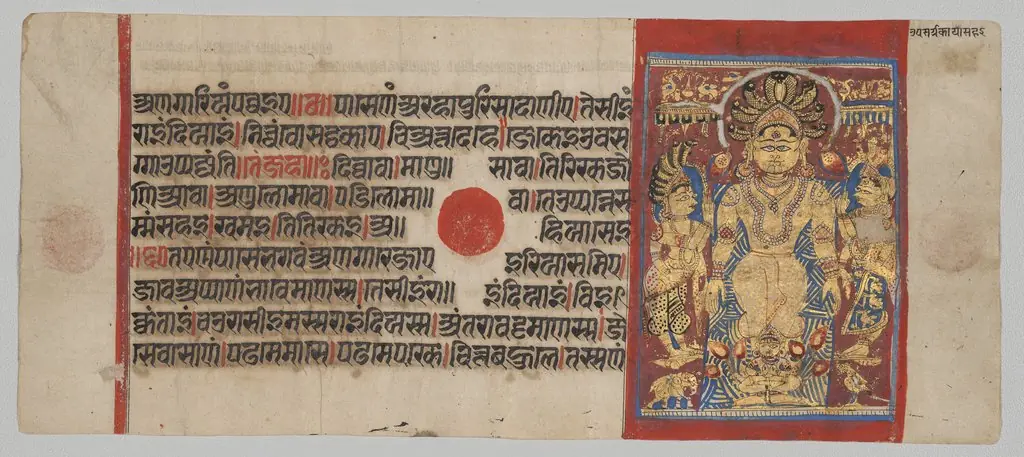 Parshva Undergoes Physical Trials, Folio 46 (recto), from a Kalpa-sutra
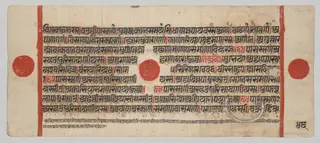 Text, Folio 46 (verso), from a Kalpa-sutra
 Serpents Protect Parshva from the Flood, from the Kalpa-sutra
 The Lion's Cave with Sthulabhadra and His Sisters, Folio 60 (verso), from a Kalpa-sutra
 The Fourteen Dreams of Queen Trishala, folio 14 (recto), from a Kalpa-sutra