Artwork
歌川芳員画 『外国人衣服仕立之図』|Foreign Family with Wife Making Clothes (Gaikokujin ifuku shitate no zu)
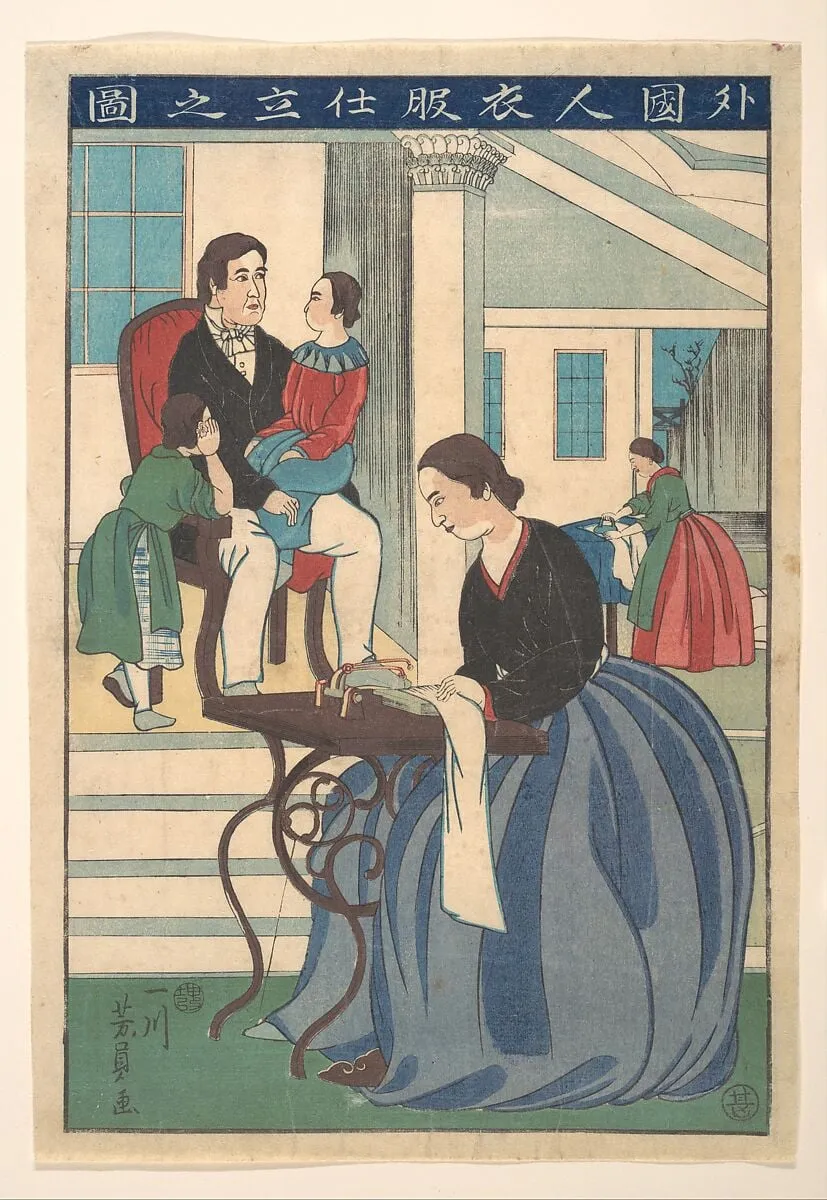
歌川芳員画 『外国人衣服仕立之図』|Foreign Family with Wife Making Clothes (Gaikokujin ifuku shitate no zu) is an ink print by the Impressionist artist Utagawa Yoshikazu. It dates from 1860 and is held in the collection of the Metropolitan Museum of Art.
- Accession no.
- 2007.49.156
- Credit line
- Bequest of William S. Lieberman, 2005
About this work
The artist shows Western clothes, furniture, and even a newspaper, things most Japanese viewers had never seen.
You see a Japanese woodblock print of a Western family in their parlor. The wife sews at a table, a child plays on the floor, and the husband reads a newspaper. A hot iron sits on a stand.
This print was made in 1860, just as Japan opened its ports to foreign trade. The artist shows Western clothes, furniture, and even a newspaper, things most Japanese viewers had never seen. The scene feels stiff, like a staged photo, because it was based on a foreign engraving, not real life.
Look up other prints of daily life from the same museum.
Subject & Meaning
The print depicts a foreign family engaged in domestic textile work, showing a man and woman sewing while a child observes. The scene centers on the preparation of clothing, with a clothes iron present as a visual element. This domestic activity symbolizes the assimilation and adaptation of foreign customs within Japanese visual culture, reflecting contemporary interests in cross-cultural representation during the mid-19th century. The composition emphasizes familial roles and the transmission of domestic skills across generations.
The subject matter combines ethnographic curiosity with everyday domestic labor, framing foreign attire and household practices as worthy of artistic documentation. The presence of sewing and clothing production underscores themes of cultural exchange and the material culture of 1860s Japan.
Utagawa Yoshikazu created this work as part of his series documenting foreign residents in Edo-period Japan, using woodblock printing techniques to capture both narrative detail and social observation.
Technique & Style
The work is a full-color woodblock print (nishiki-e) executed in ink and pigment on paper. Yoshikazu’s technique follows the ukiyo-e tradition: key-block outlines were carved first, followed by separate blocks for each color, allowing precise registration of flat, saturated hues without brushwork.
The support is thin, hand-made Japanese paper, consistent with Edo-period commercial prints. Stylistically, the composition relies on bold, unmodulated planes of color, sharp contour lines, and a shallow pictorial space typical of mid-nineteenth-century Yokohama-e. The figures’ costumes and tools are rendered with fine, descriptive linework, while the background remains largely undetailed, emphasizing the domestic narrative.
History & Provenance
The print is dated to 1860 on internal records, aligning with the late Edo–early Meiji period when ukiyo‑e artists produced images of foreign residents in Yokohama. It was later accessioned by the Metropolitan Museum of Art in 2007 as 2007.49.156, entering the museum’s holdings as a woodblock print (nishiki‑e) in ink and color on paper.
Overview
Utagawa Yoshikazu's 1860 woodblock print, 'Foreign Family with Wife Making Clothes' (Gaikokujin ifuku shitate no zu), depicts a domestic scene of a Western family within their parlor. The composition centers on the wife seated at a table, actively sewing, while her husband reads a newspaper nearby and a child plays on the floor. A hot iron rests on a stand, emphasizing the specific activity of garment construction.
Created in 1860, shortly after the opening of Japanese ports to foreign trade, the work reflects the intense contemporary curiosity regarding Western customs and material culture. As a nishiki-e print, it utilizes ink and color on paper to render the distinct clothing and interior furnishings of the foreign subjects. This piece is a significant example of the kaikoku (opening of the country) genre, where Japanese artists documented the sudden presence of foreigners in treaty ports.
Yoshikazu, active during the late Edo period, produced this work to satisfy public interest in the 'other,' translating observed or imagined Western life into the traditional ukiyo-e format. The print serves as a historical document of the Meiji Restoration's precursors, capturing the moment Japan began to visually integrate foreign elements into its artistic narrative.
Context
During the late Tokugawa era, Japanese printmakers began incorporating foreign motifs after exposure to imported images and printed matter. This work exemplifies that trend, using a foreign engraving as a source, which explains its staged, photograph‑like quality.
Legacy
The print stands as a document of Japan’s initial visual encounter with Western domesticity, illustrating how ukiyo‑e artists adapted new subject matter while retaining traditional woodblock techniques. It continues to inform studies of cultural perception in the early Meiji period.
Artist & collection

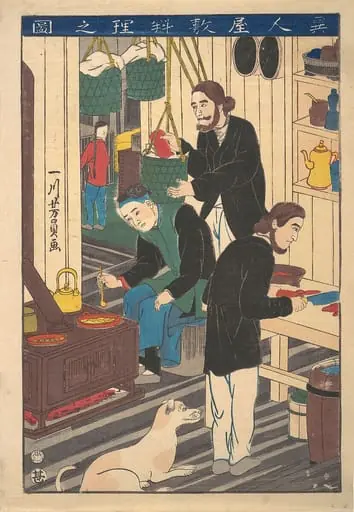 Ijiin Yashiki ryōri no zu|Inside a Foreign Restaurant
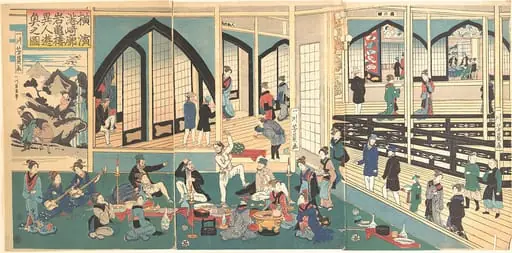 Yokohama Miyozaki-kaku Gankirō ijin yūkyō no zu|Foreigners Enjoying a Party at the Gankirō Tea House
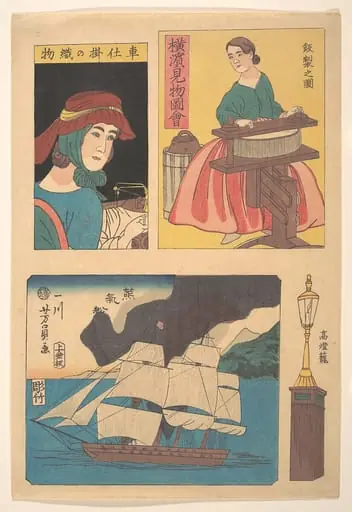 Yokohama kenbutsu zue|Picture of Sights in Yokohama: Woman with a Ringer, Lamp Post, a Steamboat at Full Sail and a Woman with a Sewing Machine
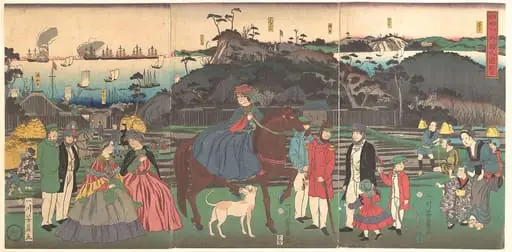 Kanagawa Gongenyama Gaikokujin yūran|Foreigners Visiting the Famous Site of Mt. Gongen in Kanagawa
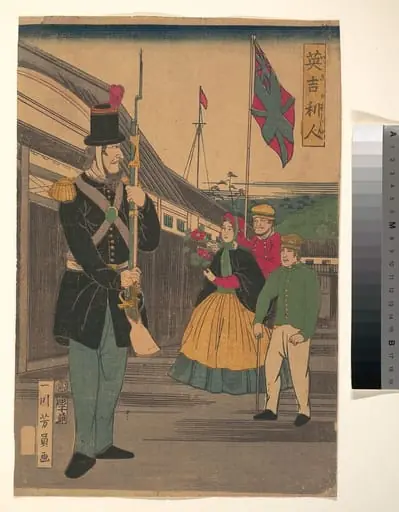 Igirisujin|英吉利人|Englishmen
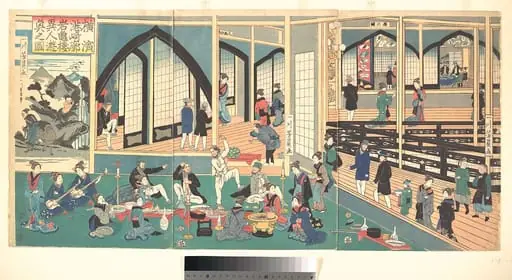 Untitled
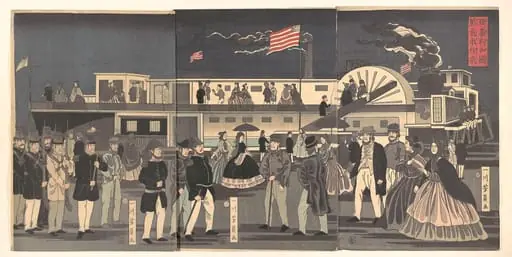 「亞墨利加國蒸氣車往来」|“America”: A Steamship in Transit
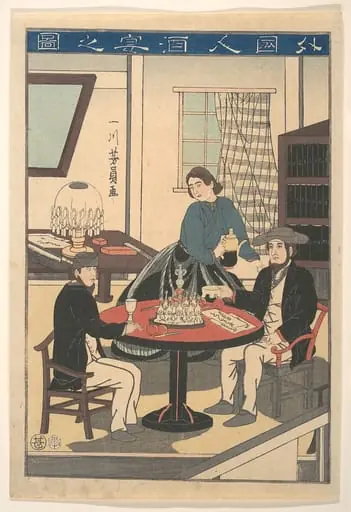 Gaikokujin Sake no zu|A Foreigner's Wine Party (Gaikokujin shuen no zu), from an untitled series of foreigners at home
- Gaikokujin ifuku shitate no zu|Picture of a Foreigner Making Clothes
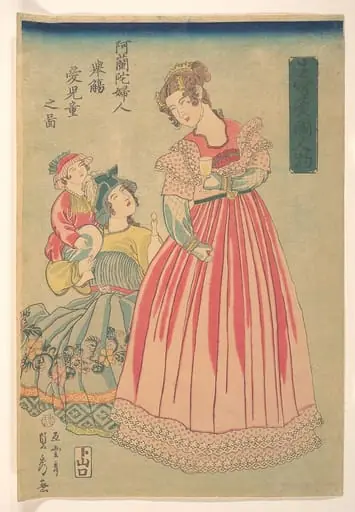 歌川五雲亭貞秀画 『生写異国人物 阿蘭陀婦人舉觴 愛児童之図』|Dutch Woman and Child (Seisha ikoku jinbutsu Oranda fujin aijidō no zu)
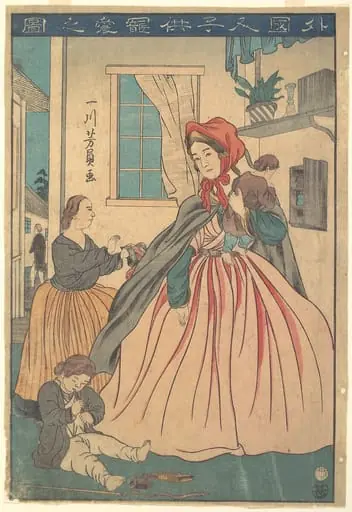 Gaikokujin kodomo choai no zu|A Foreigner Enjoying Her Children
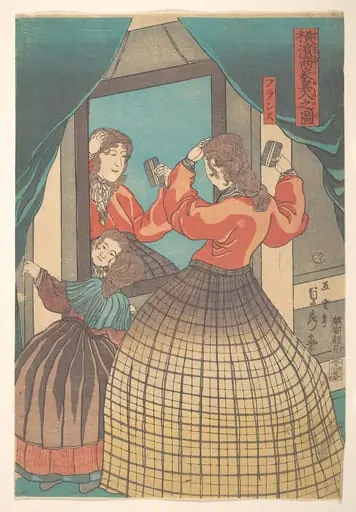 歌川五雲亭貞秀画 『横浜商家異人之図』|French Woman and Girl, from the series Foreign Merchants in Yokohama (Yokohama shōka ijin no zu)
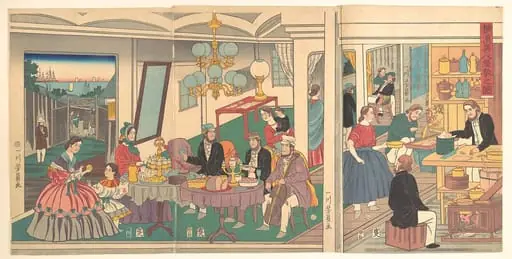 歌川芳員画 「横浜異人屋敷之圖」|A Foreign Residence in Yokohama
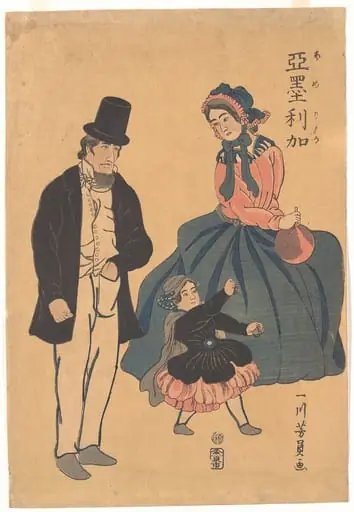 亜墨利加|American Family with a Dancing Daughter