Artwork
Christ and the Woman of Samaria
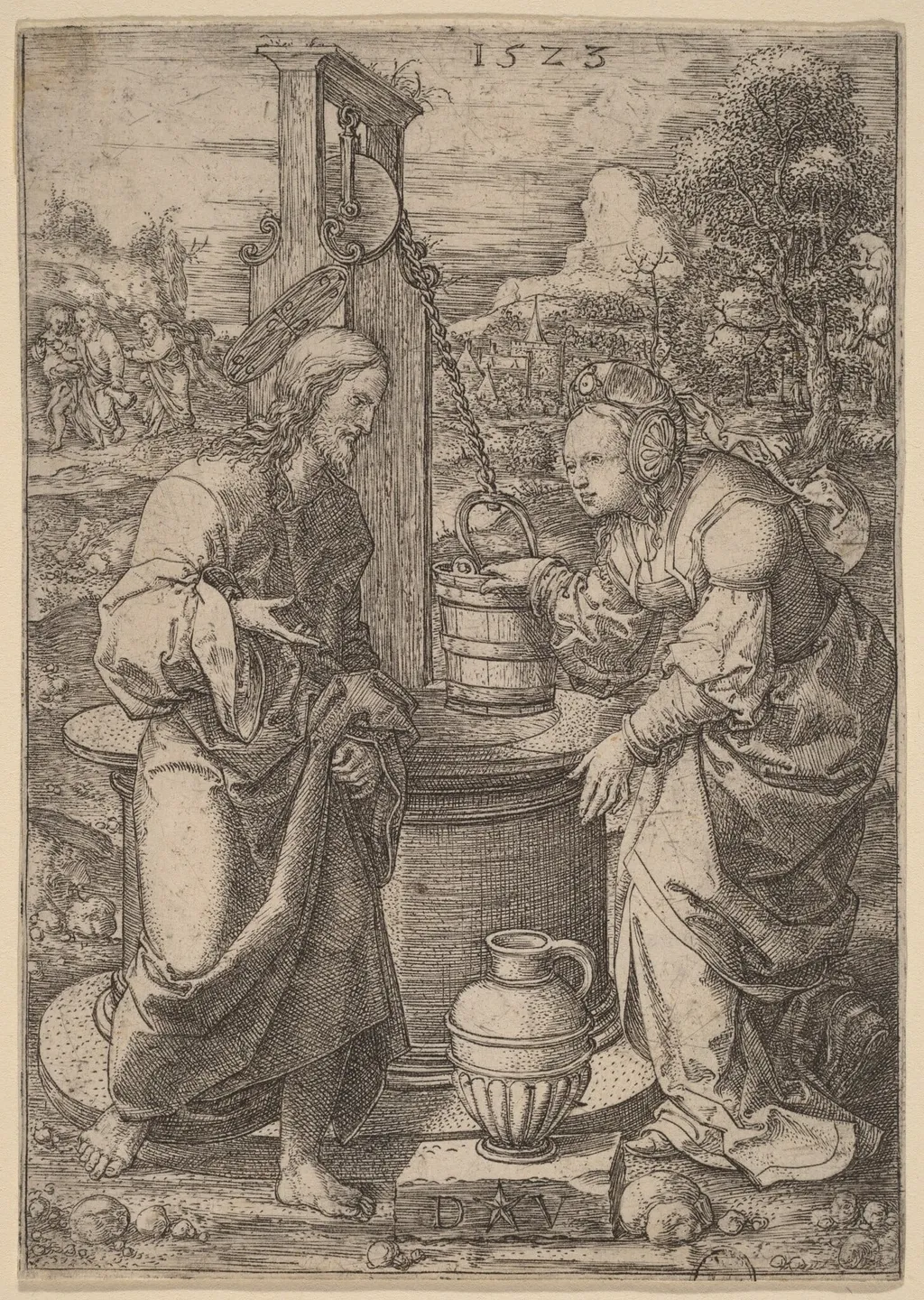
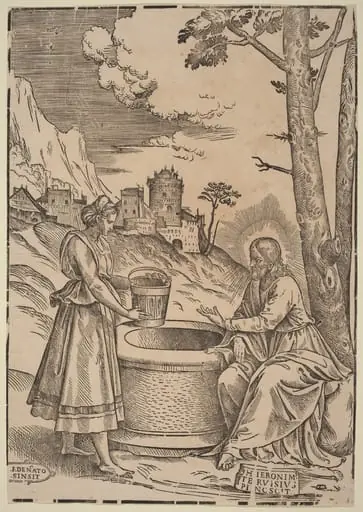
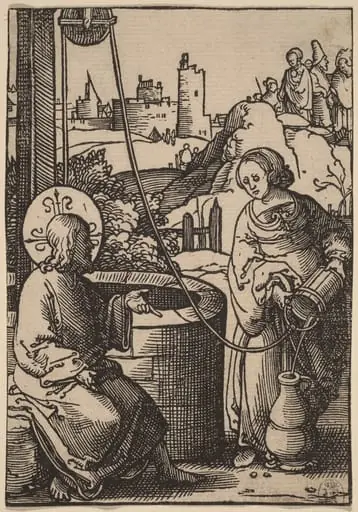
Christ and the Woman of Samaria is an ink print by the Renaissance artist Dirk Jacobsz Vellert. It dates from 1523 and is held in the collection of the National Gallery of Art.
About this work
Overview
The scene is set within a sparse landscape featuring a solitary tree, which directs the viewer's focus to the theological dialogue between the figures.
Created in 1523, 'Christ and the Woman of Samaria' is an engraving by the Flemish artist Dirk Jacobsz Vellert. The work illustrates the biblical narrative from the Gospel of John, depicting the encounter between Jesus and the Samaritan woman at the well. The composition centers on two figures positioned beside a stone well structure equipped with a rope and bucket.
Christ, identifiable by his halo and loose robes, kneels and gestures downward, likely referencing the living water he offers. Opposite him, the woman, dressed in a long gown and head covering, leans over a large barrel while holding a water jug. The scene is set within a sparse landscape featuring a solitary tree, which directs the viewer's focus to the theological dialogue between the figures.
Executed in black and white, the print demonstrates Vellert's skill in line work and spatial arrangement typical of early 16th-century Northern Renaissance printmaking. This piece reflects the artist's engagement with religious subjects and his contribution to the dissemination of biblical stories through the medium of engraving during the Reformation era.
Subject & Meaning
The print visualizes the biblical encounter between Jesus and the Samaritan woman, emphasizing the exchange of water as a metaphor for spiritual nourishment. The man’s downward gesture suggests the revelation of the living water, while the woman’s attentive posture and the presence of the well underscore the narrative’s focus on dialogue and conversion.
Technique & Style
Vellert employs fine, parallel lines to render texture and volume, a method known as cross‑hatching. This technique creates subtle gradations of tone, defining the folds of the garments, the stone of the well, and the surrounding foliage. The careful modulation of line density imparts depth within the limited black‑and‑white medium.
History & Provenance
Created in the early sixteenth century, the engraving reflects the Northern Renaissance’s interest in religious subjects for devotional prints. While specific ownership records are scarce, the work is attributed to Vellert, a Dutch artist active in the Haarlem region, and is catalogued among his known prints of biblical scenes.
Context
The image aligns with contemporary print culture that disseminated scriptural narratives to a broader audience. By translating a Gospel episode into an accessible visual format, Vellert contributed to the spread of reformist ideas and the growing demand for portable, affordable religious imagery during the period.
Own this work as a print
Artist & collection


![Christ and the Woman of Samaria [verso], by German 16th Century](https://artifactworldgallery.com/img/german-16th-century--christ-and-the-woman-of-samaria-verso--b92a651572d4a24c-w320.webp)