Artwork
Saint Attila
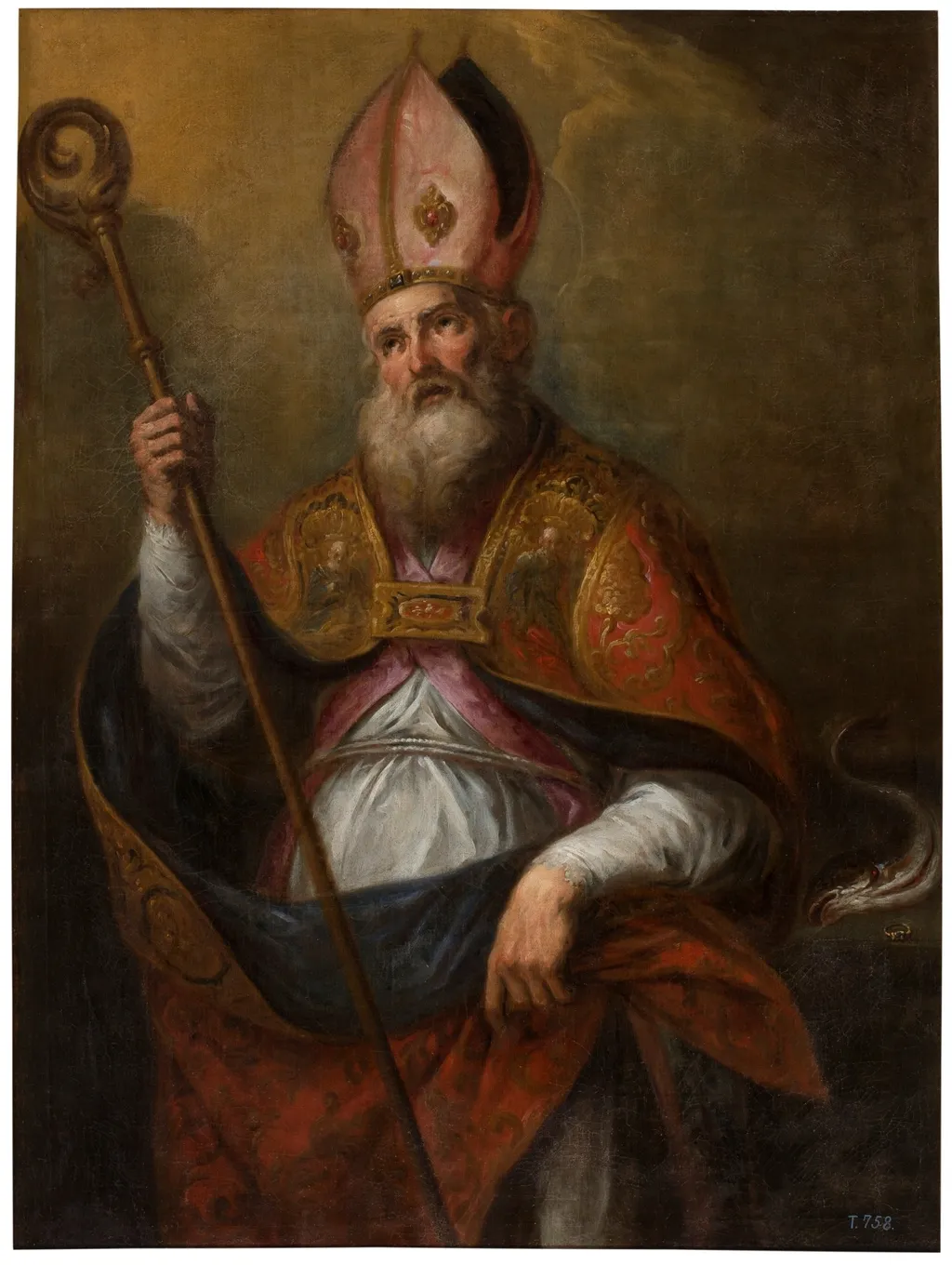
Saint Attila is an oil painting by the Spanish Baroque Tenebrist artist Vicente Berdusán. It dates from 1675 and is held in the collection of the Museo del Prado.
About this work
Subject & Meaning
The painting Saint Attila portrays the saintly bishop of Zamora, Attilanus, in a devotional context typical of 17th-century Spanish religious art.
The painting Saint Attila portrays the saintly bishop of Zamora, Attilanus, in a devotional context typical of 17th-century Spanish religious art. Rendered in oil on canvas, the composition emphasizes his ecclesiastical authority through traditional iconography of the period, linking him to local Spanish saintly traditions and the broader Counter-Reformation emphasis on saintly intercession. The work’s meaning derives from its devotional function within ecclesiastical settings, reflecting contemporary Spanish attitudes toward saintly cults and episcopal sanctity.
Measured at 130 cm by 96 cm, the canvas demonstrates the scale appropriate for altarpiece or devotional use in Spanish churches of the era.
Technique & Style
The work is an oil painting executed on canvas, depicting Saint Attilanus of Zamora. Executed in the Baroque manner, it reflects the naturalistic modeling and devotional intensity characteristic of 17th-century Spanish religious art. The composition presents the saint in half-length, clothed in a dark habit, with a gaunt face and intense gaze, rendered through chiaroscuro modeling of the features and drapery.
The handling of paint emphasizes textural contrast between the smooth flesh tones and the more gestural brushwork of the background, contributing to a sense of immediacy and spiritual gravity.
History & Provenance
The painting Saint Attila was created in 1675 by Vicente Berdusán, as documented in its cataloging at the Museo del Prado.
It entered the collection of the Museo del Prado and remains part of the museum's holdings.
The work is attributed to Vicente Berdusán y Osorio and is classified as a religious painting, reflecting the artist's focus on devotional subjects.
The painting measures 130 cm in height and 96 cm in width, confirming its substantial scale within the museum's collection of Spanish Baroque religious art.
Overview
Saint Attila is a 17th-century oil painting created by Vicente Berdusán in 1675, portraying the saint Attilanus of Zamora. It is part of the collection at the Museo del Prado.
Context
Vicente Berdusán, though not widely recognized in broad European art historical narratives, was active during the Baroque period, a time when religious art flourished in Spain. This work reflects the era's artistic and religious sentiments.
Legacy
As part of the Museo del Prado's collection, Saint Attila contributes to the museum's extensive holdings of Spanish Baroque art, offering insight into the religious and artistic practices of 17th-century Spain.
Own this work as a print
Artist & collection

- El papa San León I Magno
 Bishop Wincenty Popiel (1825–1912)
 Saint Augustine
 Saint Ambrose
 St.Benno
 El patriarca san Juan de Ribera (copia)
 Aparição da Virgem com o Menino a santo Ubaldo, bispo de Gubbio, que indica ao fundo a cidade de Pesaro
 Triumph of St Norbert
 St. Gerardo Sagredo, Bishop of Csanád
 Saint Eugenius
 Unknown Saint Abbot (Saint Benedict?)
 Theodosius and Saint Ambrose