Artwork
Theodosius and Saint Ambrose
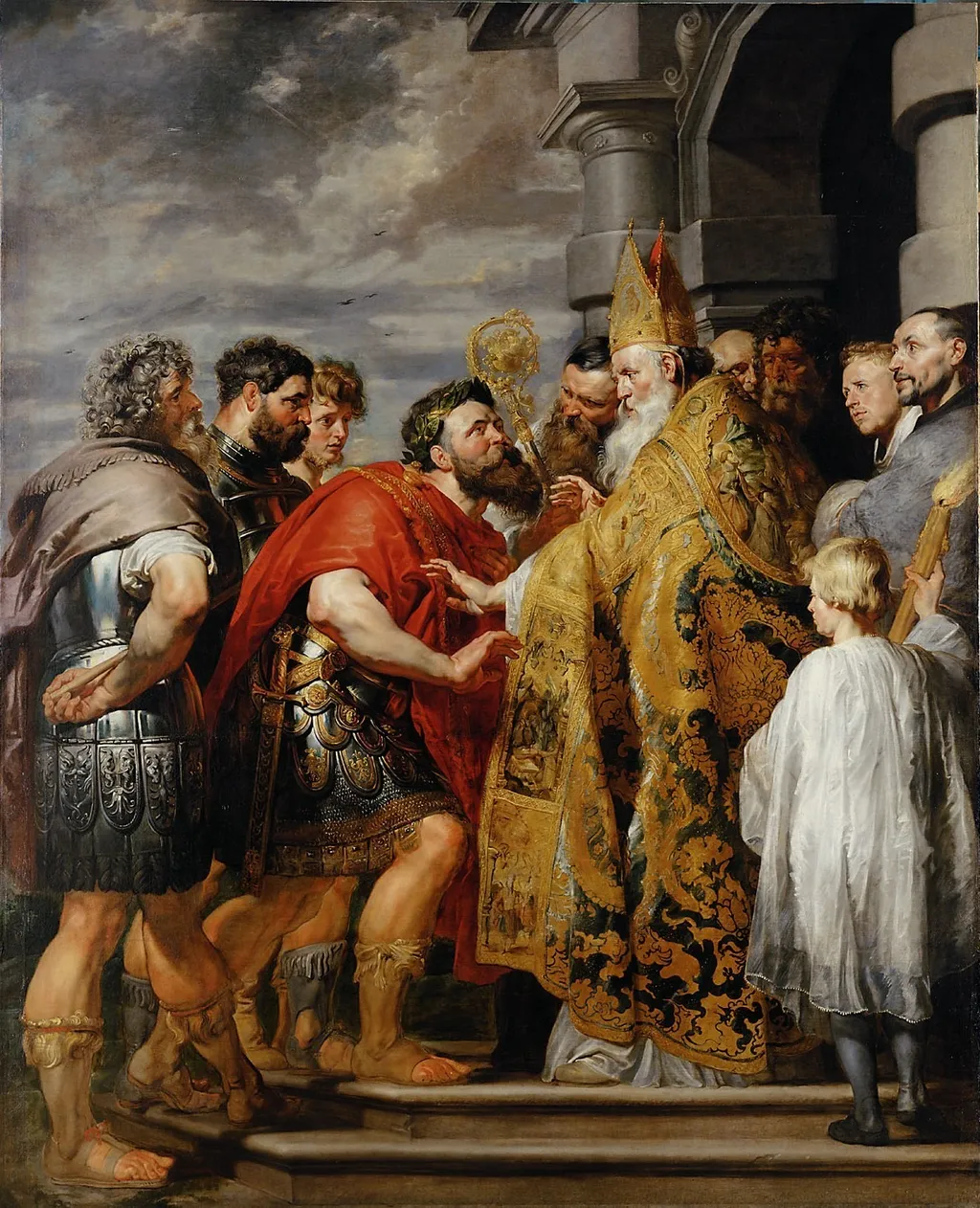
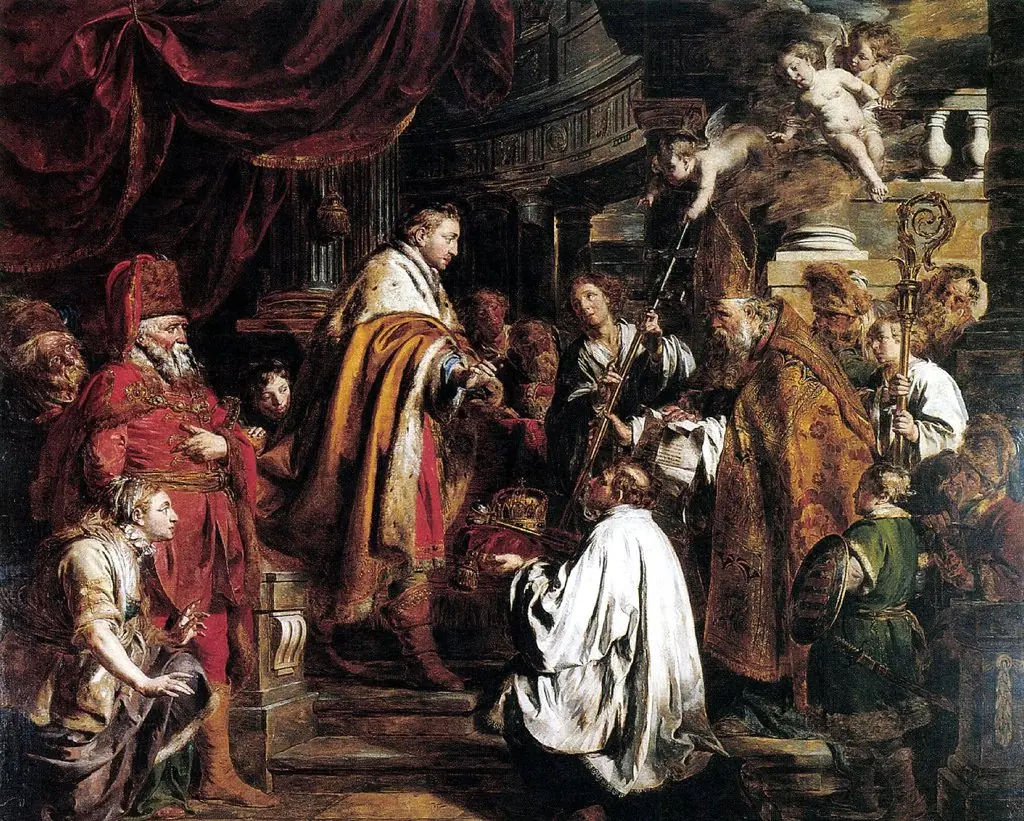
Theodosius and Saint Ambrose is an oil painting by the Flemish Baroque painting artist Peter Paul Rubens. It dates from 1617 and is held in the collection of the Kunsthistorisches Museum.
About this work
Subject & Meaning
The painting depicts the late fourth-century Roman emperor Theodosius I halted at the threshold of Milan Cathedral by Saint Ambrose, archbishop of Milan.
The painting depicts the late fourth-century Roman emperor Theodosius I halted at the threshold of Milan Cathedral by Saint Ambrose, archbishop of Milan. According to ecclesiastical history, the confrontation followed Theodosius’s order to punish the city of Thessalonica after the killing of one of his generals; the massacre provoked Ambrose to bar the emperor from entry until he publicly repented. Rubens’s composition visualizes this moment of ecclesiastical authority asserting moral limits over imperial power, staging the saint in episcopal vestments with raised hand while the emperor and his retinue appear outside the sacred precincts. The work thus allegorizes the primacy of church over state and the redemptive value of penance, themes resonant in Counter-Reformation culture.
Technique & Style
Executed in oil on canvas, the work measures 362 cm in height and 246 cm in width. The composition is dominated by robust figural modeling and dynamic drapery, with the figures arranged along a shallow, stage-like recession. Ambrose stands centrally, his authority conveyed through rigid posture and austerely modeled garments, while Theodosius appears bearded and flanked by attendants. The architectural setting recedes with minimal detail, focusing attention on the protagonists. Handling shows a division of labor: Rubens prepared the design, while Anthony van Dyck carried out the painting almost entirely, later adapting a closely related version of the subject.
History & Provenance
The painting *Theodosius and Saint Ambrose* was created between 1615 and 1618, with sources citing specific dates of c. 1615-1616, 1617, and 1617-1618. The work originated from a preparatory drawing by Peter Paul Rubens, but the oil-on-canvas execution was performed almost entirely by his pupil Anthony van Dyck. This collaboration occurred while van Dyck was working in Rubens's studio, resulting in a piece where Rubens provided the design and van Dyck handled the bulk of the painting. The subject depicts the historical moment when Saint Ambrose barred Emperor Theodosius I from entering the Milan Cathedral as penance for the Massacre of Thessalonica. The composition distinguishes itself from van Dyck's later, similar version by featuring a less defined architectural background and a bearded Theodosius. The painting is held in the Kunsthistorisches Museum in Vienna. Its inventory number is KHM 1617. It was first exhibited in a Rubens retrospective at the museum in 1962. The work has been included in subsequent exhibitions of Baroque art in Vienna and Vienna-related art displays. The piece was created in 1617 and is cataloged as part of the museum's collection of religious paintings.
Context
The painting’s collaborative genesis and iconography situate it within Rubens’s Antwerp workshop practices and the Counter-Reformation’s moralizing strain. Rubens supplied the preparatory drawing, while Anthony van Dyck, his principal pupil, executed the majority of the canvas around 1617-1618, before establishing his own reputation. The subject, the confrontation between Emperor Theodosius I and Saint Ambrose at Milan Cathedral, draws on a historical episode used to assert ecclesiastical authority over secular power, a theme resonant with post-Tridentine Catholic discourse. Van Dyck later repeated the composition in a closely related version, underscoring the pedagogical transfer of Rubens’s model to his studio practice and the evolving status of the pupil’s hand within early Baroque Antwerp.
Artist & collection
Artist
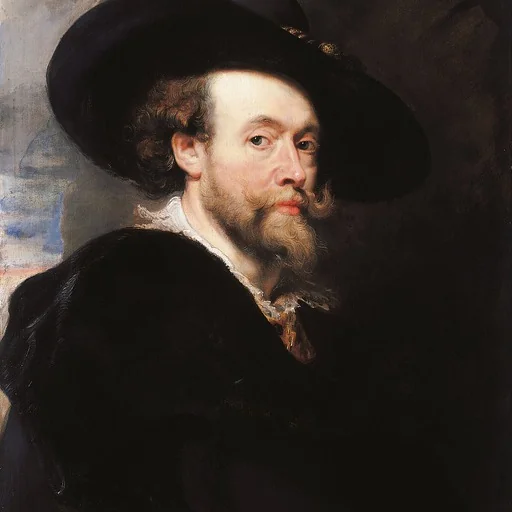
Sir Peter Paul Rubens ( ROO-bənz; Dutch:; 28 June 1577 – 30 May 1640) was a Flemish artist and diplomat.