Artwork
Sunflowers
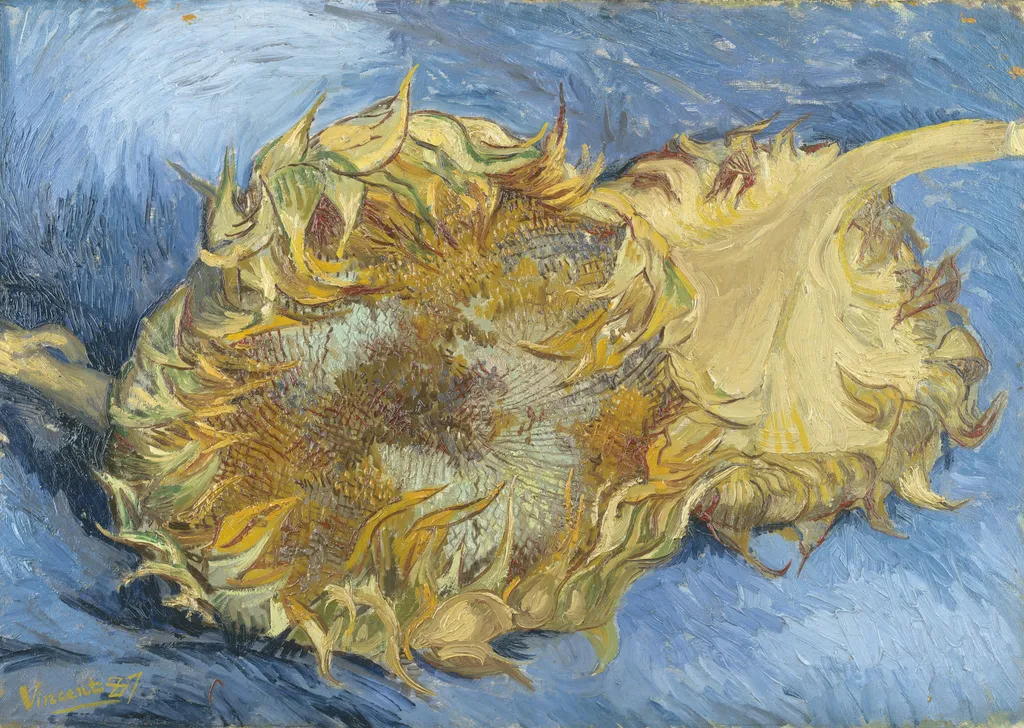
Sunflowers is an oil painting by the Post-Impressionist artist Vincent van Gogh. It is held in the collection of the Metropolitan Museum of Art.
About this work
Subject & Meaning
The subject marks an important phase in Van Gogh's development, among the first works in which the expressive color of his later period emerges.
The painting depicts two cut sunflowers, a still life in which the flower heads nearly fill the canvas. Each petal is rendered with meticulous detail, and the lines within the heart of the bloom are precise and realistic. The work sets orange-yellow blossoms against a deep blue background, employing complementary contrasts that produce a warm, vivid impression while lending the composition depth.
The subject marks an important phase in Van Gogh's development, among the first works in which the expressive color of his later period emerges. It also absorbs influences from Eugène Delacroix's color theories, the Impressionists' lighter palette, and Japanese printmaking, visible in the black accents of the irregularly rendered petals, the dark lines drawn into the heart of the flower, and the division of the composition into large flat planes.
Technique & Style
Sunflowers is an oil painting on canvas measuring 43.2 by 61 centimeters, produced by Vincent van Gogh in Paris in August–September 1887. The work is an intimate still life in which two cut sunflower heads nearly fill the canvas, each petal rendered with detailed brushwork and the lines within the flower's heart drawn with extreme precision. Van Gogh placed the orange-yellow blooms against a deep blue background, deploying a complementary color scheme that yields a surprisingly warm impression despite the cool contrast, while the juxtaposition lends depth.
The handling incorporates dark accents, black tones in the petals and dark lines scratched in with the tip of the brush at the centers, reflecting the influence of Japanese printmaking, as does the division of the surface into large flat planes.
History & Provenance
Vincent van Gogh created the oil painting Sunflowers (also titled Two Cut Sunflowers) in Paris between August and September 1887. The work, measuring 43.2 by 61 centimeters, is one of several floral studies from his Parisian period that predate his more famous Arles compositions. According to Wikidata, it was previously owned by Cornelis Hoogendijk and later by Richard Bühler before entering the collection of the Metropolitan Museum of Art in New York, where it is now held.
The Dutch- and Italian-language Wikipedia entries likewise place the work at the Metropolitan Museum. No specific accession number or discrete exhibition history is recorded in the available sources.
Context
Van Gogh's 1887 Parisian Sunflowers (specifically Two Cut Sunflowers) represents a pivotal moment in his evolution, often overshadowed by his later Arles series. Scholars identify these works as experiments in which the artist absorbed diverse influences, including Delacroix's color theories, Impressionist lightness, and Japanese print composition. The painting demonstrates his transition toward a distinct style through complementary colors, orange-yellow flowers against deep blue, to create depth and warmth.
This period marked his synthesis of external inspirations into a personal vocabulary that would fully mature in Arles, establishing these Parisian still lifes within the broader narrative of Post-Impressionism.
Overview
Vincent van Gogh's Sunflowers is an oil painting completed in 1894. This still life composition features a vibrant arrangement of common sunflowers. The artwork is currently part of the collection at The Metropolitan Museum of Art, where it offers viewers an example of Van Gogh's distinctive approach to depicting natural forms through bold color and texture.
Own this work as a print
Artist & collection
Artist
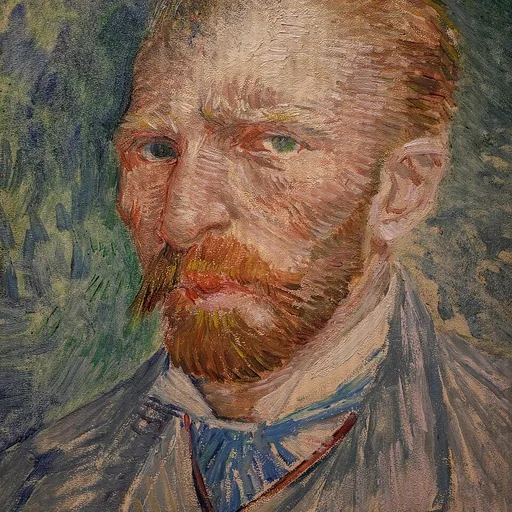
Vincent Willem van Gogh was a Dutch Post-Impressionist painter who is among the most famous and influential figures in the history of Western art.