Artwork
The Olive Orchard
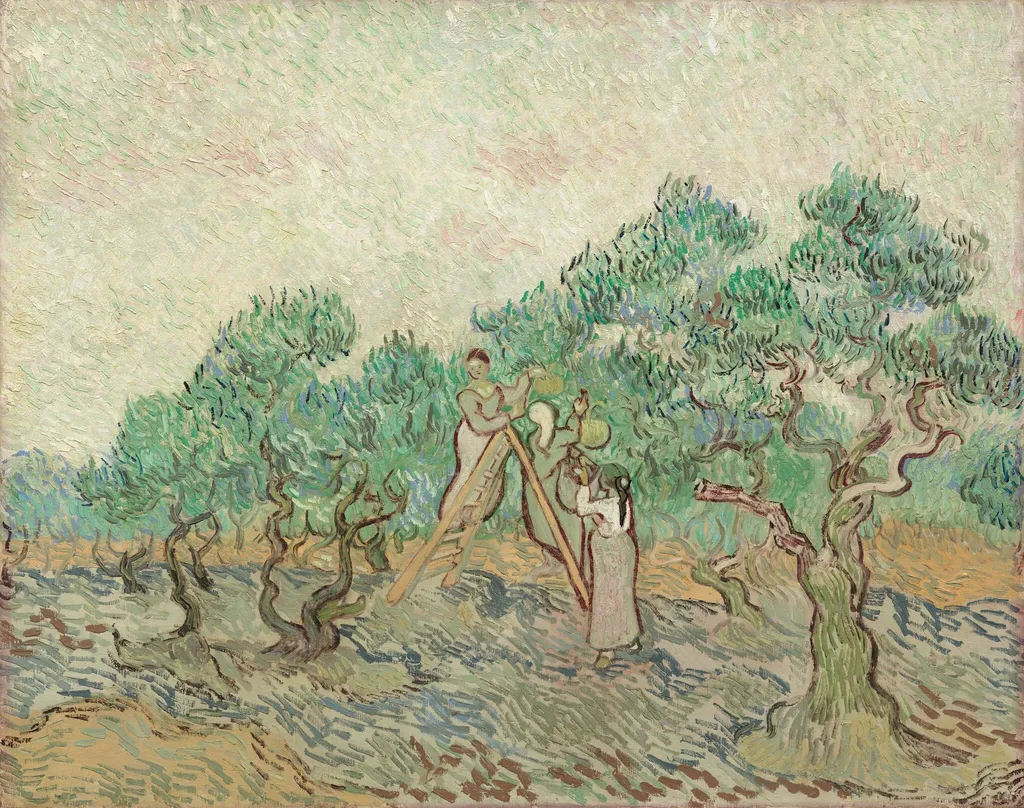
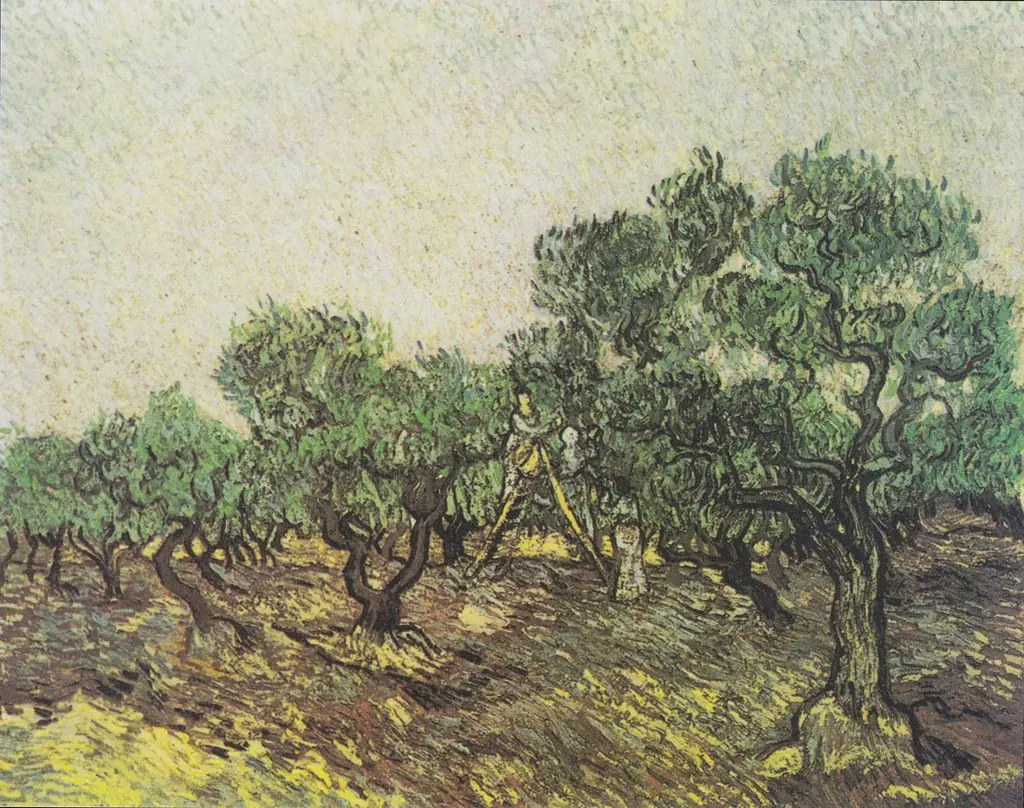
The Olive Orchard is an oil painting by the Impressionist artist Vincent van Gogh. It dates from 1889 and is held in the collection of the National Gallery of Art.
About this work
A woman stands in an olive orchard, a ladder leaning against a tree, the scene quiet and still. Van Gogh painted it in 1889 during his time at the asylum, and the bold strokes and vivid color carry his mood. Thick layers of paint, or impasto, build the texture.
Subject & Meaning
As one of several versions of this subject created by the artist, the work focuses on the agricultural labor of olive picking.
Painted in 1889 at Saint-Rémy-de-Provence, this horizontal oil on canvas depicts a genre scene set within an olive orchard. The composition features three women engaged in the harvest, utilizing a ladder to gather olives from the trees. As one of several versions of this subject created by the artist, the work focuses on the agricultural labor of olive picking.
While the painting documents a specific rural activity, the provided sources do not elaborate on deeper symbolic interpretations or specific iconographic meanings beyond the literal representation of the harvest.
Technique & Style
The Olive Orchard is executed in oil on canvas, a medium confirmed by the work’s classification as a painting and its recorded material of oil paint and canvas. The support is a rectangular canvas, oriented horizontally, which frames a genre scene of olive picking. Van Gogh depicts three women using ladders within an orchard, a composition typical of his post‑impressionist landscapes.
The brushwork and color handling, though not detailed in the provenance records, are implied by the vivid depiction of foliage and the atmospheric handling of light characteristic of his Saint‑Rémy period. The painting has been part of the National Gallery of Art’s collection since 1963.
History & Provenance
Painted in 1889 in Saint-Rémy-de-Provence, The Olive Orchard entered the art market when Jo van Gogh-Bonger sold it in 1905 to dealer Paul Cassirer in Berlin as part of an eight-canvas batch for 8,259.50 guilders. Cassirer quickly resold the work that same year to Julius Stern. Following Stern's death, the painting appeared in his estate sale at Cassirer's gallery on May 22, 1916, where it was purchased by Dr. Fritz A. Molle of Brieg.
The work later passed to Dr. Alfred Gold in Berlin before being acquired by Étienne Bignou in Paris on October 15, 1929. Bignou sold the canvas later that month to the joint account of Alex Reid and Lefèvre and M. Knoedler & Co. On May 23, 1931, Galerie Étienne Bignou facilitated the sale to New York collector Chester Dale, who bequeathed the painting to the National Gallery of Art in 1963.
The Olive Orchard is currently held by the National Gallery of Art in Washington, D.C., where it entered the collection through the 1963 bequest of Chester Dale [1][2][3]. The painting was originally owned by the artist’s sister‑in‑law, Mme J. van Gogh‑Bonger, and was sold in 1905 to Paul Cassirer before passing through the Berlin dealer Julius Stern, Dr. Fritz A. Molle, and eventually to Chester Dale in 1931 [1]. Its provenance includes a documented sale in 1916 from the estate of Julius Stern and a 1929 transaction involving Étienne Bignou, M. Knoedler & Co., and the London‑Glasgow firm of Alex Reid and Lefèvre [1].
The work, painted in 1889 in Saint‑Rémy‑de‑Provence, measures 73 × 92 cm and is catalogued as an oil on canvas genre scene [2].
Context
The Olive Orchard (1889), an oil‑on‑canvas genre scene of a woman harvesting olives beneath a ladder in a Provençal orchard, exemplifies Van Gogh’s post‑impressionist focus on rural labor and bright natural light. Painted during his stay in Saint‑Rémy‑de‑Provence, the work reflects his fascination with Mediterranean agriculture and his experimental handling of color and perspective. Its early sale to dealer Paul Cassirer and collector Julius Stern demonstrates contemporary recognition of its artistic merit.
The painting entered the National Gallery of Art collection through Chester Dale’s bequest in 1963, cementing its status in a major public museum. Scholarship situates it within Van Gogh’s 1889 output of olive‑orchard subjects, highlighting its role in the transition from Impressionism to Post‑Impressionism and its influence on later landscape painting.
Legacy
The Olive Orchard entered the National Gallery of Art in Washington, D.C., through Chester Dale’s bequest in 1963, becoming a permanent part of the museum’s collection. Its provenance traces a line of early‑twentieth‑century owners, from Theo and Jo van Gogh‑Bonger, through dealers Paul Cassirer and Julius Stern, to collectors such as Dr. Fritz A. Molle and Alfred Gold, and finally to the Reid‑Lefèvre and Knoedler galleries before Dale’s acquisition. The painting is one of several versions of Van Gogh’s olive‑orchard motif; related works are recorded in Athens, Greece, and New York, underscoring the motif’s recurrence in his oeuvre. This institutional housing and documented provenance secure its ongoing visibility and scholarly reference.
Overview
The Olive Orchard is an oil on canvas painting that captures a solitary woman within a grove of olive trees, a ladder resting against one. Created during a period of personal challenge for the artist, the work's quiet atmosphere and expressive qualities are understood to reflect his emotional state. It presents a contemplative scene, rendered with a distinctive approach to color and texture.
Own this work as a print
Artist & collection
Artist
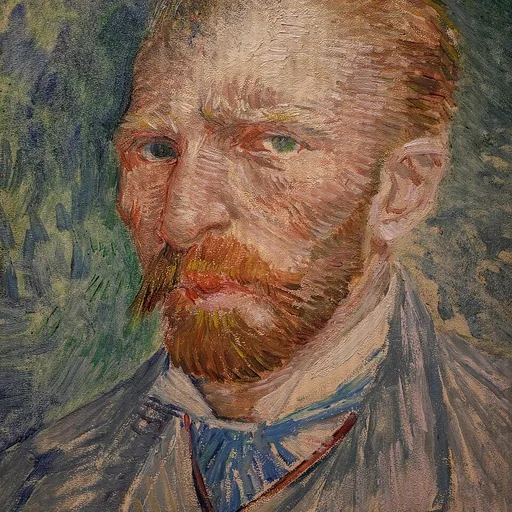
Vincent Willem van Gogh was a Dutch Post-Impressionist painter who is among the most famous and influential figures in the history of Western art.