Artwork
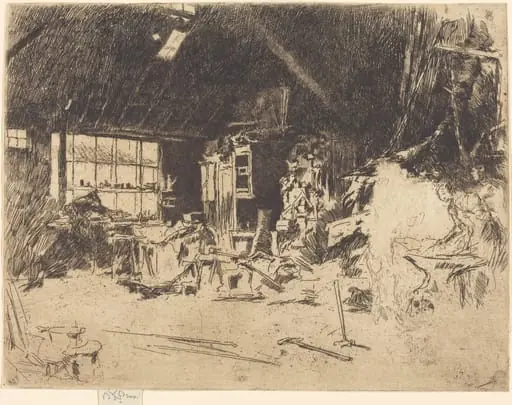
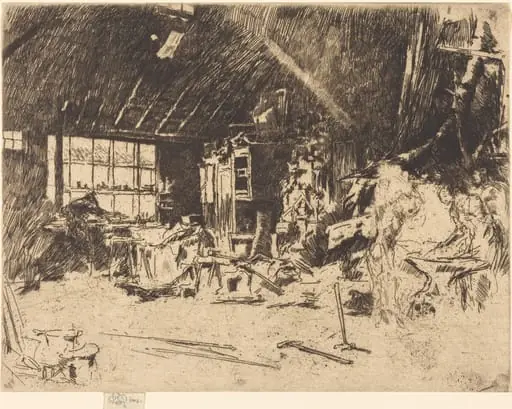
The Blacksmith's Shop
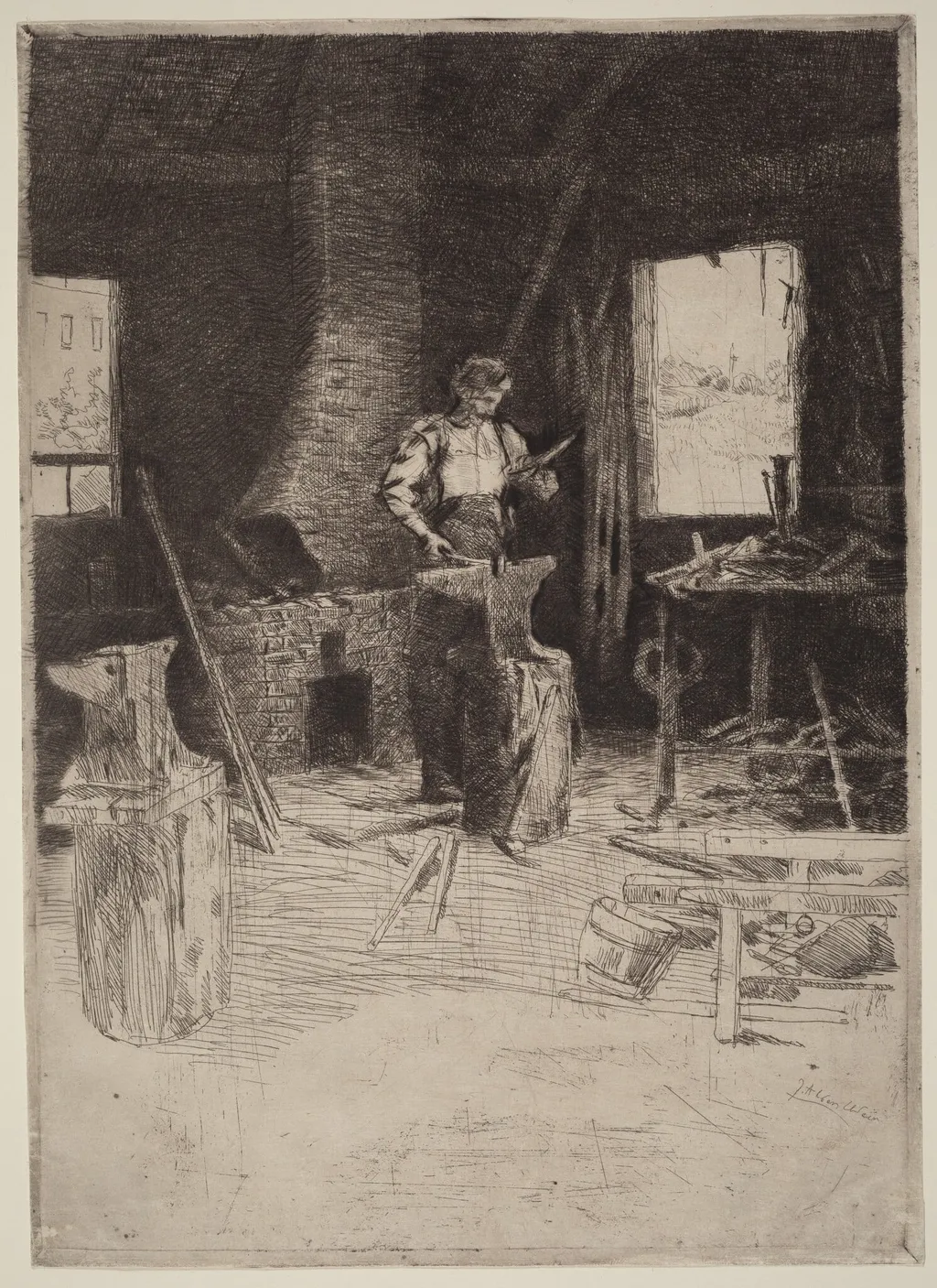
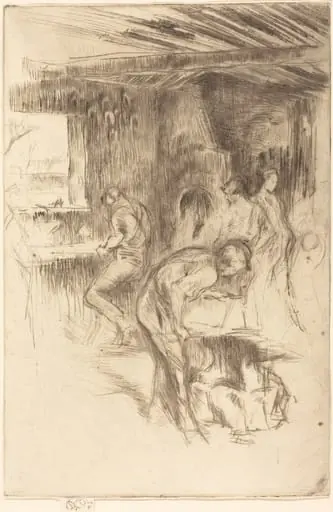
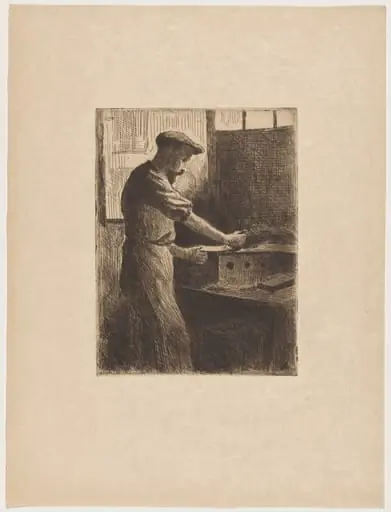
The Blacksmith's Shop is an ink print by the Impressionist artist Julian Alden Weir. It dates from 1886 and is held in the collection of the National Gallery of Art.
About this work
Overview
The etching demonstrates Weir's technical proficiency in the medium, capturing the weight of the tools and the stillness of the moment with precise line work.
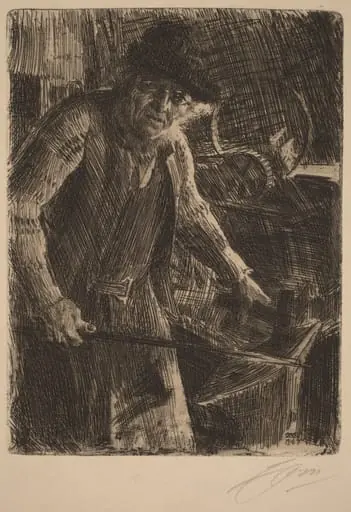
Julian Alden Weir's 1886 etching, The Blacksmith's Shop, depicts a solitary figure engaged in manual labor within a confined interior. The composition centers on the blacksmith standing at an anvil, hammer raised, surrounded by the cluttered implements of his trade. Weir utilizes a single light source from a window on the right to illuminate the worker's focused expression and the textures of the tools, leaving the remainder of the room in deep shadow.
This interplay of light and dark creates a dramatic, intimate atmosphere characteristic of the artist's interest in genre scenes and tonal contrast. Created during a period when Weir was exploring realism and the dignity of labor, the work reflects his engagement with American subjects before his later shift toward Impressionism. The etching demonstrates Weir's technical proficiency in the medium, capturing the weight of the tools and the stillness of the moment with precise line work.
It stands as a significant example of his early career focus on everyday life and the quiet intensity of the American worker.
Subject & Meaning
The work focuses on the concentration of the blacksmith, whose intent gaze and steady posture convey a sense of diligent labor. The cluttered workshop, illuminated only faintly, underscores the everyday reality of manual craft, inviting viewers to consider the quiet perseverance inherent in such occupations.
Technique & Style
Executed in etching, Weir employs fine line work to render the textures of iron, wood, and stone, creating depth through varying line density and tonal shading. The subtle gradations of dark and light enhance the atmospheric dimness of the shop, while the crisp outlines of tools emphasize their materiality.
Context
The piece aligns with a broader 19th‑century interest in genre scenes that depict ordinary work life, echoing the social realism of artists like Jean‑François Millet. By choosing a blacksmith’s workshop, Weir joins contemporaries in highlighting the dignity of labor within the evolving industrial landscape.
Own this work as a print
Artist & collection

Artist
Julian Alden Weir was an American impressionist painter and member of the Cos Cob Art Colony in Greenwich, Connecticut.