Artwork
Bernardin Realinus, Jesuit Priest
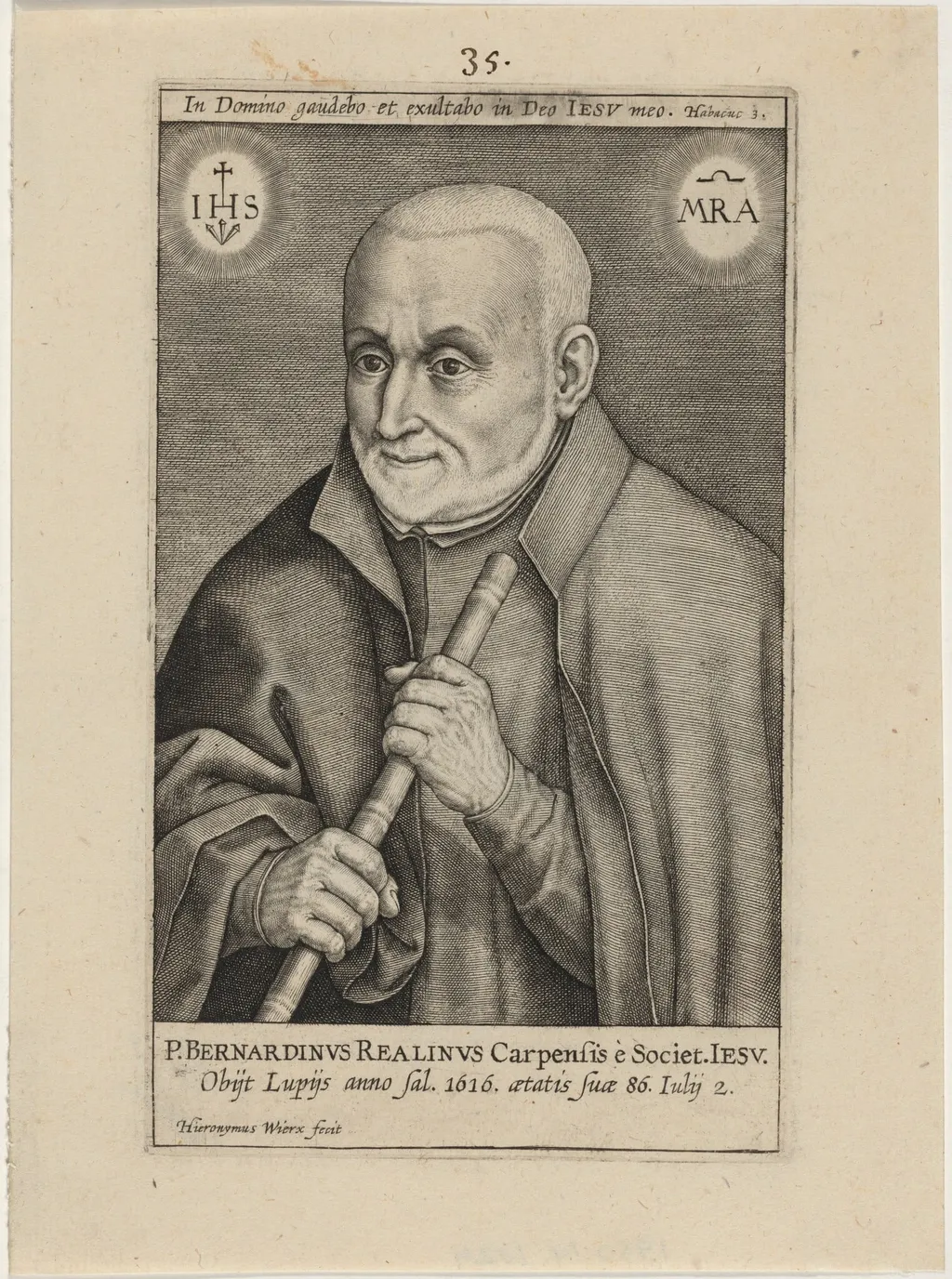
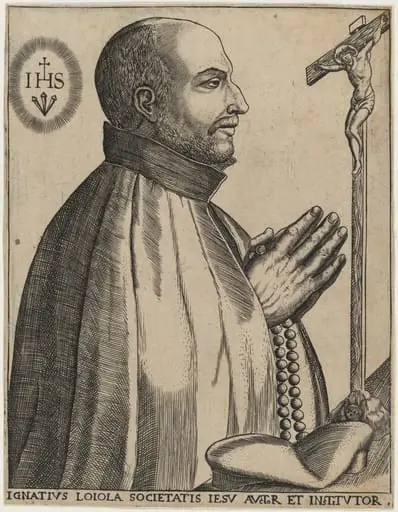
Bernardin Realinus, Jesuit Priest is an ink print by the Renaissance artist Hieronymus Wierix. It dates from 1586 and is held in the collection of the National Gallery of Art.
About this work
The text below his name says he died in 1616 at age 86, which fits the Renaissance era’s style of detailed portraits.
This is a black-and-white engraving of an older man in a priest’s robe. He holds a pair of rosary beads and looks directly at you. The background is plain, but the top corners have symbols: "IHS" on the left and "MRA" on the right.
The text below his name says he died in 1616 at age 86, which fits the Renaissance era’s style of detailed portraits.
Next, look up engraving to see how artists like this carved images into metal plates.
Overview
Created in 1586 by Flemish engraver Hieronymus Wierix, this black‑and‑white print portrays the Jesuit priest Bernardin Realinus. The portrait shows an elderly cleric in a simple robe, holding rosary beads and gazing directly at the viewer, with the monograms IHS and MRA placed in the upper corners.
Subject & Meaning
The image identifies Realinus as a Jesuit, emphasizing his religious vocation through the rosary and the Christogram IHS, a common Jesuit emblem. The inclusion of MRA, an abbreviation of the Latin Marian title "Mater Regina Angelorum," underscores the Catholic devotional context of the work.
Technique & Style
Wierix employed fine line engraving on a copper plate, a method that allowed intricate detailing of facial features and fabric texture. His approach reflects the precise, almost calligraphic strokes characteristic of the Wierix workshop, which was renowned for reproducing the works of earlier masters with high fidelity.
History & Provenance
The print was produced during a period when the Wierix family circulated Netherlandish art across Europe through reproductive prints. Although the original plate’s ownership record is sparse, the work has survived in several museum collections, attesting to its continued circulation since the late 16th century.
Context
Issued in the Southern Netherlands amid the Counter‑Reformation, the engraving aligns with the Jesuit order’s efforts to promote Catholic imagery. Its production coincided with heightened confessional tensions, making such devotional portraits both a spiritual and political statement.
Own this work as a print
Artist & collection

Artist
Hieronymus Wierix (1553–1619) was a Flemish engraver, draughtsman and publisher. He is known for his reproductive engravings after the work of well-known local and foreign artists including Albrecht Dürer. Together with…