Artwork
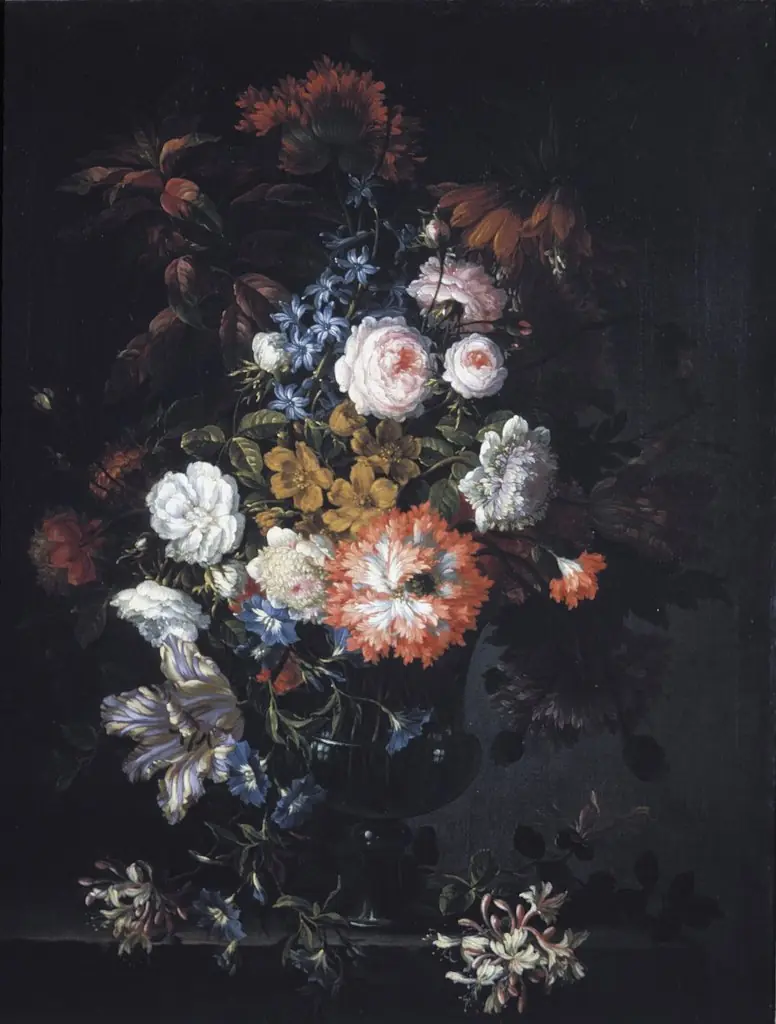
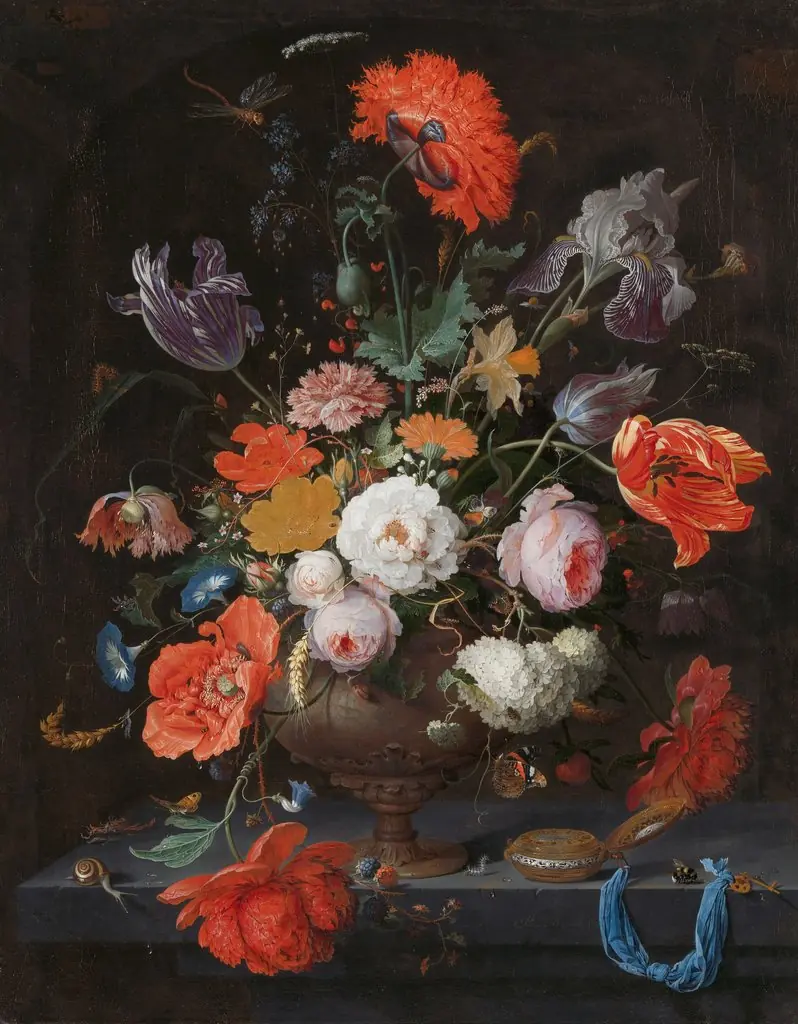
Flower still life with a watch
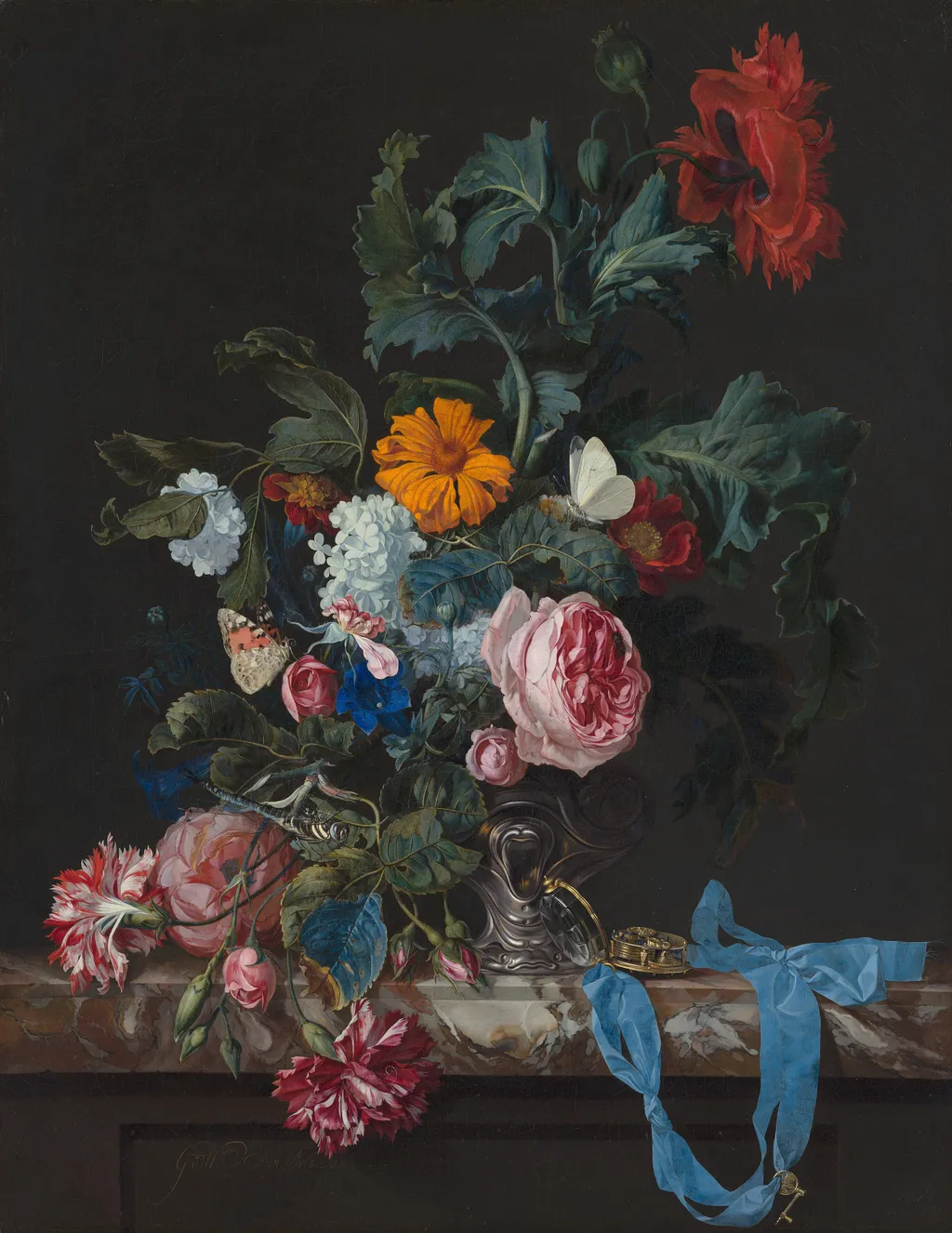
Flower still life with a watch is an oil painting by the Dutch Golden Age artist Willem van Aelst. It dates from 1663 and is held in the collection of the Mauritshuis.
About this work
This painting is a still life with flowers and a watch. It's an oil painting created by Willem van Aelst.
The painting is from 1663 and is part of the Mauritshuis collection. It's also exhibited at the Gallery Prince Willem V, which suggests it's a notable work.
You can learn more about the artist who created this piece, the artist: Willem van Aelst.
Subject & Meaning
The inclusion of a watch on a blue ribbon symbolizes the passage of time and mortality, aligning with vanitas themes.
Flower still life with a watch depicts a bouquet of Rosa gallica, poppy, Pieris, forget-me-not, gentiana, Viburnum opulus, Tagetes lucida, Tagetes patula, butterfly, Southern Hawker, and Calliphoridae arranged in a vase created by Johannes Lutma. The inclusion of a watch on a blue ribbon symbolizes the passage of time and mortality, aligning with vanitas themes. The work is part of a tradition of Dutch and Flemish floral paintings that use such objects to convey transience.
The painting follows vanitas symbolism by pairing the watch with a bouquet of flowers representing fleeting beauty, while the auricular-style vase by Lutma reinforces the period's artistic motifs. It was created during Van Aelst's time in Amsterdam and reflects his influence on contemporaries like Rachel Ruysch.
The work was part of the Dutch Royal collection at Het Loo Palace, moved to The Hague by William V, Prince of Orange for his 1774 gallery, and later displayed in the Louvre from 1795 to 1815 before being returned.
Technique & Style
Executed in oil on canvas in 1663, the work exhibits the refined handling typical of Willem van Aelst’s late Amsterdam period, marked by crisp detail and luminous color. The bouquet is arranged in a tall, narrow glass vase with auricular-style mounts, its petals rendered with delicate glazes to capture subtle shifts in hue and texture. A pocket watch suspended from a blue ribbon and its winding key appear at lower left, a conventional vanitas motif signaling mortality.
The composition balances naturalistic observation with artful arrangement: Rosa gallica, poppies, forget-me-nots, gentians, lilacs, and marigolds are set against a dark ground, creating strong tonal contrast that heightens the illusion of three-dimensional space. A butterfly and hoverfly contribute animated detail, reinforcing the transience theme.
History & Provenance
Flower still life with a watch (1663) was painted by Willem van Aelst in Amsterdam, signed "Guillelmo van Aelst" reflecting his recent Italian period before settling permanently in the city. The work entered the collection of the Dutch Royal House, appearing in the inventory of Het Loo Palace by 1757 and later displayed in The Hague gallery of William V, Prince of Orange, before being taken to Paris during the French occupation and exhibited at the Louvre between 1795 and 1815. It remains in the Mauritshuis collection and was shown in the Gallery Prince Willem V exhibition.
The painting’s iconography includes a watch with a blue ribbon, rendered alongside a bouquet of Rosa gallica, poppy, Pieris, forget-me-not, gentiana, and other botanicals, within a vase crafted by Johannes Lutma in the auricular style. This composition aligns with Dutch and Flemish vanitas traditions, using the watch as a symbol of transience.
The work’s provenance traces a clear chain from its creation in 1663 to inclusion in the Royal collection, subsequent transfers during the late 18th century, and eventual placement in the Mauritshuis, where it has been exhibited in dedicated gallery spaces.
Flower still life with a watch is held in the Mauritshuis collection and was exhibited in the Gallery Prince Willem V. It entered the Prince of Orange's collection at Het Loo Palace by 1757 and was later displayed in The Hague before being taken to Paris as war booty between 1795 and 1815, after which it returned to public view.
Context
Painted in 1663 shortly after Willem van Aelst's return from Italy, Flower still life with a watch exemplifies the Dutch Golden Age tradition of vanitas symbolism. The work integrates a pocket watch attached to a blue ribbon and a vase by Johannes Lutma to meditate on the transience of life, a recurring motif in Flemish and Dutch floral painting. Van Aelst's influence extended beyond his own output, shaping the careers of subsequent Amsterdam flower painters such as Rachel Ruysch.
The painting's historical trajectory, moving from the Dutch Royal collection at Het Loo Palace to the Louvre during the French occupation and back, further underscores its significance within the canon of 17th-century still life art.
Legacy
Willem van Aelst exerted a significant influence on subsequent Amsterdam flower painters, most notably Rachel Ruysch, following his return from Italy. The work's reputation is evidenced by its long-standing presence in the Dutch Royal collection at Het Loo Palace, where it was registered by 1757. Its prominence continued when Prince William V included it in his 1774 gallery in The Hague.
The painting's international stature was further highlighted during the French occupation, when it was transported to Paris as war booty and exhibited at the Louvre from 1795 until its return in 1815. Today, it remains a key piece in the Mauritshuis collection.
Overview
Flower still life with a watch is an oil painting executed by the Dutch artist Willem van Aelst in 1663. The work depicts a lavish, asymmetrical arrangement of various blooming flowers, including tulips and roses, contained within a glass vase. A silver-gilt watch rests prominently among the stems, serving as a classic vanitas symbol that contrasts the fleeting beauty of the blooms with the measurement of time and the inevitability of decay.
Van Aelst, a master of the Dutch Golden Age known for his precise technique and sophisticated compositions, renders the textures of petals, glass, and metal with meticulous realism. The painting exemplifies his mature style, characterized by a dark, neutral background that isolates the objects and enhances their luminosity. Created during a period when the artist was highly sought after by European aristocracy, this piece reflects the high status of still life painting in the Netherlands during the seventeenth century.
The work is currently held in the collection of the Mauritshuis in The Hague, having previously been displayed in the Gallery of Prince Willem V, underscoring its historical significance within the canon of Dutch floral still lifes.
Own this work as a print
Artist & collection
Artist
Willem van Aelst (16 May 1627 – buried 22 May 1683) was a Dutch Golden Age artist who specialized in still-life painting with flowers or game.