Artwork
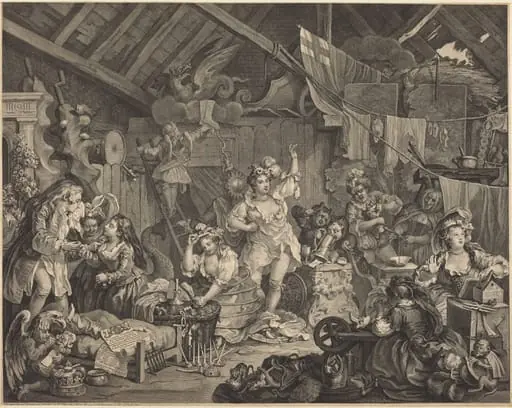
Strolling Actresses Dressing in a Barn
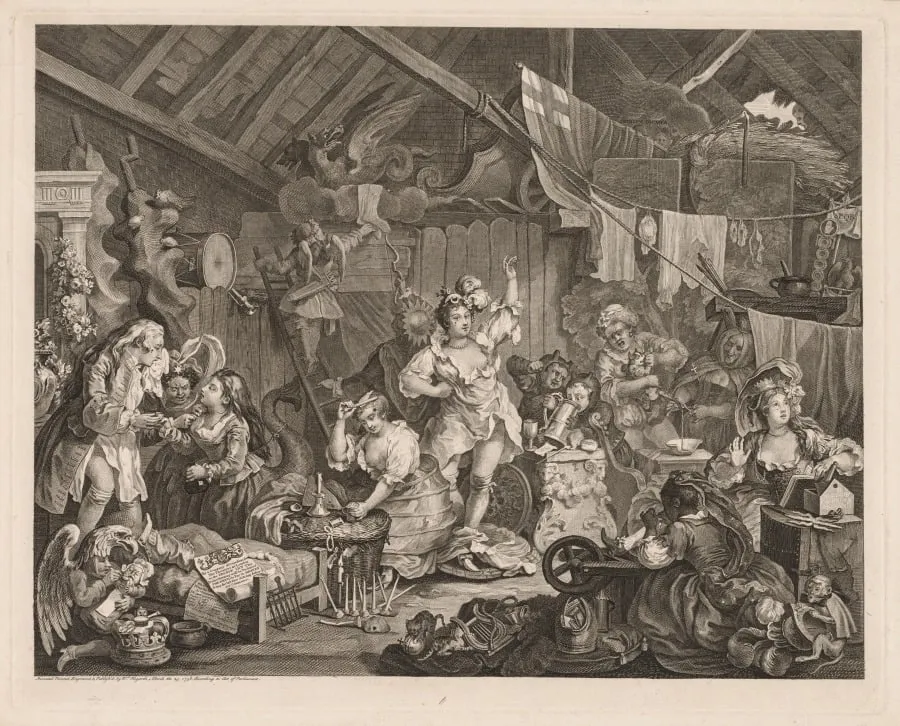
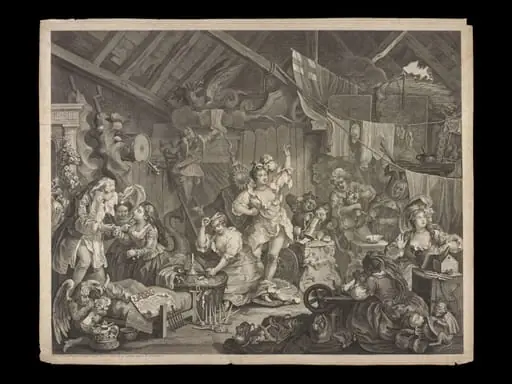
Strolling Actresses Dressing in a Barn is a print by the Baroque artist William Hogarth. It dates from 1738 and is held in the collection of the Cleveland Museum of Art.
- Accession no.
- 1959.310
- Credit line
- Gift of Mr. and Mrs. Milton Curtiss Rose
About this work
A new law let the government censor plays, so he showed the messy, real side of theater, far from the fancy stories on stage.
You see a crowded backstage scene: actresses in rumpled costumes, half-dressed, fixing wigs and makeup in a dim barn. Props and set pieces lie around, some grand, some broken.
Hogarth made this as a protest. A new law let the government censor plays, so he showed the messy, real side of theater, far from the fancy stories on stage. A crown in the corner hints at the power behind the rules.
Look up other works about England, 18th century to see how artists tackled politics and daily life.
Overview
Created by William Hogarth in 1738, this print is a satirical commentary on the Licensing Act of 1737, which granted the British government authority to censor stage performances. Rather than depicting theatrical grandeur, Hogarth reveals the disorderly reality behind the scenes: actresses in disheveled attire, cluttered props, and signs of excess. The work functions as both political critique and social observation, contrasting official control with the unvarnished lives of performers.
Subject & Meaning
The print juxtaposes the illusion of classical myth and elevated drama, suggested by scattered stage backdrops, with the gritty, mundane conditions of backstage life. Actresses, some young, are shown drinking and preparing amidst chaos, undermining the polished personas they portray. The crown in the foreground, inscribed with reference to the Licensing Act, symbolizes state interference, framing the scene as a critique of censorship disguised as moral regulation.
Technique & Style
Hogarth employs detailed engraving to capture the cluttered interior of a rustic barn, with layered textures in fabric, wood, and props. Figures are rendered with expressive, slightly exaggerated gestures, emphasizing their fatigue and disarray. The composition is deliberately crowded, guiding the viewer’s eye across a narrative of neglect and indulgence, while subtle lighting enhances the dim, unglamorous atmosphere.
History & Provenance
Produced shortly after the passage of the Licensing Act, the print was part of Hogarth’s broader campaign against state control of the arts. It was circulated among London’s literate public and likely intended for private ownership rather than public display. Though not officially banned, its sharp critique aligned it with other dissident prints of the period, contributing to its rarity and historical significance.
Context
In 18th-century England, theater was a contested cultural space, caught between popular appeal and elite moral concern. The Licensing Act reflected growing anxieties about public morality and political dissent. Hogarth’s depiction of actresses, often marginalized figures, highlighted the hypocrisy of a system that punished performance while ignoring the human cost of its enforcement.
Legacy
The print remains a key example of Hogarth’s use of visual satire to engage with political issues. It influenced later artists who sought to expose institutional power through everyday scenes. Its unromanticized portrayal of theatrical labor contributed to a broader shift in visual culture, where the backstage became a legitimate subject for social commentary rather than mere spectacle.
Artist & collection
Artist
William Hogarth (; 10 November 1697 – 26 October 1764) was an English painter, engraver, satirist, cartoonist and writer.