Artwork
Rocks at Nahant
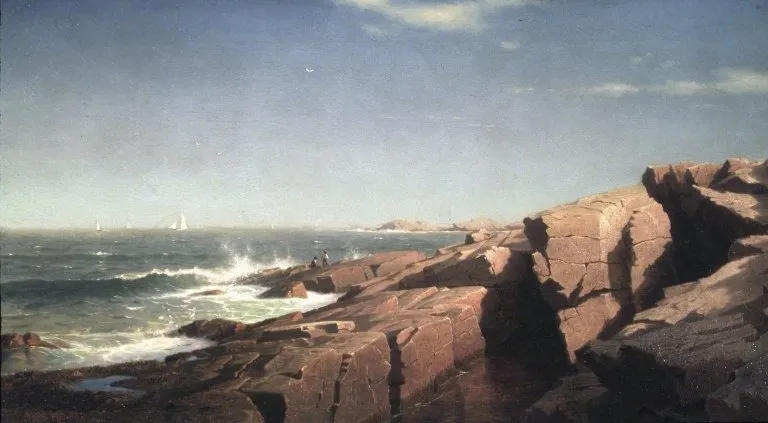
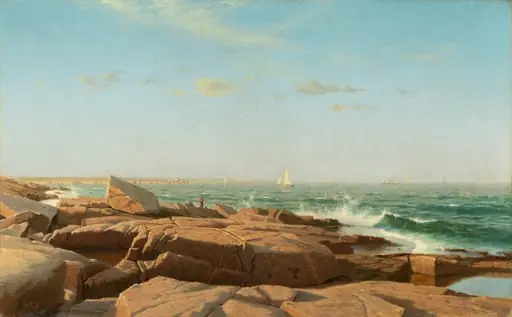
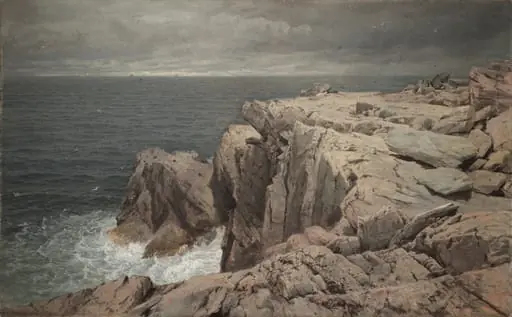
Rocks at Nahant is an oil painting by the American Impressionist artist William Stanley Haseltine. It dates from 1864 and is held in the collection of the Brooklyn Museum.
About this work
Subject & Meaning
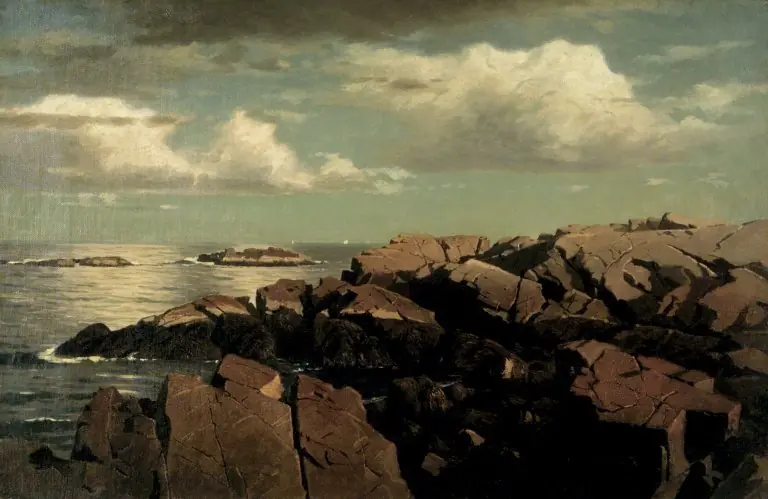
Rocks at Nahant depicts a marine scene centered on the rocky coastline of Nahant, Massachusetts, where the Atlantic Ocean meets the shore.
Rocks at Nahant depicts a marine scene centered on the rocky coastline of Nahant, Massachusetts, where the Atlantic Ocean meets the shore. The composition features prominent rocks, wind-driven waves, and a horizon line under a sky filled with clouds, capturing the raw power of the coastal environment. As a work of marine art, the painting focuses on the natural elements of the seascape rather than human activity or narrative allegory.
The subject emphasizes the interaction between the solid earth and the turbulent sea, presenting a direct observation of the specific location's geological and atmospheric conditions.
Technique & Style
Executed in 1864, Rocks at Nahant is an oil painting applied to a canvas support. The work measures 56 cm in height and 101.9 cm in width. As a marine genre piece, the composition depicts the Atlantic Ocean coastline at Nahant, featuring prominent rock formations, wind-driven waves, and a horizon line set against a sky with clouds. The handling of the medium captures the specific geological and atmospheric conditions of the coastal scene.
History & Provenance
William Stanley Haseltine created the oil painting Rocks at Nahant in 1864. The work, which depicts the rocky coastline of Nahant along the Atlantic Ocean, is executed on canvas. Since its creation, the painting has entered the collection of the Brooklyn Museum, where it remains housed.
Context
Rocks at Nahant, painted in 1864 by William Stanley Haseltine, exemplifies the luminous marine genre that defined his early American career, capturing the dramatic coastal landscape of Nahant with meticulous atmospheric detail and a sense of sublime natural force. The work reflects Haseltine's engagement with contemporary scientific interest in geology and meteorology, as well as his dialogue with Hudson River School aesthetics while developing a more refined, almost photographic precision in rendering coastal forms. Its inclusion in the Brooklyn Museum's collection since its creation underscores its enduring significance within American maritime art scholarship.
Scholars have highlighted the painting's role in bridging 19th-century Romantic visions of the sea with emerging concerns about environmental change, positioning it as a key example of how American artists interpreted coastal identity through both artistic and scientific lenses.
Overview
William Stanley Haseltine’s 1864 oil painting, titled Rocks at Nahant, portrays a stretch of the Atlantic coastline near the Massachusetts town of Nahant. The composition centers on a cluster of reddish, jagged rocks in the foreground, while distant waves and a few small vessels occupy the horizon under a bright, cloud‑dotted sky.
Artist & collection
Artist
William Stanley Haseltine was born on June 11, 1835, in Philadelphia to John Haseltine, a successful businessman, and Elizabeth Shinn Haseltine, an amateur landscape painter.