Artwork
From Paradise to Purgatory, Newport
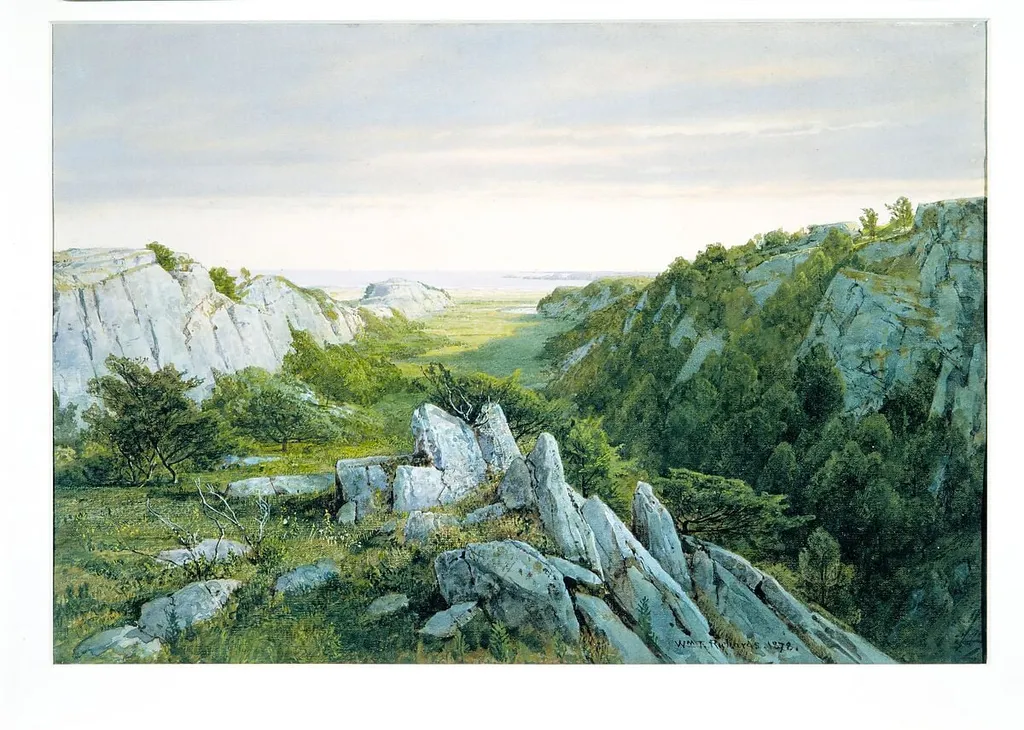
From Paradise to Purgatory, Newport is a watercolor work on paper by the Hudson River School artist William Trost Richards. It dates from 1878 and is held in the collection of the Metropolitan Museum of Art.
About this work
Technique & Style
Formal qualities emphasize a low horizon and elevated viewpoint, framing a dense thicket of trees that recedes into atmospheric space.
The work is executed in watercolor and gouache over graphite on an off-white wove paper support, combining translucent washes with denser, opaque highlights typical of Richards’s mature watercolor practice.
Formal qualities emphasize a low horizon and elevated viewpoint, framing a dense thicket of trees that recedes into atmospheric space. The handling balances fine botanical detail with broader atmospheric effects, using wet-into-wet passages for foliage and sharper graphite underdrawing to define trunks and branches. The palette remains earthy and restrained, with muted greens and umbers punctuated by subtle light effects.
The sheet measures 25.4 cm in height and 36.5 cm in width, consistent with Richards’s small-scale plein-air studies.
History & Provenance
The watercolor and gouache work From Paradise to Purgatory, Newport was created by William Trost Richards in 1878, as indicated by its internal documentation and the Metropolitan Museum of Art’s records.
The painting entered the collection of the Metropolitan Museum of Art, where it remains held. Its provenance is documented directly through the museum’s holdings, which list the work under Richards’s oeuvre with a creation date of 1878. The medium, watercolor, gouache, and graphite on off-white wove paper, is consistent with Richards’s practice during this period, and the subject aligns with his depictions of the Newport landscape.
Overview
From Paradise to Purgatory, Newport (1878) is a watercolor, gouache, and graphite work by American landscape painter William Trost Richards. Created during the artist's summers in Newport, Rhode Island, the piece depicts a quiet forest clearing at dusk, characterized by trees rising like columns within a soft blue light. Richards employs a technique of tiny, layered brushstrokes that resemble stitching to construct atmospheric depth and texture.
The off-white wove paper remains visible in areas, contributing to an airy luminosity that distinguishes the scene from darker, more opaque compositions. This work reflects Richards' mature style within the Hudson River School tradition, where he moved toward a more intimate, detailed observation of nature compared to the grandiose vistas of his earlier career. The title suggests a thematic transition, yet the visual focus remains on the serene, almost meditative quality of the coastal woodland environment.
The painting exemplifies the artist's dedication to capturing specific light conditions and the subtle interplay between foliage and sky in the late 19th-century American landscape genre.
Subject & Meaning
The composition portrays a tranquil forest clearing at dusk near Newport, Rhode Island, where Richards often summered. A solitary tree rises centrally, its trunks rendered as vertical columns against a soft blue twilight, suggesting a transition from the serenity of evening toward a more contemplative space.
Artist & collection

 The Mount Washington Range, from Mount Kearsarge
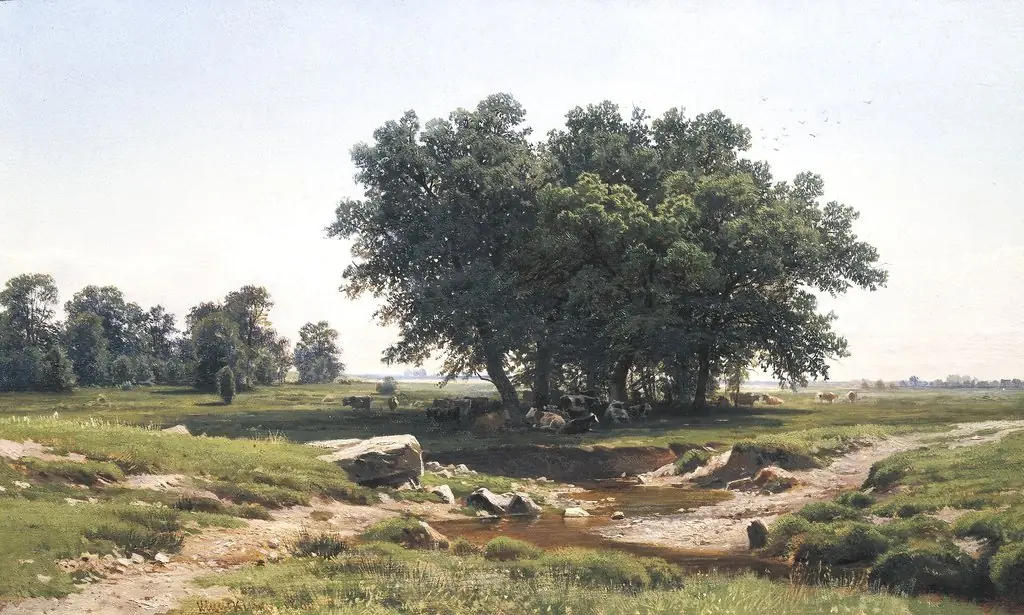 Oaks
Oaks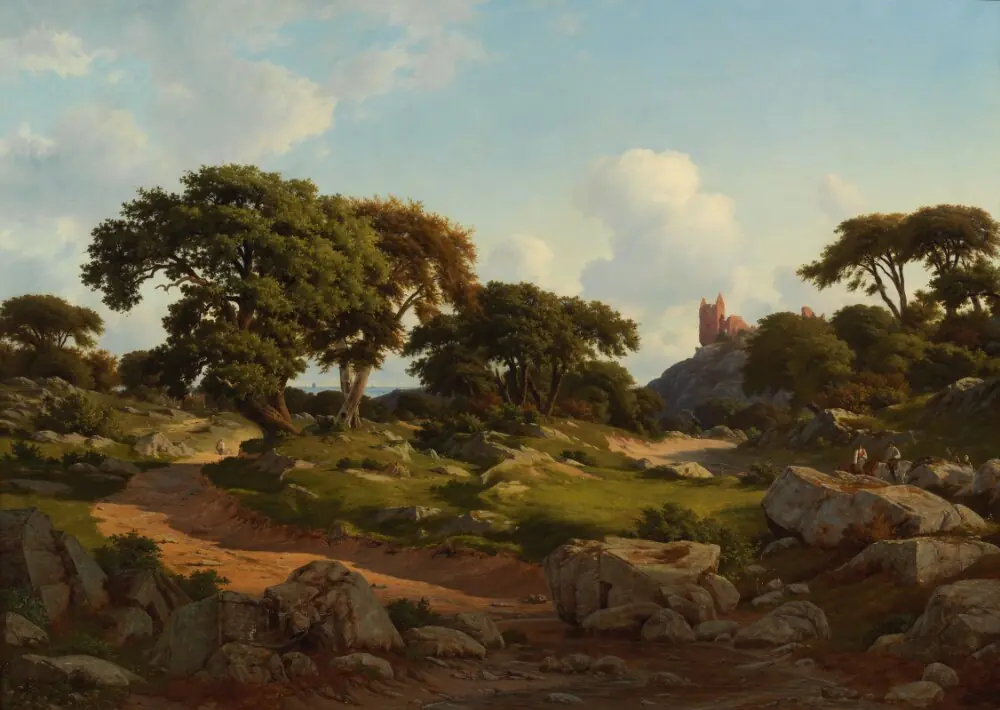 Landscape with a Ruined Castle, Hammershus on the Island Bornholm
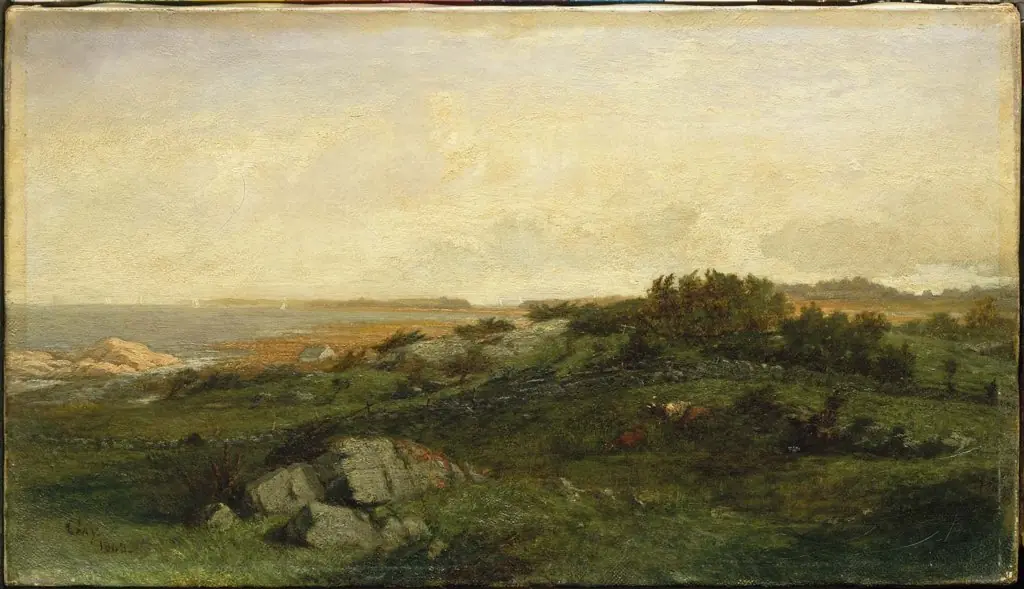 By the Sea
 Landskab fra Esromegnen
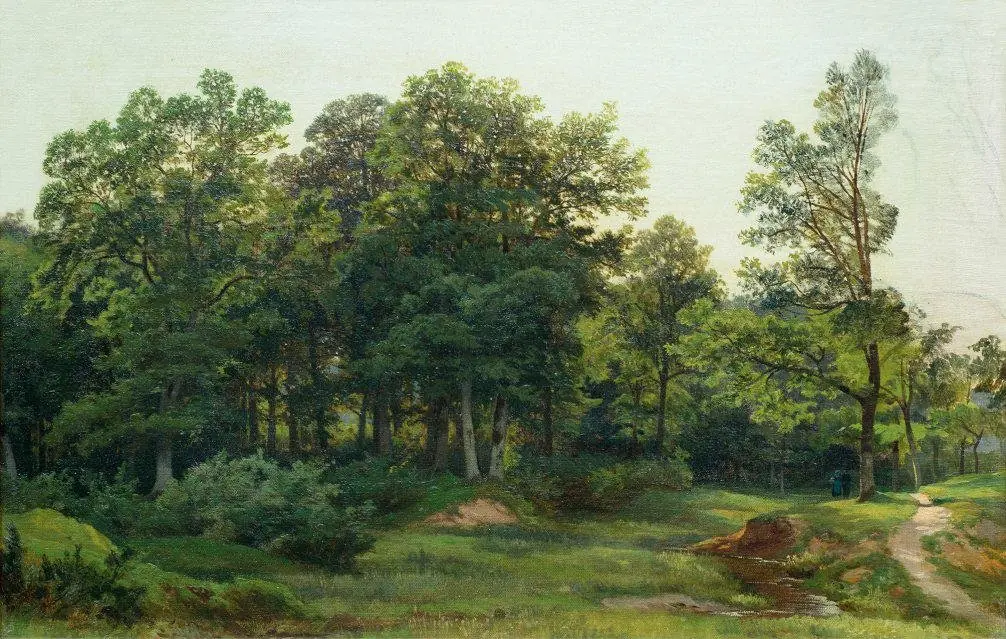 Deciduous forest
 The Coast of Jutland Seen from Mølleknap Hills in Funen. Study
 Landskab med træer på en skrænt
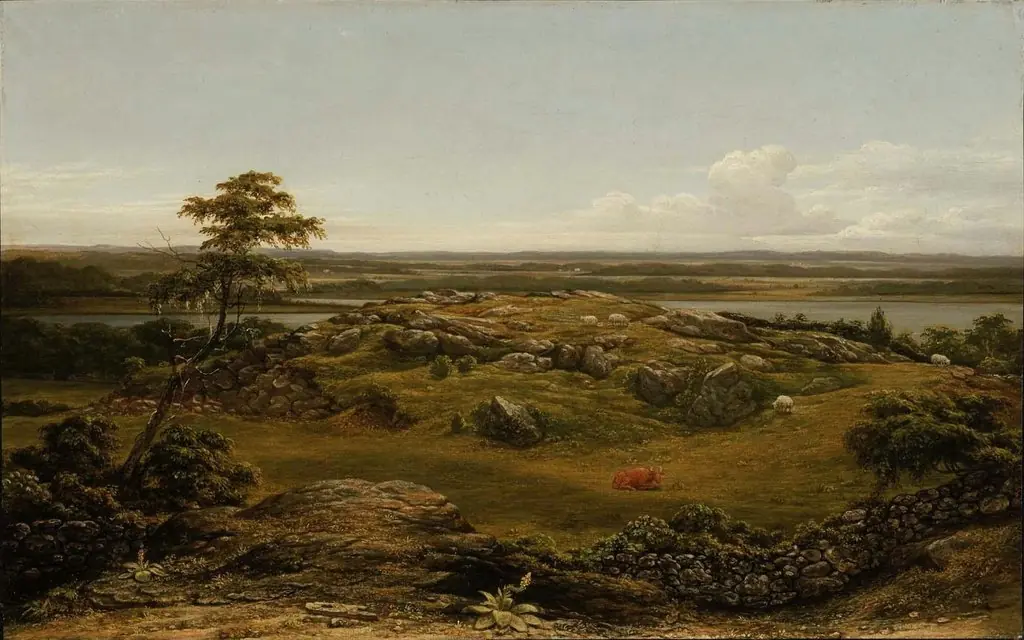 Rocks in New England
 Landskab med træer på en skrænt
 At the Edge of the Forest
- Paradise, Newport