Artwork
Lake Squam and the Sandwich Mountains
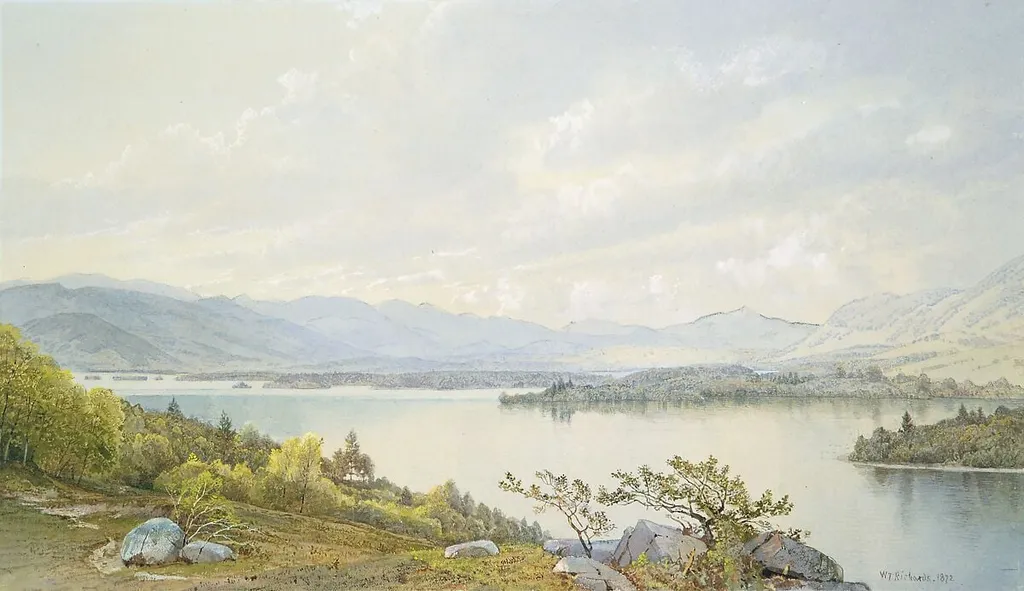
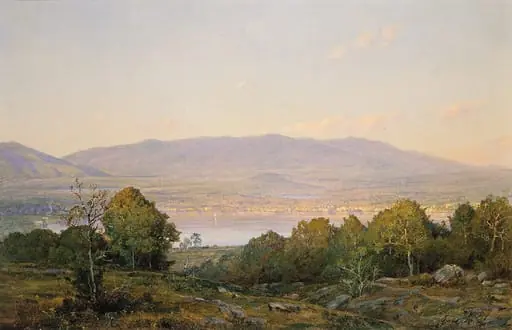
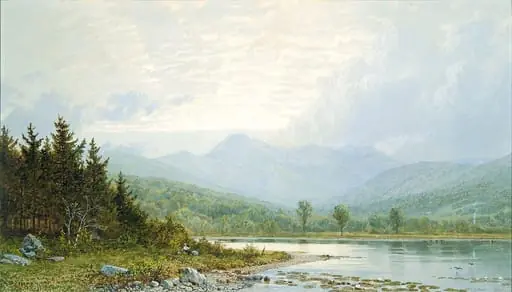
Lake Squam and the Sandwich Mountains is a gouache work on paper by the Hudson River School artist William Trost Richards. It dates from 1872 and is held in the collection of the Metropolitan Museum of Art.
About this work
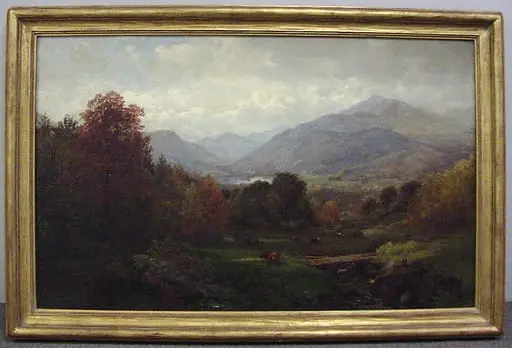
You see a quiet lake ringed by dark evergreens, the Sandwich Mountains rising soft and blue in the distance.
You see a quiet lake ringed by dark evergreens, the Sandwich Mountains rising soft and blue in the distance.
Richards painted this in 1872, when most artists still worked in oil. He used watercolor and gouache, opaque watercolor, to build up thin, glowing layers. The paper’s gray tone peeks through, giving the whole scene a misty, early-morning feel.
If you like this, look up technique: watercolor, glazing to see how artists layer colors for depth.
Subject & Meaning
Created in 1872, this landscape work by William Trost Richards depicts a specific vista of Squam Lake framed by the Sandwich Mountains in New Hampshire. The composition incorporates natural elements including trees, clouds, and an expansive sky, rendered through a combination of watercolor, gouache, and graphite on light gray wove paper. As a piece within the American Wing of the Metropolitan Museum of Art, the painting functions as a topographical record of this regional scenery.
The available sources identify the depicted subjects strictly as geographical and atmospheric features, offering no explicit information regarding additional iconography, allegorical symbolism, or deeper representational meanings beyond its classification as a landscape painting of these specific locations.
Technique & Style
Lake Squam and the Sandwich Mountains is executed in watercolor and gouache with graphite underdrawing on light gray wove paper. The combination of transparent watercolor washes and opaque gouache allows Richards to build luminous atmospheric effects while retaining precise detail in the mountains, lake surface, sky, clouds, and trees. The work’s support, a smooth, lightly toned wove paper, facilitates fine linear work and subtle gradations.
As a landscape, the painting focuses on the natural topography of Squam Lake and the Sandwich Range, rendering the scene with a clear, observational hand that emphasizes topographic accuracy and delicate tonal variation.
History & Provenance
Lake Squam and the Sandwich Mountains was created by William Trost Richards in 1872, executed in watercolor, gouache, and graphite on light gray wove paper. The work entered the collection of the Metropolitan Museum of Art, where it is classified under the American Wing. Beyond the date of inception, medium, and current institutional home, the available sources do not document the circumstances of its commission, the chain of prior ownership, or the specific history of its creation.
The watercolor Lake Squam and the Sandwich Mountains (1872) by William Trost Richards is held by The Metropolitan Museum of Art, New York, where it is catalogued as part of The American Wing. The work carries the accession number 1975.1.148, assigned to its permanent collection. It has not been recorded in major temporary exhibitions since its acquisition, remaining in the museum’s holdings as a study of the White Mountains region.
Overview
Painted in 1872, Lake Squam and the Sandwich Mountains captures a serene New England vista by William Trost Richards, a prominent figure in the Hudson River School. The composition centers on the still waters of Lake Squam, bordered by dense, dark evergreen forests that frame the scene. In the background, the Sandwich Mountains rise in soft, atmospheric blues, demonstrating Richards' mastery of light and distance.
Executed in watercolor, gouache, and graphite on light gray wove paper, the work showcases the artist's transition toward luminous, detailed naturalism. Unlike many contemporaries who relied on oil, Richards utilized the translucency of watercolor combined with the opacity of gouache to create thin, glowing layers. The gray tone of the paper remains visible, serving as a unifying mid-tone that enhances the vibrancy of the highlights and the depth of the shadows.
This piece reflects Richards' mature style, characterized by precise botanical observation and a profound sensitivity to atmospheric conditions, marking a significant contribution to American landscape art in the late 19th century.
Artist & collection