Artwork
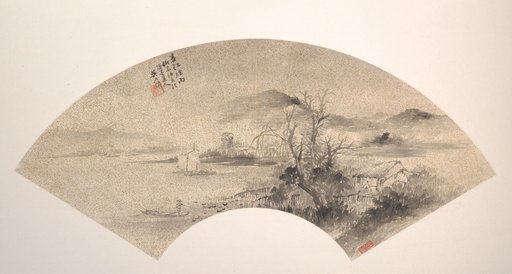
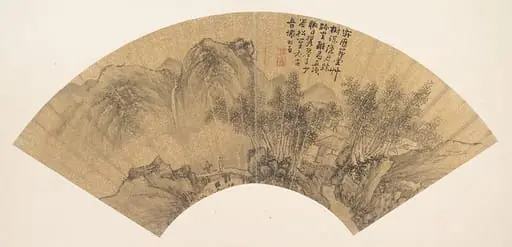
近代 吳石僊 春江煙雨 扇面|Misty Rain on the River in Spring
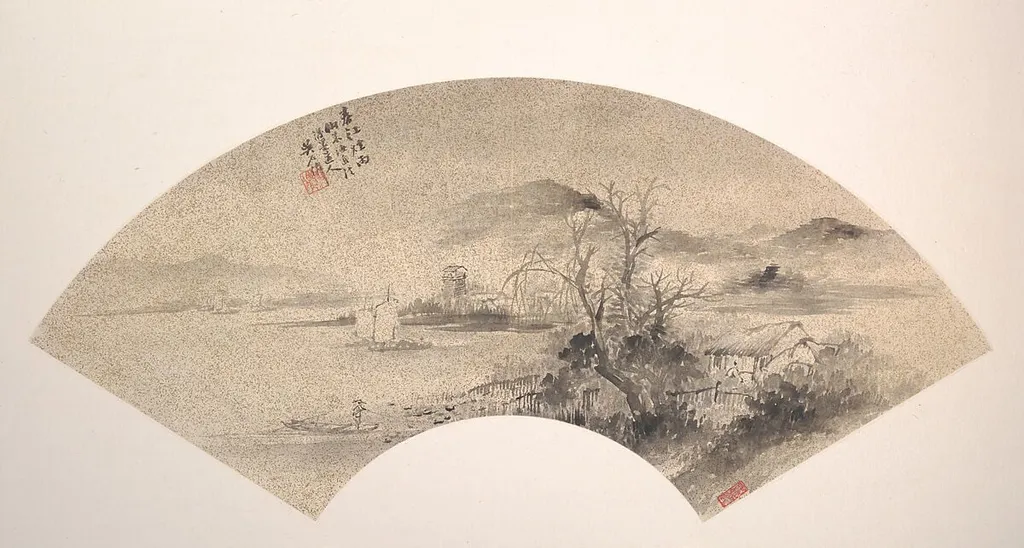
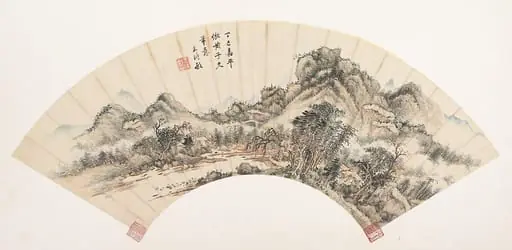
近代 吳石僊 春江煙雨 扇面|Misty Rain on the River in Spring is an ink painting by the Chinese Orthodox School artist Wu Shixian. It dates from 1866 and is held in the collection of the Metropolitan Museum of Art.
About this work
Technique & Style
The composition balances sparse brushwork with expansive negative space, creating a tranquil, mist‑laden river landscape.
The work is executed in ink on gold‑flecked paper, applied to a folding fan that has been affixed to an album leaf, a format typical of Qing‑era literati practice. Wu Shixian employs a light, atmospheric brushstroke to render mist‑shrouded water and distant hills, using gradations of wet ink to suggest vapor and subtle tonal shifts. The gold‑inflected surface catches light, enhancing the ethereal quality of the scene.
As a fan, the support is thin and flexible, requiring careful handling to preserve the delicate paper and pigment. The composition balances sparse brushwork with expansive negative space, creating a tranquil, mist‑laden river landscape.
History & Provenance
The work was created in 1866 by the Chinese painter Wu Shixian, as indicated by the artist’s inscription on the fan. The painting depicts a riverscape rendered in ink on gold-flecked paper and was originally produced as a folding fan before being remounted as an album leaf. The Metropolitan Museum of Art holds the piece, where it is catalogued as a landscape painting measuring 18.1 cm in height and 51.4 cm in width, with its creation location specified as China.
The work is held at the Metropolitan Museum of Art, accessioned as a painting by Wu Shixian. Its dimensions are recorded as 18.1 cm in height and 51.4 cm in width. The painting was created in 1866 and is classified within the museum’s holdings under the genre of landscape painting.
Overview
Wu Shixian's "Misty Rain on the River in Spring," painted in 1866, is a landscape rendered in ink on gold-flecked paper. Originally created on a folding fan, this work captures a serene river scene enveloped in atmospheric conditions. It exemplifies a traditional approach to Chinese landscape painting, focusing on the subtle beauty and tranquil power of nature through delicate brushwork and a muted palette.
Subject & Meaning
The painting depicts a river meandering through hills shrouded in a soft mist, with the ink applied so delicately that the forms almost dissolve into the atmosphere. Tiny boats drift across the water, and trees are rendered with a blurred quality, suggesting the gentle fall of rain. This composition evokes a profound sense of peace and the ephemeral beauty of a spring landscape, inviting quiet contemplation.
Artist & collection