Artwork
明 吳彬 翠壁丹楓 扇|Azure Cliff with Red Maples
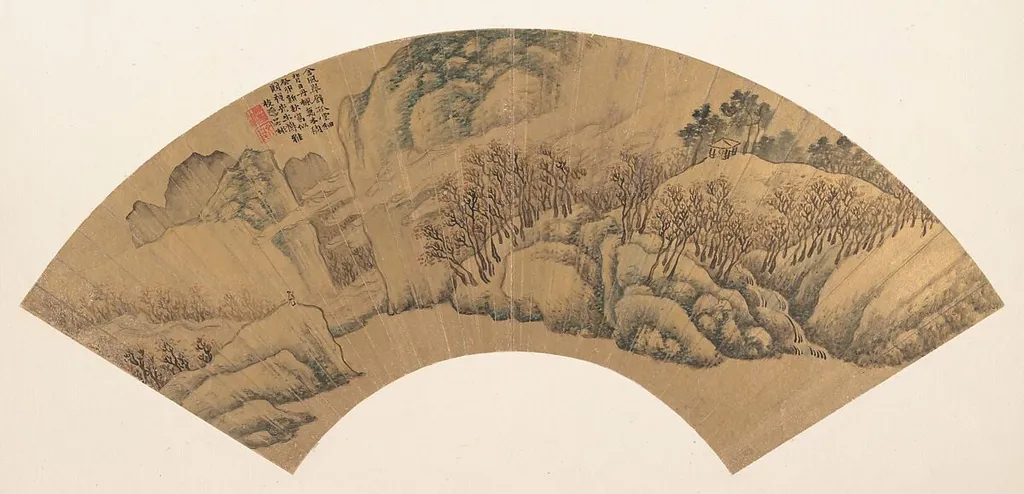
明 吳彬 翠壁丹楓 扇|Azure Cliff with Red Maples is an ink painting by the Baroque artist Wu Bin. It dates from 1603 and is held in the collection of the Metropolitan Museum of Art.
About this work
Technique & Style
The transformation from a handheld fan to a mounted leaf represents a specific handling and preservation method for this format.
Created in 1603, Azure Cliff with Red Maples is executed in ink and color on paper. The work originated as a folding fan, which was subsequently mounted as an album leaf. As a landscape painting, the piece reflects the formal qualities associated with Wu Bin's style during the Ming dynasty, utilizing traditional Chinese painting materials on a paper support.
The transformation from a handheld fan to a mounted leaf represents a specific handling and preservation method for this format.
History & Provenance
The work titled Azure Cliff with Red Maples was created by Wu Bin in 1603 in China as a folding fan mounted as an album leaf using ink and color on paper. It belongs to the landscape genre and is recorded as a painting from that year. According to the documented history, the piece entered the collection of the Metropolitan Museum of Art, where it remains on view. No records of a specific commission or subsequent ownership transfers are provided in the source material.
The painting is held by the Metropolitan Museum of Art, New York, where it is catalogued as an album leaf mounted from a folding fan. Its accession number is 1973.120.7.
It was included in the exhibition The World of Khubilai Khan: Chinese Art in the Yuan Dynasty at the Metropolitan Museum of Art, held from September 28, 2010 to January 3, 2011.
Overview
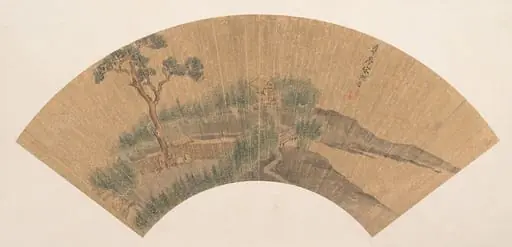
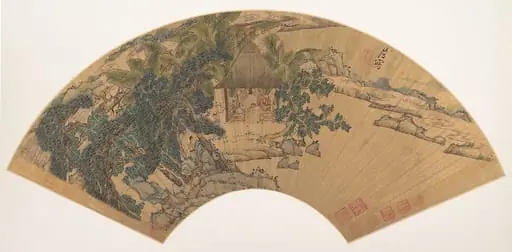
Created in 1603, Azure Cliff with Red Maples is a landscape by the late Ming dynasty artist Wu Bin, executed in ink and color on paper. Originally a folding fan, the work is now mounted as an album leaf. The composition features a curving mountain range defined by jagged, fantastical rock formations that dominate the visual field.
Wu Bin employs meticulous, calligraphic lines to articulate the complex textures of the stone and to build subtle shadows, a technique characteristic of his idiosyncratic style which often departed from strict naturalism. The palette is largely restrained with muted earth tones, greens, and browns, punctuated by distinct red accents in the maple foliage near the summit. A small architectural structure, partially obscured by sparse vegetation, nestles on the right side of the scene, providing a sense of scale and human presence within the vast, surreal topography.
This work exemplifies Wu Bin's mature period, where he synthesized traditional literati techniques with imaginative, almost hallucinatory forms that would later influence the eccentric painters of the seventeenth century.
Subject & Meaning
The painting presents a dynamic mountain landscape, dominated by steeply curving, jagged rock formations. Sparse trees dot the terrain, with their foliage rendered in a palette of muted browns and greens. Striking red accents near the upper portion of the composition suggest the changing colors of autumn.
A small, partially concealed building is visible towards the right, nestled among the trees, adding a subtle human element to the natural grandeur.
Artist & collection