Artwork
明 佚名(仿)吳育 新安汪氏譜牒 卷|Portrait of a Member and Record of the Wang Family
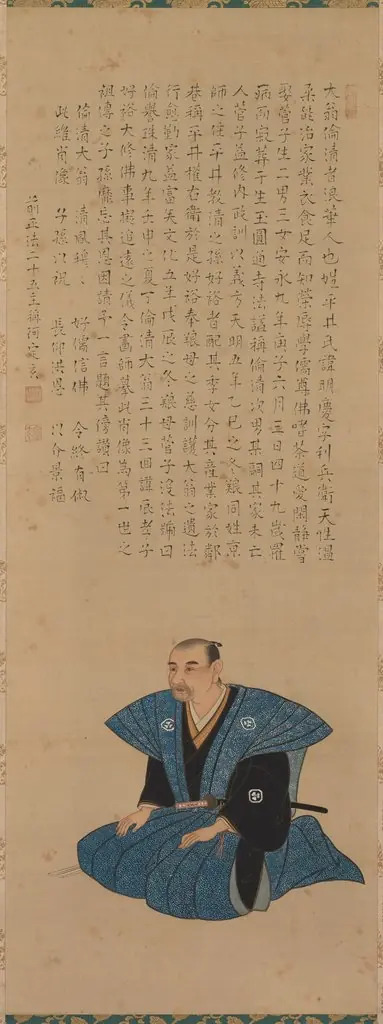
明 佚名(仿)吳育 新安汪氏譜牒 卷|Portrait of a Member and Record of the Wang Family is an ink painting by the Chinese Orthodox School artist Wu Yu. It dates from 1506 and is held in the collection of the Metropolitan Museum of Art.
About this work
Subject & Meaning
The anonymous execution reflects the typical workshop practice of the period, while the dating to 1506 anchors the piece within the early Ming artistic milieu.
The handscroll presents a single male sitter identified as a member of the Wang family, rendered in a style characteristic of early‑16th‑century Chinese portraiture. The figure is depicted in formal attire, his presence recorded alongside a family genealogy, indicating the work’s dual function as both likeness and dynastic documentation. Symbolically, the portrait conveys the sitter’s social rank and the family’s continuity, using conventional visual cues such as dignified posture and inscription to underscore status and lineage.
The anonymous execution reflects the typical workshop practice of the period, while the dating to 1506 anchors the piece within the early Ming artistic milieu.
Technique & Style
Executed in 1506, this work is a handscroll produced in China by an unidentified artist imitating the style of Wu Yu. The piece utilizes a composite medium on paper support, combining calligraphic text with a painted portrait. The artist employed black ink for the script and figure outlines, while applying color to specific areas of the portrait to render the subject, a man.
As a handscroll, the object is designed for sequential, horizontal viewing, allowing the narrative of the Wang family genealogy to unfold alongside the likeness of the family member. The integration of dense calligraphy with a colored portrait reflects a formal approach typical of Ming dynasty genealogical records, where textual documentation and visual representation are unified on a single paper surface.
History & Provenance
The work was created in 1506 in China by an anonymous hand, likely Wu Yu, as a handscroll portrait of a Wang family member for the New安汪氏譜牒. Its medium is ink on paper with added color, measuring 33.3 × 24.8 cm. The painting entered the collection of the Metropolitan Museum of Art, where it remains on display. Documentation of its acquisition is not detailed in the available records, but its inclusion in the museum’s catalogue confirms its provenance from a Chinese source to the museum’s holdings.
The handscroll is held in the collection of the Metropolitan Museum of Art. Source records identify the work as part of the museum's holdings, with its location listed as the Metropolitan Museum of Art. No specific inventory or accession number is provided in the available documentation.
Likewise, no exhibition history is recorded in the consulted sources, and any prior loans or displays beyond the museum's own collection cannot be confirmed from the available information.
Overview
This handscroll, titled Portrait of a Member and Record of the Wang Family, is attributed to an anonymous artist imitating Wu Yu, and dates to 1506. It combines a painted portrait with extensive calligraphy, executed in ink and color on paper. More than merely an artistic depiction, the scroll served as a vital document, confirming the identity and lineage of an individual within the prominent Wang clan of Xin'an. Its format integrates visual representation with textual record-keeping.
Context
During the Ming dynasty, scrolls like this played a significant role in Chinese society, particularly for elite families. They were not solely aesthetic objects but also practical instruments for maintaining and asserting family lineage and social standing. By combining a visual likeness with detailed genealogical information, these artifacts provided concrete proof of an individual's identity and connection to their ancestors, functioning as a comprehensive record of familial heritage and belonging.
Artist & collection
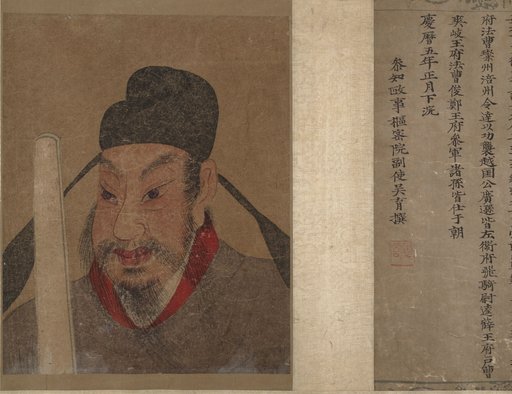
Artist
This painter left no name behind, just a brush that knew how to honor others. They spent years copying the faces of the Wang family into a single handscroll, blending ink and gentle color so every line feels like a…

- 明/清 佚名 冒氏先人小像二幅 卷|Two Ancestors of the Mao Family
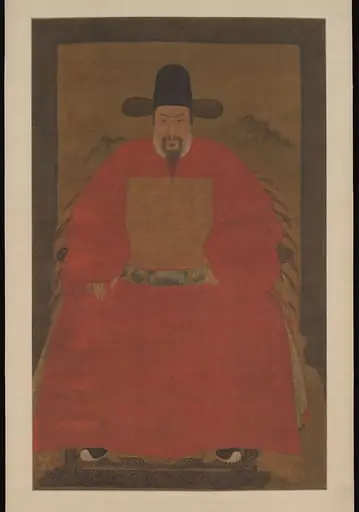 明 佚名 人物肖像 圖 鏡面|Portrait of a Gentleman
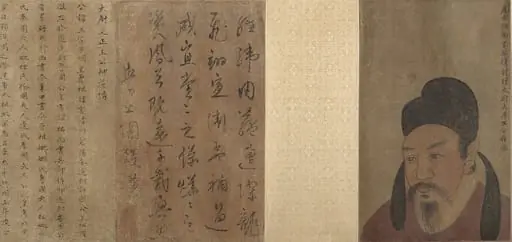 清 佚名 摹王旦、王素、王禹偁小像圖 卷|Three Bust Portraits of Tang and Song Officials
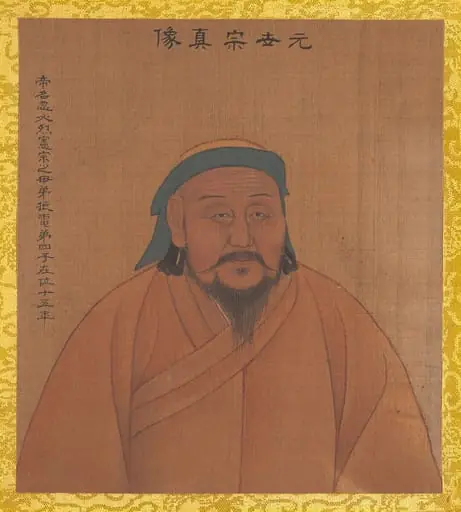 清 佚名 傳姚文瀚 歷代帝王真像 冊|Portraits of Emperors of Successive Dynasties
 清 佚名 傳姚文瀚 歷代帝王真像 冊|Portraits of Emperors of Successive Dynasties
 清 汪恭 摹趙孟頫肖像 軸|Copy of a Portrait of Zhao Mengfu