Artwork
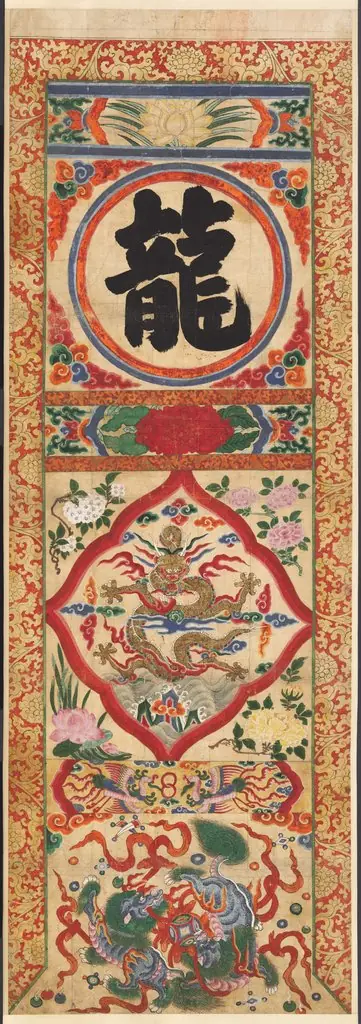
Painted Panel of Character "Dragon"
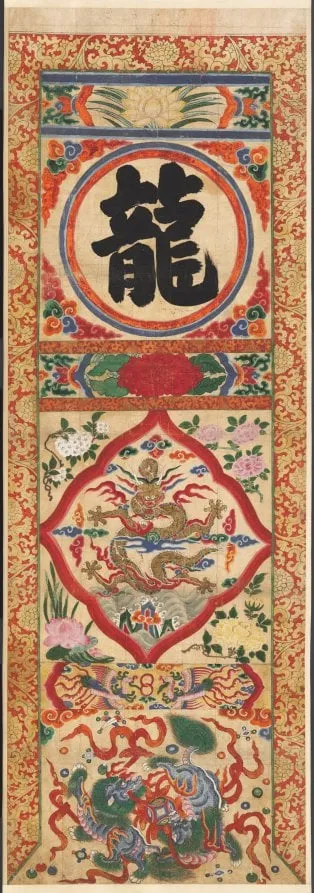
Painted Panel of Character "Dragon" is an unspecified painting by the Korean Minhwa artist Unknown. It dates from 1904 and is held in the collection of the Cleveland Museum of Art. This artwork is one of four hanging scrolls created during the Joseon dynasty, likely employed in outdoor Buddhist rituals.
- Accession no.
- 1998.119.2
About this work
The dragon and tiger weren’t just animals, they were guards of the east and west, meant to call down blessings.
You see a bright green dragon twisting through clouds, claws out, mouth open like it’s about to roar.
This painting was part of a set of four scrolls used in outdoor Buddhist ceremonies. The dragon and tiger weren’t just animals, they were guards of the east and west, meant to call down blessings. The colors are bold, almost like a comic, but the meaning was serious.
Look up more about korea, joseon dynasty (1392–1910) to see how these symbols worked in rituals.
Overview
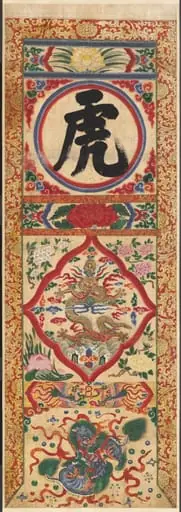
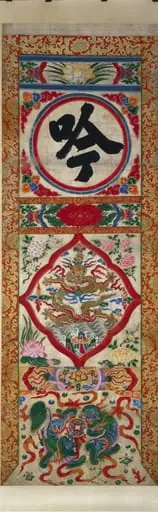
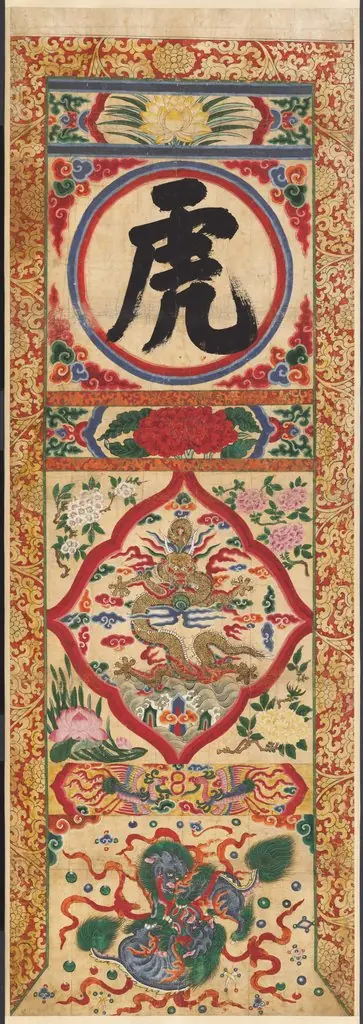
This artwork is one of four hanging scrolls created during the Joseon dynasty, likely employed in outdoor Buddhist rituals. Each scroll features a single symbolic character, dragon, tiger, whistle, and recite, arranged to invoke celestial protection and spiritual harmony. The scrolls were designed for ceremonial use, suspended in open-air settings to align with natural forces and guide ritual outcomes through visual symbolism.
Subject & Meaning
The dragon represents the eastern direction and embodies yang energy, power, renewal, and divine authority. Paired with the tiger, symbolizing the west and yin forces, the two form part of a traditional quartet of directional guardians in East Asian cosmology. The remaining scrolls, depicting 'whistle' and 'recite,' suggest sonic or verbal elements of ritual practice, completing a system where image, sound, and direction converge to summon blessings.
Technique & Style
Rendered in vivid mineral pigments on silk, the dragon is depicted with dynamic curves, flaring claws, and an open mouth as if mid-roar. The background swirls with stylized clouds rendered in layered washes, enhancing motion. Bold outlines and saturated hues, emerald green, crimson, and gold, create a striking visual impact, blending folk vibrancy with monastic solemnity, characteristic of Joseon ritual art that prioritized symbolic clarity over naturalism.
History & Provenance
The set likely originated in a Joseon-era temple or royal ceremonial context, where such scrolls were temporarily displayed during seasonal rites or prayers for rain and harvest. Their portable, scroll-based format allowed for transport and suspension in open-air altars. While exact provenance is undocumented, similar sets appear in temple inventories from the 17th to 19th centuries, indicating widespread use in state-sanctioned Buddhist observances.
Context
In Joseon Korea, Buddhism coexisted with Confucian state ideology, yet ritual practices involving celestial guardians persisted in folk and monastic traditions. The dragon and tiger, rooted in ancient Chinese cosmology, were adapted into Korean liturgical art as protectors of cosmic order. Their inclusion in outdoor ceremonies reflects a syncretic approach, merging Buddhist invocation with indigenous beliefs in directional spirits and natural forces.
Legacy
These scrolls exemplify how religious symbolism in Joseon Korea was visually codified for communal ritual use. Though later Confucian orthodoxy suppressed public Buddhist expression, such works survived in temple archives and private collections, preserving a visual language of spiritual protection. Today, they offer insight into the resilience of ritual art amid shifting religious policies and the enduring role of mythic imagery in Korean spiritual life.
Artist & collection