Movement
Divisionism
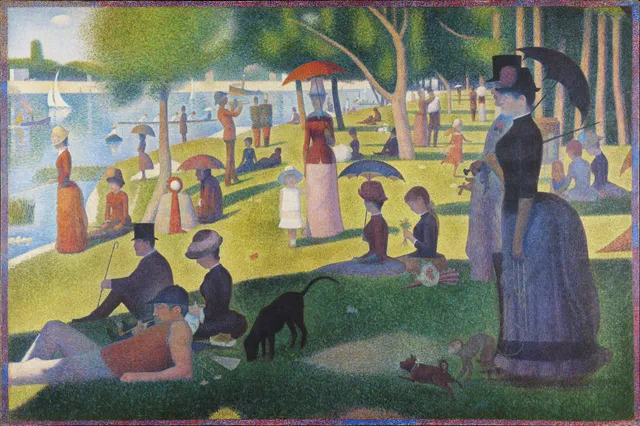
Divisionism is an art movement of the 1880–1900 period. The gallery holds 2 works in this movement. Browse Divisionism paintings, portraits, pictures and artworks from the world's public-domain museum collections.
Divisionism—called *chromoluminarism* by its inventor and often used interchangeably with Pointillism—emerged in France in the mid-1880s as a rigorously systematic outgrowth of Impressionism. Its principal architect was Georges Seurat (1859–1891), a painter steeped in optical and color science who sought to replace the Impressionists' intuitive, atmospheric brushwork with a method grounded in theory. Seurat drew on the writings of the chemist Michel-Eugène Chevreul, whose *The Principles of Harmony and Contrast of Colours* (1839) formalized the laws of simultaneous contrast, as well as on Charles Blanc, Ogden Rood, and Hermann von Helmholtz. Together with the younger Paul Signac, he forged the technique that anchored the Neo-Impressionist movement.
The defining principle is optical mixture. Rather than blending pigments on the palette, the Divisionist lays down small, distinct touches of pure, unmixed color side by side so that they fuse in the viewer's eye at a distance, yielding greater luminosity and vibration than premixed tones could achieve. Strictly speaking, Pointillism names the dotted handling of paint, while Divisionism names the underlying separation of color into its components—juxtaposing complementaries and broken hues to build form and light methodically.
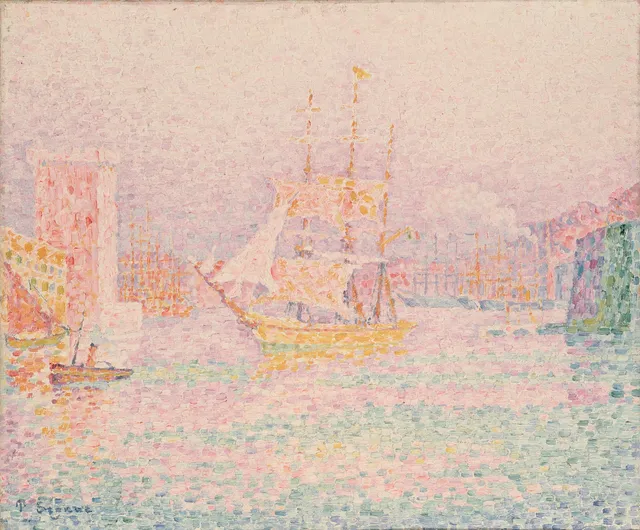
The movement's manifesto-painting is Seurat's *A Sunday Afternoon on the Island of La Grande Jatte* (1884–1886), reworked in the new technique and unveiled at the eighth and final Impressionist exhibition in 1886. After Seurat's early death in 1891, Signac became the movement's chief theorist and propagandist, codifying its ideas in *D'Eugène Delacroix au Néo-Impressionnisme* (1899); his luminous Mediterranean harbor scenes, including views of the port of Marseille, exemplify the looser, more expressive later style. Camille and Lucien Pissarro, Henri-Edmond Cross, Charles Angrand, Albert Dubois-Pillet, and Maximilien Luce also adopted the method.
Divisionism's reach extended well beyond France. In Italy a distinct Divisionist school—Giovanni Segantini, Giuseppe Pellizza da Volpedo, Angelo Morbelli, and Gaetano Previati—surfaced around 1891 at the Brera Triennale and supplied the technical and expressive groundwork for Futurism. The movement's liberation of pure color also fed directly into the work of van Gogh, Matisse and the Fauves, and the early experiments of Delaunay and Picasso, making it a crucial bridge from Impressionism to twentieth-century modernism.
Works
Learn this movement
Frequently asked questions
What is Divisionism?
Divisionism is an art movement. An Italian variant of Neo-Impressionism that gained its own character in the 1890s, using small, distinct strokes of pure color placed side-by-side to create luminous optical mixtures.
When did Divisionism take place?
Divisionism dates from 1880–1900.
Where can I see Divisionism works?
Divisionism works in the collection are held by Art Institute of Chicago and Hermitage Museum.