
Movement
Neo Geo
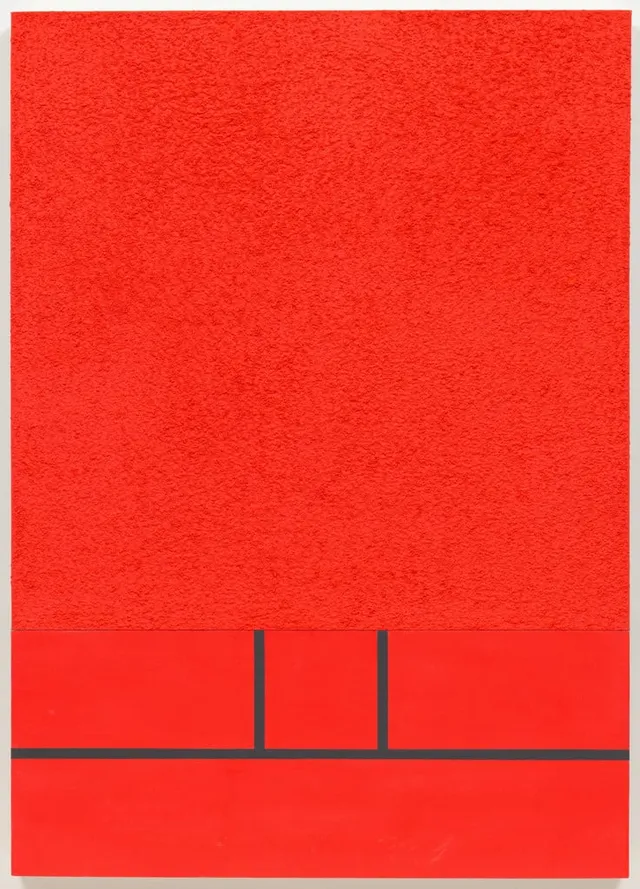
Neo Geo is an art movement of the 1980–1990 period. The gallery holds 1 work in this movement, including works by Peter Halley. Browse Neo Geo paintings, portraits, pictures and artworks from the world's public-domain museum collections.
Neo-Geo—short for Neo-Geometric Conceptualism, and also called Neo-Conceptualism or, by Peter Halley, "Simulationism"—was a New York art phenomenon of the mid-1980s. The label crystallized around a single, much-discussed group exhibition at the Sonnabend Gallery in SoHo in 1986, which brought together Peter Halley, Jeff Koons, Ashley Bickerton, and Meyer Vaisman. The four were soon dubbed the "Hot Four" by critic Paul Taylor in New York Magazine that October. Several had already shown together at International With Monument, the Lower East Side gallery run by Vaisman, during the East Village scene's early-1980s ferment. The movement arose from a booming art market and a generation steeped in French post-structuralist theory—especially Jean Baudrillard's writing on simulacra and hyperreality, and Michel Foucault on social confinement.
Visually, Neo-Geo recycled the vocabulary of geometric abstraction—Minimalism, Op art, and the legacies of Malevich and Albers—but drained it of utopian sincerity, treating hard-edged form as a readymade sign rather than a spiritual ideal. The work is cool, deadpan, and synthetic, deliberately invoking commercial and industrial imagery. Where one wing of the tendency leaned toward sculpture and the appropriated commodity (Koons's pristine vitrines, Steinbach's shelf displays of consumer goods), Halley's painting drove the "geometric" half of the name.
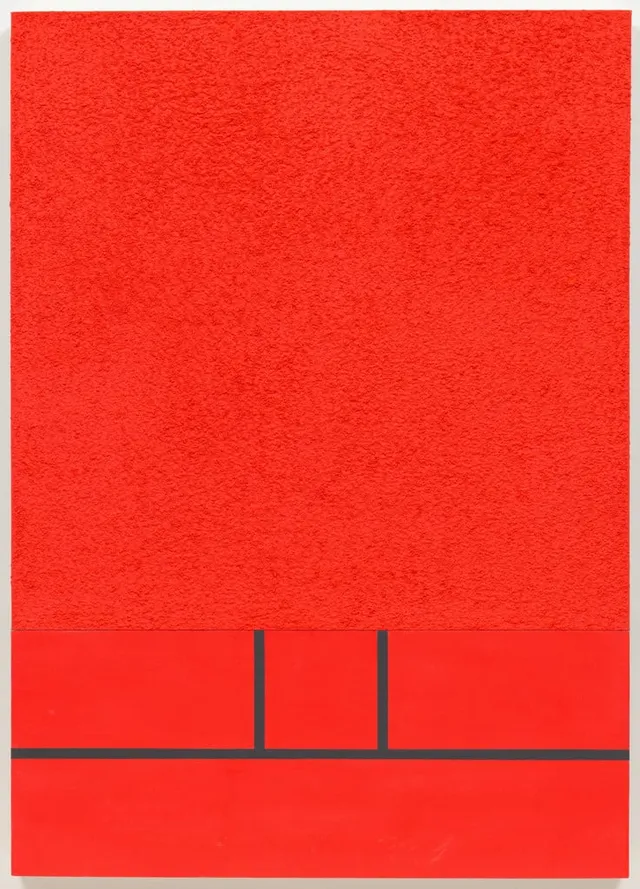
Halley (b. 1953) is the canonical figure. From the early 1980s he painted "cells" and "prisons"—rectangles barred or linked by "conduits"—rendered in fluorescent Day-Glo acrylic and Roll-a-Tex, a suburban wall-texturing compound that gives the surfaces a stuccoed, architectural tactility. He read these forms as diagrams of contemporary confinement and connection: prisons, highways, circuit boards, and the informational networks of modern life. Works such as Red Cell with Conduit (1982) typify the approach, and our collection holds his Untitled. Koons's Three Ball Total Equilibrium Tank (1985) represents the movement's object-based counterpart.
Neo-Geo positioned itself against the gestural, expressive painting of Neo-Expressionism that had dominated the early 1980s, substituting irony, theory, and machine-cool surface for raw emotion. Critics were divided: Kay Larson dismissed the Sonnabend show as "Masters of Hype" and a marketing ploy, while curator Dan Cameron called it among the most talked-about exhibitions of the decade. Though the artists were always more loosely allied than a coherent school, their fusion of abstraction with consumer critique proved durable, feeding later appropriation art and the ongoing dialogue between painting and commodity culture.
Key artists
Works
Frequently asked questions
What is Neo Geo?
Neo Geo is an art movement. Short for Neo-Geometric Conceptualism, a 1980s New York movement.
Who are the key Neo Geo artists?
Key Neo Geo artists in the collection include Peter Halley.
When did Neo Geo take place?
Neo Geo dates from 1980–1990.
Where can I see Neo Geo works?
Neo Geo works in the collection are held by Museum of Modern Art.