Movement
Primitivism
Primitivism is an art movement of the 1890–1940 period. The gallery holds 1 work in this movement, including works by Paul Gauguin, Henri Rousseau and Henry Moore. Browse Primitivism paintings, portraits, pictures and artworks from the world's public-domain museum collections.
Primitivism is not a single organized school but a current that ran through European modern art in the late nineteenth and early twentieth centuries, in which avant-garde artists sought renewal in the forms of cultures they regarded as "primitive" — the arts of Africa, Oceania, the pre-Columbian Americas, medieval Europe, folk traditions, and the untutored vision of children and the self-taught. It arose against the backdrop of intense industrialization and European colonial expansion, which filled the ethnographic galleries of museums such as the Trocadéro in Paris with masks, carvings, and sculptures. To artists disillusioned with academic naturalism, these objects seemed to carry an emotional directness and spiritual authenticity that Western tradition had lost. The label itself is now used critically, reflecting the colonial assumptions and appropriations embedded in that fascination.
Visually, Primitivism favored bold, non-naturalistic color, flattened space, the suppression of linear perspective, and a deliberate simplification or distortion of the human figure into mask-like, schematic, or geometric forms. Decorative pattern and frank, unmodeled surfaces replaced academic finish and chiaroscuro.
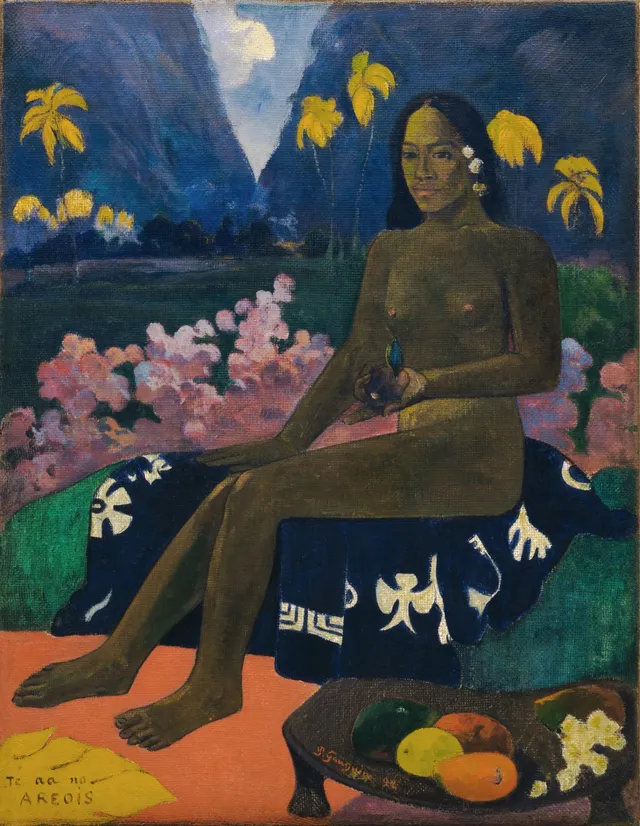
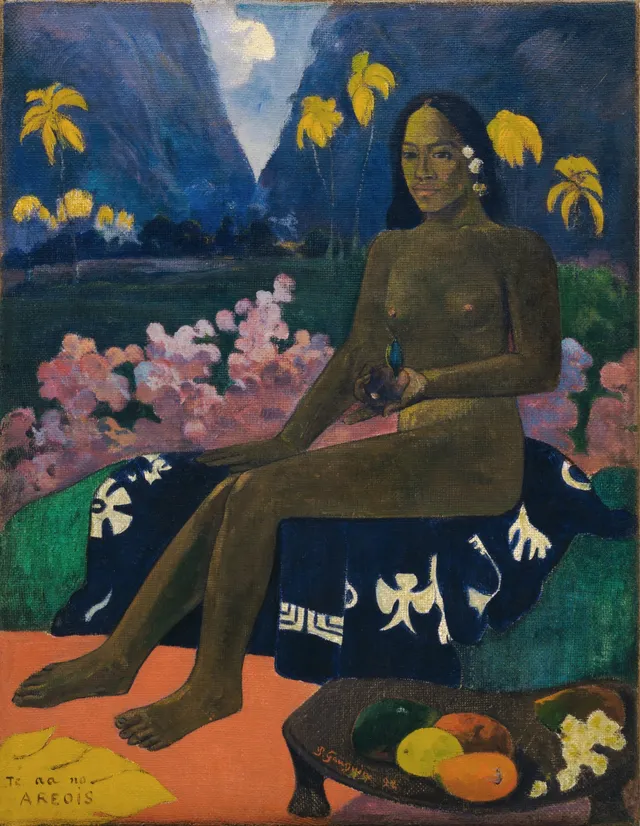
Paul Gauguin is the pivotal early figure. Abandoning Paris first for Brittany and then, in 1891, for Tahiti, he produced flatly patterned, symbolist canvases of Polynesian life such as The Seed of the Areoi (1892) and Where Do We Come From? What Are We? Where Are We Going? (1897–98). His Tahitian work and the carved statue Oviri, shown in Paris in 1906, shaped the next generation. Pablo Picasso's Les Demoiselles d'Avignon (1907), with its angular, mask-derived faces drawn from African and Iberian sculpture, marks the movement's most consequential moment, opening directly onto Cubism. Henri Rousseau, the self-taught "Douanier," embodied the parallel strain of Naïve art, his jungle visions like The Dream (1910) admired by Kandinsky and Franz Marc.
Primitivism fed Fauvism, German Expressionism (Die Brücke), and Cubism, and its echoes persist in the carved sculpture of Henry Moore and, much later, the raw figuration of Jean-Michel Basquiat. Its legacy is double-edged: it expanded modern art's formal vocabulary while flattening the cultures it borrowed from, a tension crystallized — and contested — by MoMA's landmark 1984 exhibition "'Primitivism' in 20th Century Art."
Key artists

Works
Frequently asked questions
What is Primitivism?
Primitivism is an art movement. The term used by Western modern art for the influence of non-Western, prehistoric, or folk traditions on avant-garde artists.
Who are the key Primitivism artists?
Key Primitivism artists in the collection include Paul Gauguin, Henri Rousseau and Henry Moore.
When did Primitivism take place?
Primitivism dates from 1890–1940.
Where can I see Primitivism works?
Primitivism works in the collection are held by Museum of Modern Art.