Look at enough paintings by Caravaggio and you stop seeing a parade of saints and card sharps and severed heads. You start to see one question asked over and over, in slightly different light, by a man who refused to let it go. The question is not religious, though most of his commissions were. It is physical. What does a human body actually do in the half-second when something irreversible reaches it? When a finger points and a tax collector understands he must rise and leave his money on the table. When a sword has just finished its work and the head it removed is still warm. Michelangelo Merisi, born in 1571 and dead at thirty-eight in 1610, spent his whole short career rephrasing that single sentence and answering it again, never quite the same way twice.
Here is the thesis this essay will defend, work by work: Caravaggio's pictures are not a sequence of subjects but a sequence of answers to that one question, and the answers darken in step with his life. The early ones answer with seduction and a kind of held breath. The middle ones, painted at the height of his Roman fame, answer with the shock of recognition, ordinary faces caught at the instant of grace. The late ones, made on the run after he killed a man and fled Rome, answer with exhaustion and self-accusation. Read this way, the famous lighting is not a style he applied. It is the instrument he built to isolate the decisive moment and force us to watch it. The dark is there to delete everything that is not the answer.
The question, stated plainly
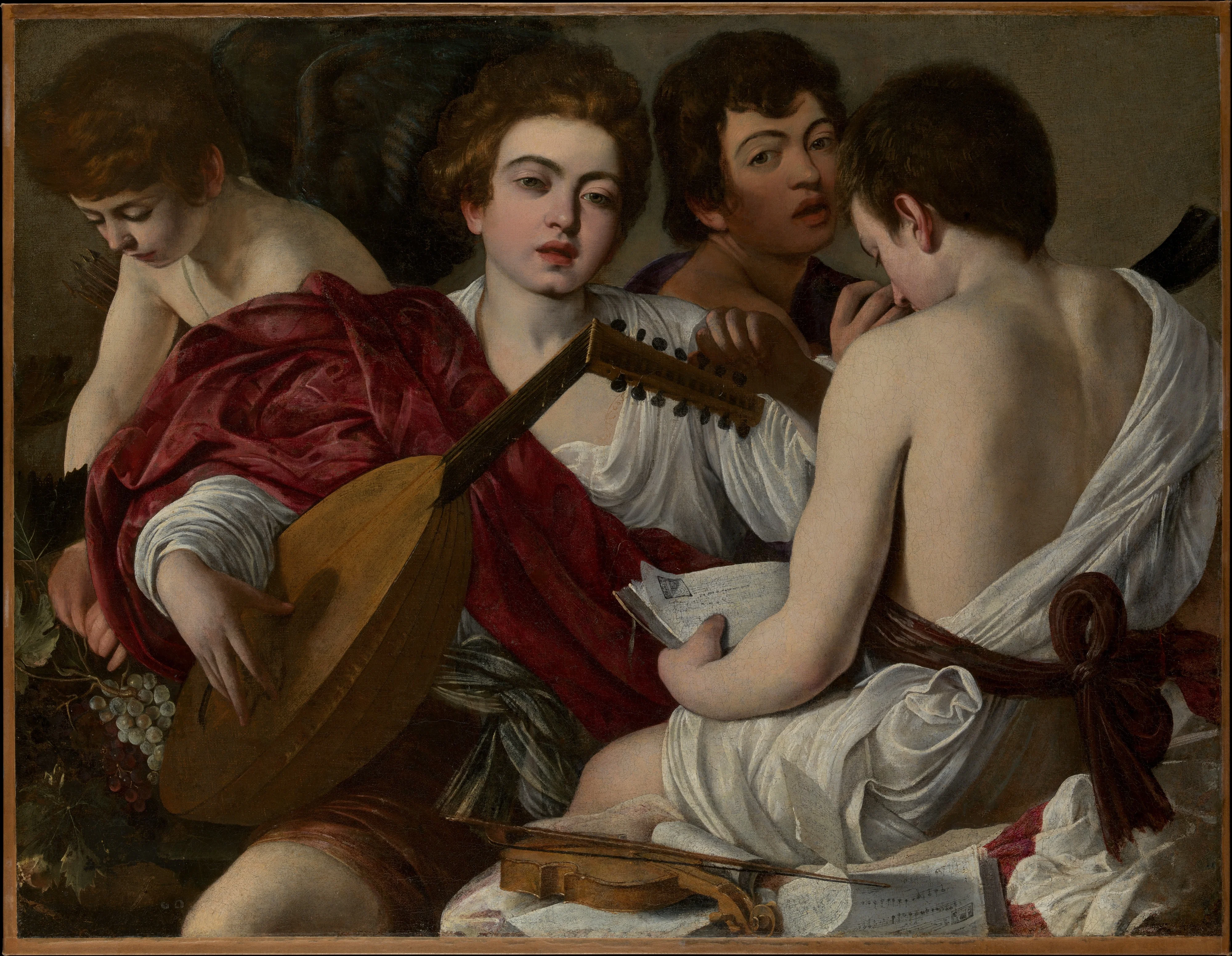
Start before the violence, with one of the earliest works our archive holds. The Musicians crowds four young men into a space too shallow to hold them. There is barely any room behind the front plane, so the figures press toward us, shoulder against shoulder, as if the canvas had been packed rather than composed. The boy in the foreground sits in profile, tuning a lute. Its rounded belly turns outward and catches the light along a single curved edge, the brightest thing in the picture after the bare skin. Sheet music lies open near his hands. A second youth, half-turned, lifts his face directly toward the viewer, and his eyes are wet, glassy, faintly red at the rims, as though he had been crying or is about to. At the left a winged figure reaches among grapes and vine leaves. The drapery is loose and slipping. Nothing is idealized into smoothness; you can read the weight of a real arm, the slight slump of a real spine.
What is the moment here? It is the pause before the music, instruments not yet sounded, the boy still tuning. Caravaggio has already found his subject, which is anticipation rendered as a physical fact: a body arranged at the edge of an action it has not yet taken. The melancholy in those wet eyes is the first version of an emotion he will keep returning to, the sense that the instant about to arrive carries a cost. He is not painting a concert. He is painting the second before one.
Our own holdings let me put a number to how persistently he worked this seam. Artifact World Gallery gathers thirty-seven works under his name, spread across nineteen separate venues, dated from roughly 1596 to 1610. That is nearly the whole arc of a career compressed into a generation of canvases, and it is scattered, no single room owning the story. Compare that with the densest physical concentration anywhere: the J. Paul Getty Museum notes that the Galleria Borghese in Rome holds six Caravaggios, the largest gathering of his work in one collection (Getty). Six in one room is the record. To follow the question across its several answers, you have to travel, and a digital gallery is one of the few places the scattered evidence can sit side by side.
Works discussed in this article
First answer: grace as a physical event
The work that made him public answered the question at full volume. In 1600 his two large canvases for the Contarelli Chapel in San Luigi dei Francesi were set in place, and the Roman art world saw the Calling of Saint Matthew and the Martyrdom of Saint Matthew for the first time (The Met). The Calling is the cleanest statement of the whole career. A shaft of light enters from the right and lands on a table of men counting coins. Christ's hand extends, and Matthew, half in shadow, gestures back as if to say, who, me. Caravaggio painted the scene as a contemporary event, the men in the dress of his own day, the room a plain interior, the figures studied from ordinary models posed in the studio rather than corrected toward an ideal (Smarthistory). The miracle is not a glow around a halo. It is the way a man's hand stops mid-count.
That decision, to let grace arrive as a bodily interruption, runs straight through the religious pictures in our archive. The Denial of Saint Peter is the question stripped to three heads and six hands. A servant girl points, a soldier points, and Peter raises both his hands toward his own chest, fingers spread, in the universal gesture of a man saying not me, you have the wrong person. The light catches the forehead and the knuckles and abandons the rest. There is no architecture to speak of, no crowd, no city. Caravaggio has cut everything that is not the lie and the instant of telling it. The painting holds the exact moment the cock is about to crow, and Peter does not yet know what he has just done. Anticipation again, the same nerve struck in The Musicians, now carrying a man's soul instead of a tune.
How his own century read him
We are unusually well informed about how Caravaggio struck the people who knew his work, because three writers set down his life within living memory of it. The earliest accounts come from Giulio Mancini, Giovanni Baglione, and Giovanni Pietro Bellori, biographers whose dates bracket the seventeenth century and whose verdicts still shape every modern reading (Internet Archive). They did not agree. To some, working directly from a posed model in a darkened room was a betrayal of everything Renaissance theory had built, the careful improvement of nature toward an ideal. To others it was the most thrilling thing painting had done in a generation. The Getty puts the split plainly: his bold, naturalistic manner, which insisted on the common humanity of his figures, was at once highly admired and highly controversial among his contemporaries.
That controversy is the second clue to why one question yields several answers. Caravaggio kept revising because his approach kept getting rejected. Altarpieces were refused for showing a saint with dirty feet or a Virgin who looked like a real, tired woman. Each refusal pressed him to answer again, and the answers grew more severe rather than more accommodating. He never softened toward the ideal. He doubled down on the body. You can feel the lineage of that decision in every later painter who built a scene from a single hard light, the whole Baroque century of candlelit interiors and raking shadow descending from a few square metres of Roman chapel wall.
Rome to the road: the answer darkens
The Met's account of his movements reads like a fugitive's itinerary. Active in Rome from 1592 to 1606, then Naples in 1606 and 1607, Malta in 1607 and 1608, Sicily in 1608 and 1609, and Naples again before the end. He painted from posed models the whole way, holding to the method that broke with the idealizing premise of Renaissance theory even as his circumstances collapsed. The biographical fact behind the travel is brutal. He left Rome a wanted man, having killed someone in a brawl, and the paintings he made afterward carry that weight. The question stops being abstract. The decisive instant he keeps depicting becomes, more and more, the instant of suffering and death.
Our archive holds the evidence of that turn. The Crucifixion of Saint Andrew, a work tied to his Naples years, refuses the obvious drama. By legend, Andrew preached from his cross for days and forbade his rescuers to take him down, and Caravaggio paints the failed rescue, an old man's body slack on the timber, a workman frozen on a ladder, his arms going nowhere. The light finds the saint's pale torso and the upturned faces below and lets the rest go to brown dark. Nothing is heroic. The miracle, such as it is, is that the man simply stops. The Holy Family with Saint John the Baptist offers the rare quiet answer from these years, tenderness staged in the same unforgiving light, the same real bodies.
Even at the height of his Roman success the violence was already there, handled with chilling control. In 1602 he painted The Taking of Christ, the night arrest in the garden, lit so that a soldier's polished armour throws back the only cold gleam in the scene (National Gallery of Art). Judas has just landed the kiss. Christ's hands are laced and lowered in the posture of a man who has decided not to resist. The picture freezes the half-second after betrayal and before capture, the same hinge Caravaggio kept returning to, now turned toward his own dread. The hand on the shoulder is the question. The lowered eyes are the answer.
The same subject, revisited
Nowhere is the one-question, several-answers logic more literal than in his David and Goliath. He returned to this single biblical episode more than once, and our archive holds two of those returns side by side. David and Goliath gives the more active reading, the young shepherd at his work over the fallen giant. Then there is David with the Head of Goliath, and this is where the revisiting becomes confession.
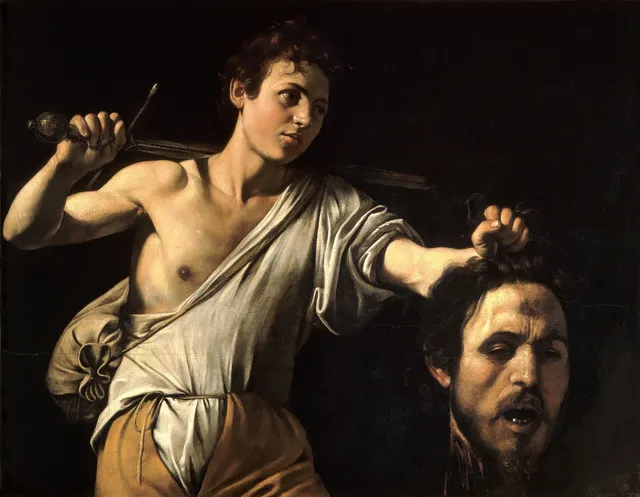
Look closely. David holds the severed head out toward us at arm's length, and the boy is not exultant. His brow is furrowed, his mouth set, his gaze cast down at the thing in his hand with something closer to pity than to pride. The sword hangs slack. The light rakes across David's bare chest and shoulder, slides down the extended arm, and stops on the giant's face, which is the most finished, most alive part of the whole canvas. The mouth is open, the eyes half-rolled, the brow still gathered as if the head had not yet learned it was dead. Caravaggio paints the head with more tenderness than the victor. Long tradition, and the look of other self-portraits, hold that the dying face is the painter's own. Whether or not you accept the identification, the picture stages a man handing over his own ruined head to be judged, and refusing himself the satisfaction of the kill. The decisive instant here is not the blow. It is the aftermath, the moment the winner realizes what winning costs.
Set the two Davids against The Musicians and the trajectory is complete. The early picture answered the question with the sweetness of a body about to make music. The last answers it with a body holding the evidence of a killing and looking away from it. Same compression, same single light, same refusal of the surrounding world. What changed was the man holding the brush, who began by painting anticipation as pleasure and ended by painting it as guilt.
Why the question still works
Caravaggio left no school in the formal sense and few students who learned directly at his side. His earliest training was elsewhere; before Rome he worked in Milan in the orbit of a Lombard master, Simone Peterzano, whose two works our archive also keeps. What spread was not a workshop lineage but the method, the single hard light and the ordinary model, picked up across Italy and the Spanish and Dutch north by painters who never met him. The whole later Baroque taste for candlelit drama begins in his refusal to flatter. He gave the seventeenth century permission to put a real face on a saint.
That is the information our scattered thirty-seven offer that a single famous room cannot. Six together at the Borghese give you concentration. Nineteen venues across fifteen years give you the argument, the chance to lay the tuning boy beside the dying giant and watch one mind work the same nerve from opposite ends of a life. Browse the holdings in sequence and the lighting reads less like a signature than like a confession method, a way of putting one body in the dark and turning a lamp on it until it has nowhere left to hide. Start with The Denial of Saint Peter, then go to David with the Head of Goliath, and watch a man rehearse his own reckoning twice, once as a lie and once as a head in his hand.
He died in 1610 on a beach, still trying to get back to Rome and a pardon that may already have been granted. The career we can reconstruct from these canvases is barely twenty years long. In that time he asked his one question so insistently, and answered it with such physical conviction, that four hundred years later we still walk into a dark room, find the single lit body, and feel the half-second close around us. The work of Caravaggio is best understood not as a gallery of subjects but as one sentence, written again and again, getting truer and harder to bear each time he set it down.
Sources & further reading
- Caravaggio (Michelangelo Merisi) (1571-1610) and His Followers — The Metropolitan Museum of Art, Heilbrunn Timeline (Keith Christiansen)
- Caravaggio, Calling of Saint Matthew — Smarthistory
- Caravaggio's Taking of Christ — National Gallery of Art
- Caravaggio — The J. Paul Getty Museum
- Caravaggio — Wikipedia
- Chiaroscuro (art term) — Tate
- Lives of Caravaggio (Mancini, Baglione, Bellori) — Internet Archive / Pallas Athene