Artwork
The Musicians
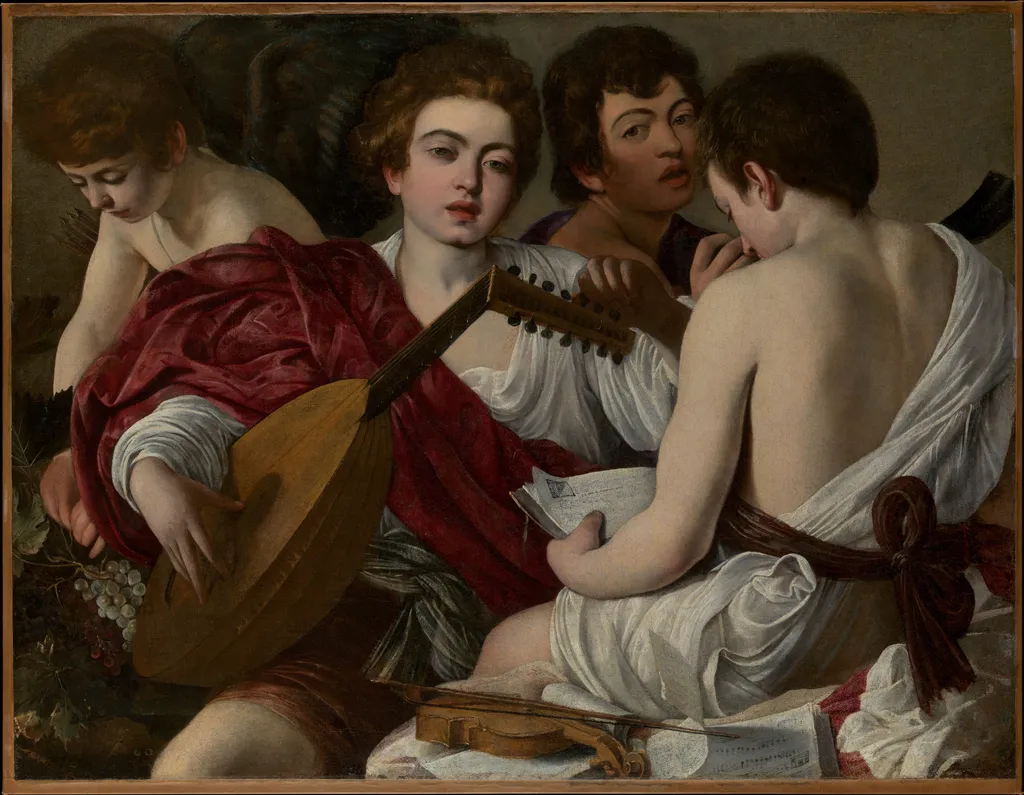
The Musicians is an oil painting by the Baroque artist Caravaggio. It dates from 1598 and is held in the collection of the Metropolitan Museum of Art.
About this work
A lutenist gazes out with tearful eyes while three companions and a winged Cupid gather around scattered sheet music in a Roman rehearsal room.
A lutenist gazes out with tearful eyes while three companions and a winged Cupid gather around scattered sheet music in a Roman rehearsal room. Caravaggio painted it around 1598, the first work he made for Cardinal Francesco Maria del Monte, his earliest major patron. A violin lies in the foreground as if waiting for a fifth player, and the boy with the cornett is thought to be Caravaggio himself.
Subject & Meaning
The painting depicts four youths in classical attire: three musicians (a lutenist, a cornettist, and a singer) and a winged Cupid reaching for a bunch of grapes. This composition presents an allegory linking music to the sustenance of love, analogous to food sustaining life. The madrigals they perform celebrate love, yet the lutenist's moist eyes suggest the sorrow of love.
Cupid, distracted by the grapes, may indicate love's need for nourishment. The violin in the foreground implies a fifth participant, drawing the viewer into the scene. The work carries an erotic, homoerotic atmosphere typical of Caravaggio's early paintings.
The cornettist is a self-portrait, and the lutenist is likely Mario Minniti. Overall, the painting intertwines music, love, and Bacchic pleasure in a complex allegory.
Technique & Style
Executed in oil on canvas, The Musicians (c. 1595) employs Caravaggio's signature technique of painting directly from live models without preparatory sketches, a method that lends the figures a striking naturalism. The support, a canvas originally larger, has been cut approximately five centimeters on the left and slightly at the top and bottom, and the painting underwent extensive restoration in 1983 after periods of neglect that damaged the musical notation in the manuscript. The composition is notably complex for Caravaggio's early career, crowding four half-length figures into a shallow space with a relaxed front-to-back arrangement that emphasizes intimacy.
Stylistically, the work displays the Baroque master's emerging chiaroscuro, with faces flushed and details such as dirt under fingernails rendered with unidealized precision. The surface shows signs of past overpaint, particularly the wings and quiver of Cupid, which were erroneously removed during earlier restorations.
History & Provenance
The painting was commissioned by Cardinal Francesco Maria del Monte, likely in 1595 shortly after Caravaggio entered his household, and is considered one of the artist's first works for the patron. It hung in del Monte's Palazzo Madama. After the cardinal's death, the work was sold on May 8, 1628; by 1638 it was inventoried as belonging to Cardinal Richelieu, then passed to the Duchesse d'Aiguillon until 1657.
The painting then disappeared from records until it re-emerged at a Christie's sale in London in 1894. It was rediscovered in 1947 with an English collector and identified by David Carritt. Its attribution was debated but reconfirmed by Denis Mahon in 1952, after which the Metropolitan Museum of Art acquired it that same year through the Rogers Fund. The work has been in the Met's collection since 1952 and underwent major restoration in 1983.
Context
The Musicians, Caravaggio's first commission for Cardinal Francesco Maria del Monte, marks a pivotal early work in his career. Scholarly attention has focused on del Monte's significant role as patron and the painting's place within a series of musical works for his camerino. Attribution was debated after its 1947 rediscovery by David Carritt, with Roberto Longhi and Ferdinando Bologna initially rejecting it before Denis Mahon's 1952 confirmation achieved consensus.
Restorations have been contentious: the removal of Cupid's wings and quiver prior to the Met's acquisition was later deemed a mistake, and damage to the music manuscript has been noted, though Andrew Graham-Dixon affirms the work's undimmed originality. Critics have highlighted the painting's ambiguous eroticism, typical of Caravaggio's early output, and its innovative interior setting, breaking from the pastoral tradition of Giorgione and Titian. It also inaugurated Caravaggio's practice of inserting self-portraits into his compositions.
Overview
Painted around 1595, The Musicians is an oil painting by the Italian Baroque artist Michelangelo Merisi da Caravaggio. This early work depicts a gathering of young men engaged in a musical performance, accompanied by a winged figure. It was created for Cardinal Francesco Maria del Monte, a significant early patron of the artist, and represents one of Caravaggio's more intricate compositions from this period, featuring multiple figures likely rendered from live models.
Own this work as a print
Artist & collection
Artist
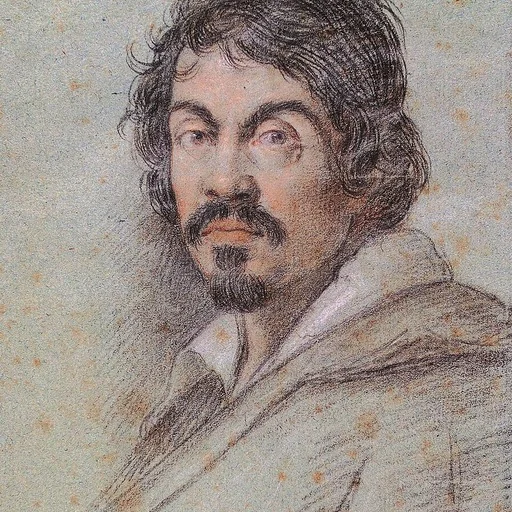
Michelangelo Merisi da Caravaggio (also Michele Angelo Merigi or Amerighi da Caravaggio; 29 September 1571 – 18 July 1610), known mononymously as Caravaggio, was an Italian painter active in Rome for most of his artistic life.

 Compared in the Caravaggio & Baroque course