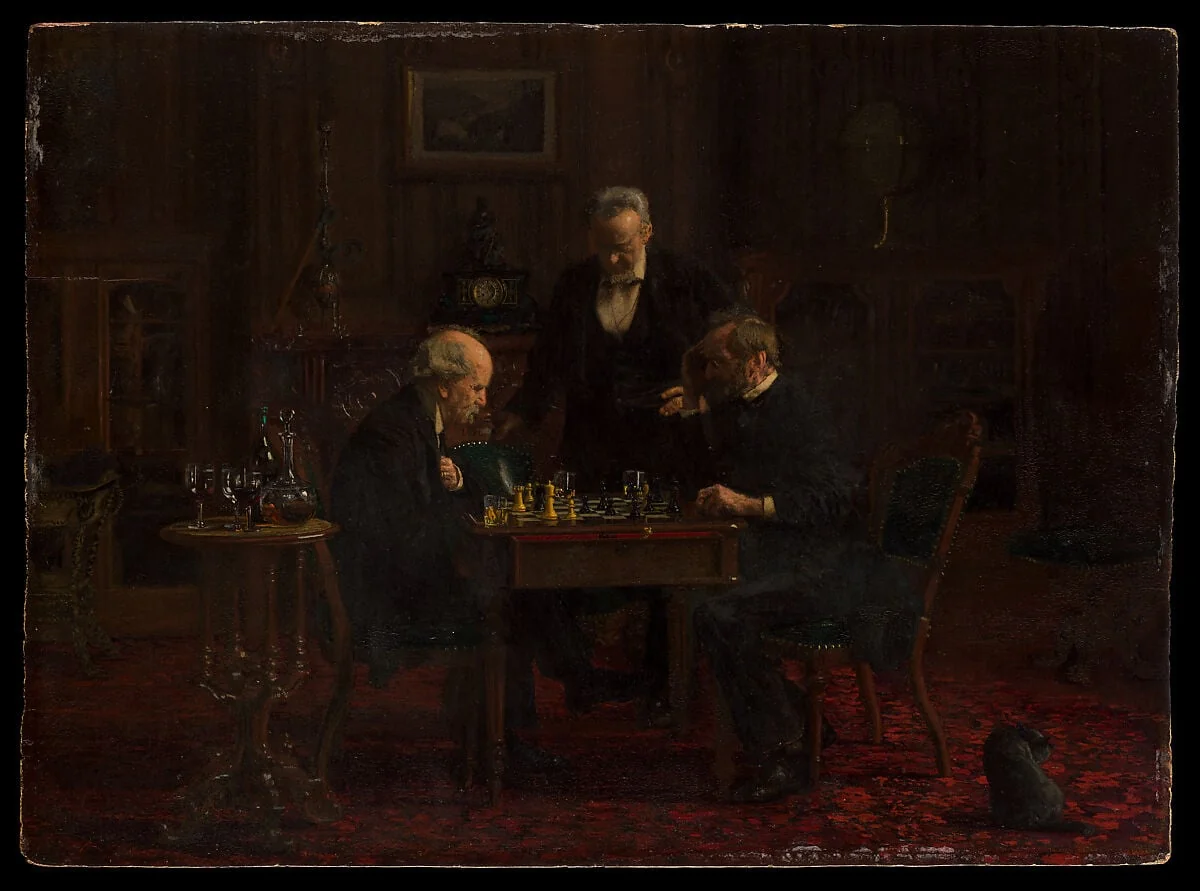
To stand in front of a Thomas Eakins painting is to be put to work. Where his French teachers wanted the eye to glide and his Impressionist contemporaries wanted it to shimmer, Eakins wanted it to measure. He built a picture the way a draftsman builds a proof in descriptive geometry: every plane located, every recession earned, every reflection traced back to a light source he could have pointed to in the room. The argument here is plain, and I think it deserves defending against the textbook label of "American realist," which softens him into a man who copied what he saw. Eakins did not copy. He reconstructed, and the reconstruction is the whole point.
The claim of this essay is that you can read the entire artist from one small panel, and that the panel to read is The Chess Players. Choose the right work and the method announces itself without commentary: the constructed perspective, the forensic light, a psychology that arrives through posture and proximity rather than through any arranged expression. The subjects shift across forty years. Rowers, surgeons, a cathedral organist, his own wife, a man lost in thought. The procedure does not shift. Understand how the chessboard sits in space on that panel and you hold the key to how Max Schmitt's scull sits on the Schuylkill and how a surgeon's bloodied hand sits in the hard light of an operating theater.
Paris, and the habit of measurement
Eakins was born in Philadelphia on 25 July 1844 and died there on 25 June 1916, two days short of seventy-two, having spent almost the whole of that life inside a few square miles of one city (Wikipedia). The exception was formative. From 1866 to 1870 he studied in Europe, most consequentially under Jean-Léon Gérôme at the École des Beaux-Arts, with further work in Madrid and Seville where the Spanish painters taught him what dark, weighted flesh could do. Gérôme gave him the academic scaffolding: the careful contour, the legible setup, the belief that a picture should be planned before it is felt. Eakins kept the scaffolding and threw out the costume drama. He also passed briefly through the orbit of Léon Bonnat, another portraitist of dense, sculptural surfaces, and you can feel that lesson in the way an Eakins head sits forward out of its shadow like a thing you could weigh.
He came home to Philadelphia in 1870 and never really left the methods of the studio behind. He took up perspective the way other painters take up a sketchbook, working out the geometry of a rowing shell or a chess table on gridded paper before a brush touched canvas. This is the unfashionable Eakins, the one who turned art into homework. It is also the source of his strangeness. A perfectly measured room, lit by a single lamp and rendered without a trace of atmospheric softening, does not look natural. It looks more real than real, scrubbed of the haze the eye actually supplies. That over-clarity is his signature, and it is why his quietest interiors carry a faint charge of unease.
Close looking: The Chess Players
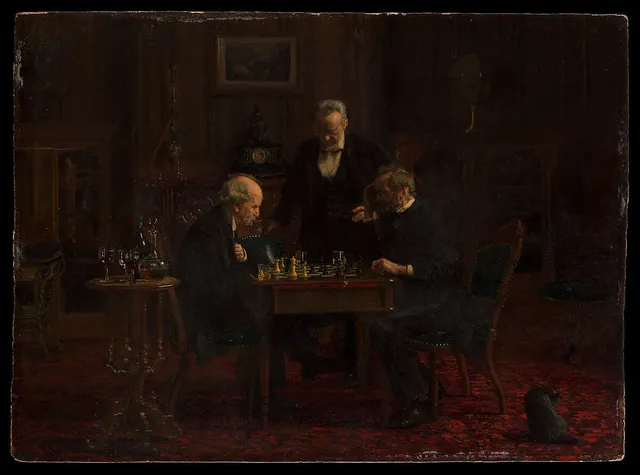
Look at the table first. Eakins tilts its top toward us, so the chessboard reads almost as a flat diagram laid against the picture plane, and yet the legs and the carved apron insist, plane by plane, on the depth he has supposedly given away. The whole composition pivots on that contradiction. Two older men face each other across the board, the player on the left leaning in with a hand lifted over his pieces, weighing a move he has not yet committed to. The light is warm and local, a lamp somewhere just out of frame pulling their faces and hands forward out of a brown interior that holds books, a carved chair, the dull gleam of furniture. Nothing is incidental. The rug under the table, the spines on the shelf, the small bright squares of the board are all set down with the same unhurried, equalizing attention, as if the painter refused to decide what mattered most until he had described all of it.
Between and slightly above the two seated men, a third figure leans on the table and watches. He is the still center, the apex of a quiet triangle whose base is the board, and he is the artist's father, Benjamin Eakins, who returns as the sitter of The Writing Master six years later. Here is the Eakins psychology in miniature. No one performs. The drama is entirely a matter of attention: three men bent toward sixty-four squares, the youngest of them present only as a watcher. Eakins is painting the act of looking, which is the act he trusted above all others, and he has built the room with such steady perspective that we are made to watch the watchers with the same patience they bring to the game.
What you will not find on the panel is flattery, mood-lighting, or the soft edge that lets a sitter dissolve into charm. Everything is held in focus, and that refusal is a position, not a limitation. A Gérôme would have polished the scene into an anecdote. Eakins lets it stay a fact. The picture is small, the size of a book cover, and it carries the entire argument of his career: build the space honestly, light it from a real source, and let character emerge from how a person occupies that space rather than from any pose you have asked them to strike.
What the archive shows
Artifact World Gallery holds sixty-three works by Eakins, spread across twelve venues and spanning roughly 1869 to 1910, the full arc from his first Philadelphia pictures to the late, darkening portraits. That spread is itself informative. The National Gallery of Art reckons he completed about 250 finished portraits, among them thirty-six full-length figures painted between 1870 and 1909 (National Gallery of Art). Set our sixty-three holdings against that lifetime total and a pattern emerges: the works that survived in public collections, and that recur in venue after venue, cluster around the same procedural concerns. Rowing and sport, the surgical amphitheater, the seated portrait of a thinker who is doing nothing but think. The archive is not a random scatter of an artist's output. It is a record of which problems he kept returning to, and a dozen separate institutions independently decided those were the works worth keeping.
The river, the scull, the system
If The Chess Players is the method in a closed room, The Champion Single Sculls is the same method let out into daylight. Eakins painted it soon after returning to his native Philadelphia from study in Paris, Madrid, and Seville, and it is in many ways the picture that launched him (Smarthistory). His friend Max Schmitt rests at the oars in the foreground, his shell cutting a long horizontal across glassy water, while Eakins paints himself into the middle distance in a second scull, rowing away, a small signature of presence. The bridges crossing the Schuylkill are rendered with the precision of an engineering drawing, their arches reflected in water that does not shimmer so much as hold still to be measured. The autumn light is cool, even, and merciless about distance.
This is where the perspective homework pays off. The recession of the river, the placement of every bridge pier, the exact foreshortening of the boat all sit in a space you could survey. A French academic would have staged a hero. Eakins instead gives us a quiet man at rest in a structure of pure geometry, and the heroism is transferred from the figure to the construction itself. The scull is a machine for moving cleanly through resistance, and the painting is a machine for moving the eye cleanly through depth. The two are the same idea.
Portraits without flattery
Eakins is, in the end, one of the great portraitists, and the strangest thing about his portraits is how few of them were commissioned and how many were refused or quietly disliked by their sitters. He told the truth about faces, and the truth is rarely a gift. The Thinker: Portrait of Louis N. Kenton is the extreme case. A man stands full-length against a bare ground, hands sunk in his pockets, head down, isolated in a field of nothing. There is no furniture, no attribute, no setting to explain him. The whole portrait is weight and gravity and the slope of a shoulder. It is one of the most austere images in nineteenth-century American painting, and it works precisely because Eakins withholds everything except the man's interior pressure.
Compare that severity with the tenderness, never sentimental, of The Artist's Wife and His Setter Dog, where Susan Macdowell Eakins sits in a studio interior with the dog at her feet, the light falling across her face with the same even honesty Eakins gave a surgeon or a stranger. He does not prettify her. He grants her the dignity of being seen exactly. The same is true of Mrs. Mary Arthur, and of The Writing Master, that grave portrait of his father bent over a sheet, pen in hand, every knuckle and every reflection on the inkwell set down with a calm that borders on reverence. The hands in The Writing Master are doing what Eakins's own hands did: making precise marks on a surface, slowly, in good light.
The clinics
The two pictures that pushed Eakins's empiricism to its limit are the great surgical portraits, painted fourteen years apart. He completed The Gross Clinic in 1875, showing the surgeon Dr. Samuel David Gross presiding over an operation in a teaching amphitheater, and the canvas provoked open controversy when it appeared around the 1876 Philadelphia Centennial Exposition (The Metropolitan Museum of Art). Viewers recoiled from the bright smear of blood on the surgeon's fingers and scalpel. Eakins had treated a modern operation with the gravity older painters reserved for martyrdoms, and he had refused to look away from the wound. The Agnew Clinic of 1889 is its companion, the same drama staged a second time in a colder, whiter light, the two works together forming a fourteen-year meditation on science as a public, heroic act (Smarthistory). These are not anatomy lessons dressed up as portraits. They are arguments that the surgeon's clear-eyed looking and the painter's are species of the same virtue.
The cost of looking
That faith in unobstructed looking eventually cost him his standing. Eakins taught at the Pennsylvania Academy of the Fine Arts and built its curriculum around the living body, dissection, and the nude as a matter of fact rather than scandal. In 1886 he was forced to resign after he removed the loincloth from a male model in a class where female students were present (Wikipedia). The episode reads now as a collision between a painter who could not separate honesty from instruction and a city that wanted its propriety left intact. His reputation never fully recovered in his lifetime, and the late portraits grow noticeably darker and lonelier, as though the man who insisted on seeing everything had been asked to stop.
The same drive sent him to the camera. Eakins made photographic motion studies of the human and animal body, freezing the phases of movement that the unaided eye runs together, work preserved today in lantern slides such as the Getty's Study of Muscular Action: Young Man Leaning on a Horse's Leg (The J. Paul Getty Museum). He was not chasing novelty. He wanted data. A muscle under load, a stride caught mid-cycle, the real geometry of a body in motion, all of it feeding back into the painter's lifelong project of building figures that obey the laws of the actual world. The camera was simply a more patient eye.
After Eakins
His influence ran through teaching as much as through painting. Thomas Anshutz, his student and eventual successor at the Academy, carried the gospel of anatomy and honest observation forward to the next generation, and through that line it reached George Bellows and the urban realists who painted prizefighters and tenements with the same refusal to look away. Set Eakins beside his great contemporaries and the difference sharpens. John Singer Sargent could make a brushstroke do the work of a sentence, and his sitters glow with a worldly fluency Eakins never wanted. Mary Cassatt absorbed the Impressionist dissolve and made it her own. Eakins stood apart from both, the painter who distrusted fluency and dissolve alike, who would rather a picture be slow and true than quick and charming.
The recovery of his reputation is largely a twentieth-century story. Lloyd Goodrich's Thomas Eakins, His Life and Work, the first major scholarly monograph on the artist, was published in 1933 by the Whitney Museum of American Art and established the serious case for him as the central figure of American realism (Internet Archive). What Goodrich saw, and what a viewer can still verify in front of any one of these works, is consistency. The painter who tilted the chessboard toward us in 1876 is the same painter who stripped Louis Kenton down to sheer interior weight decades later. Return to that small panel and the whole career is legible in it. The table that will not quite lie flat, the lamp doing real work, the watcher who is the artist's own father, the three men giving sixty-four squares the attention most painters save for a king. Eakins asked the eye to do its job. He never once let it off easy.
Works discussed in this article
Sources & further reading
- Thomas Eakins — Wikipedia
- Thomas Eakins (1844-1916): Painting — The Metropolitan Museum of Art
- Eakins, The Champion Single Sculls (Max Schmitt in a Single Scull) — Smarthistory
- Eakins, The Gross Clinic — Smarthistory
- Thomas Eakins — National Gallery of Art
- Study of Muscular Action: Young Man Leaning on a Horse's Leg — The J. Paul Getty Museum
- Thomas Eakins, His Life and Work (Lloyd Goodrich, 1933) — Internet Archive