A procedure, not a picture
Most genres name a thing you can point at. A portrait has a sitter, a landscape has land, a still life has the apples on the cloth. Allegory names a procedure instead. Its real subject is meaning itself, and the painting is the machine built to deliver that meaning to a viewer who may never read the patron's books. My claim across this essay is plain, and I think under-argued: allegory has no native style, only a native method. What survey histories file as a movement is closer to a manufacturing process, a way of assembling a picture out of borrowed signs so that a woman holding a set of scales reads, in the first second, as Justice.
That method is older than any of the schools that practiced it and outlasted all of them. Its materials were a fixed kit: the personified figure, the attribute she carries, the gesture she makes, and the staging that tells you which figure outranks which. The craft was in making the assembly feel inevitable rather than like a rebus you have to decode. Tate's glossary states the definition cleanly: allegory is when the subject of a work, or the elements that compose it, stands for a deeper moral or spiritual meaning, life, death, love, virtue, justice. That is a description of an output. This essay is about the factory that produced it, the bench it was built on, and the manual that sat open beside the easel.
The kit is the genre
Start with the kit, because the kit is the genre. Every allegory begins from one engineering problem: how do you paint something that has no body? Justice, Peace, War, September, the Catholic faith. None of these has a face. The solution the European workshops settled on, and reused for roughly four centuries, was personification plus attribute. You give the abstraction a human form, usually a woman, partly because most Latin and Greek abstract nouns are grammatically feminine, and then you load that form with objects whose meaning is already fixed by convention. Scales and a sword build Justice. A blindfold qualifies her. The figure is the noun, the attribute is the adjective, and a literate viewer parses the sentence without being told he is reading.
The word itself carries the instruction. It entered English in 1382, by way of Latin from the Greek allegoría, which means, almost too neatly, "speaking about something else" (etymology via Wikipedia). To make an allegory is to say one thing on the surface so that a second thing is understood underneath. The painter's version of that double speech is mechanical. He paints a recognizable body and a recognizable object, and the gap between them, the fact that a woman is not literally Peace, is exactly where the meaning lives.
The Rijksmuseum's Allegory of the Treaty of Ryswick shows the procedure at its barest. Peace is seated as a woman holding an olive branch in one hand and a horn of plenty in the other, the horn glossed by the museum's own catalogue on the logic that peace brings abundance, while a soldier who stands for War turns and flees out of the frame (Rijksmuseum object record). Nothing in that picture is invented. Every element is drawn from stock and slotted into place, and the painter's labor is the slotting, not the inventing.
The manual on the bench
The stock had a catalogue, and this is the part most accounts of allegory leave out. Personifications were not improvised. They were specified in print. Cesare Ripa's emblem manual, the Iconologia, first issued at the close of the sixteenth century and reprinted in translation across Europe for two hundred years, was the reference book a workshop kept within reach. An illustrated English edition appeared in London in the early eighteenth century under the engraver Pierce Tempest's hands, titled Iconologia, or, Moral Emblems. Open it and you find entry after entry of the form "how to paint Hope, how to paint Envy, how to paint Autumn," each a recipe: this gender, this age, this color of robe, these objects in the hands, this animal at the feet. It is a parts list. The genre's material reality is a desk reference more than a flash of vision.
The proof of the manual's reach is the calendar. When Joachim von Sandrart painted his Personification of September around 1644, now in the Getty, he was not dreaming up a way to depict a month. He was executing a brief one of a set of figures for the twelve months, each assigned its fixed attributes of harvest and zodiac. The same impulse runs through this archive's holdings: figures of the seasons, the senses, the virtues, the continents, the times of day, each a known assignment with a known answer key. A painter who could not draw a convincing Charity from memory could look her up.
Staging: the second tool
The kit supplies the nouns. Staging supplies the grammar. Once you have your personified figures and their attributes, you still have to arrange them so the viewer knows who is acting on whom, who has won, who has fallen. This is where composition does ideological work. A figure placed high and lit from a clear source dominates one pressed low and into shadow. A flight out of the frame, as with the fleeing soldier of War, encodes defeat without a caption. A trampled body under a virtuous foot is the oldest device of all, victory by gravity. The allegorical painter is a stage manager before he is a colorist. Blocking the figures correctly is half the message.
- Personify: give the abstraction a body, usually gendered by the grammar of its Latin name.
- Attribute: hang the fixed objects, scales, olive branch, hourglass, on or beside that body.
- Stage: rank the figures by height, light, and direction of movement so the moral reads at a glance.
- Naturalize: render the whole assembly in convincing paint so the machinery disappears into a scene.
Vermeer, caught assembling the machine
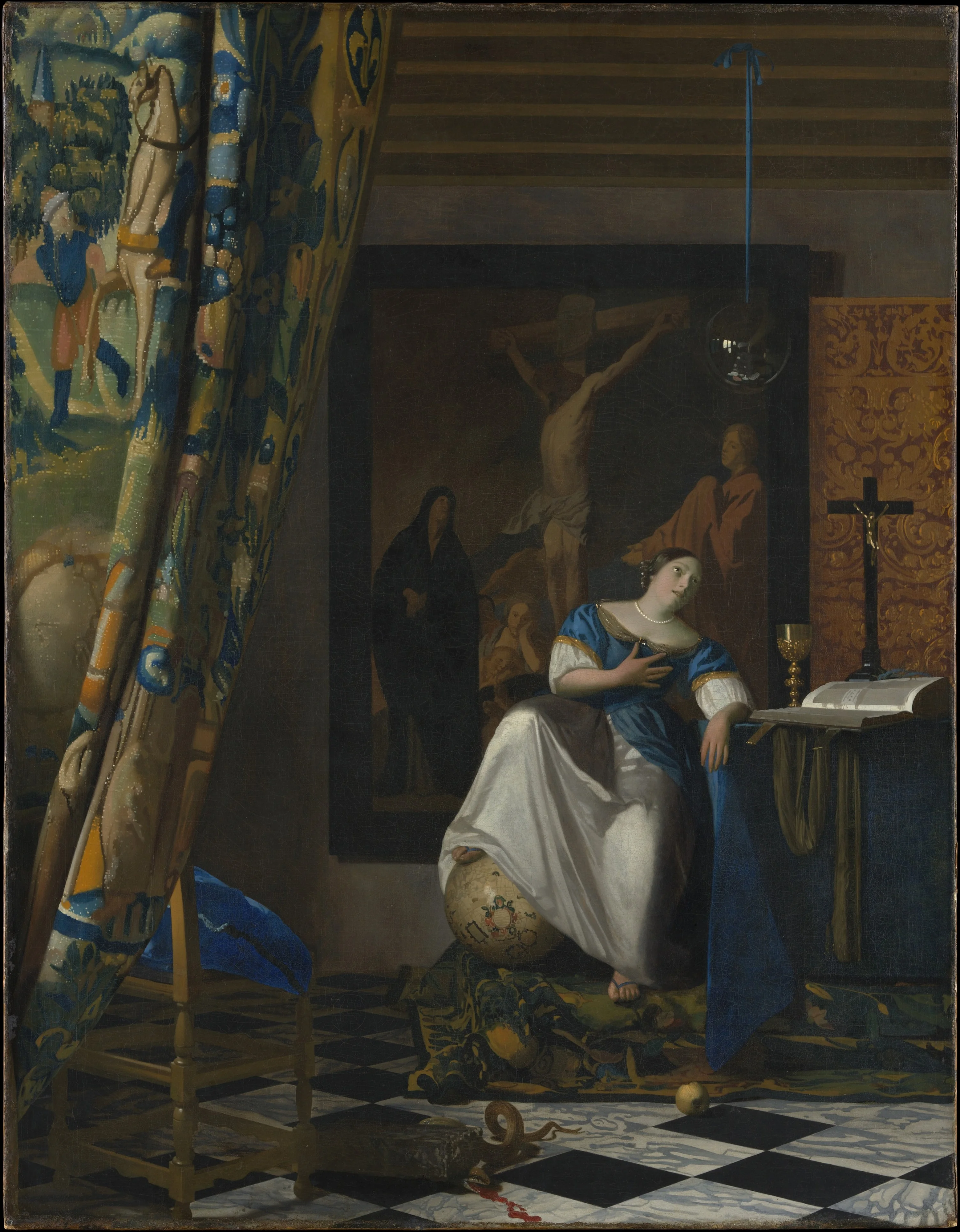
Look hard at Allegory of the Catholic Faith, the late and strange picture by Johannes Vermeer. Faith is a seated woman in blue and white, one hand pressed to her breast, one foot resting on a terrestrial globe. She is placed inside an ordinary Dutch room of the kind Vermeer painted all his life, marble floor in black and white squares, a gilt-leather wall panel, a heavy hanging drawn back at the left like a stage curtain. Behind her hangs a large Crucifixion. At her feet a cornerstone crushes a serpent, blood at its mouth, and an apple lies nearby, the bitten cause of the Fall. Above her head a clear glass sphere hangs from a blue ribbon and catches the window light.
That sphere is the whole problem of the genre in one object. It is not a thing Faith would plausibly own. It is a gloss, lifted from the emblem literature, where the small reflective globe was read as the human mind, tiny as a bubble yet able to contain a belief as large as the God it mirrors. Vermeer, who everywhere else trusts a single woman by a single window to carry an entire painting, here cannot. The meaning will not fit in a glance, so he imports the apparatus: the globe underfoot, the chalice and crucifix on the table, the crushed snake, the curtain. The picture strains under the load. The woman's upturned eyes and theatrical pose sit oddly against the cool, exact light he renders better than anyone alive. You can watch a realist's hands forced to operate a sign-machine they would rather leave switched off. That visible strain is the best evidence I know that allegory is a method laid over a painter, not a style growing out of one.
Eight thousand works, one shared bench
The reach of the method is easier to feel as a count. Across this archive, allegory accounts for 8,399 works by 2,133 separate hands, held in 115 institutions, with dated examples running from roughly 1278 to 2008. Seven centuries, two thousand artists, and the same small kit of personification and attribute underneath nearly all of it. The Met keeps a dedicated allegory index in its Heilbrunn Timeline for the same reason a library keeps a subject heading: the works are bound less by when or where they were made than by how they were made. A Ferrarese panel of 1480 and an American canvas of 1850 are siblings in technique even when they share nothing in surface. That is the information a corpus this size can show that a single museum wall cannot.
The same bench, four different shops
The kit crossed schools without friction. Titian in Venice and Ercole de' Roberti in Ferrara worked it as fluently as the Dutch did a century later, and the Baroque painters of the south handed it on to the north. What changes from shop to shop is not the method but the tone, the way each painter naturalizes the borrowed signs.
Take the moralizing branch, where allegory turns satirical. In Quentin Massys's Ill-Matched Lovers, an old man paws a young woman while her hand slips his purse to a grinning fool behind them. The attributes here are not classical props but social ones: age, lust, money, the fool's cap. The picture is an allegory of folly built from a genre scene, and the lesson lands before you have named a single personification. Hieronymus Bosch runs the same engine in Cutting the Stone, where a quack surgeon removes a "stone of madness" from a gullible patient's head while a funnel sits on the operator's skull as a badge of his own foolishness. The funnel is an attribute as fixed as any of Ripa's, only crueler. Both painters prove that the method needs no togas. It needs only agreed signs and a clear stage.
The Roman branch keeps the kit but hides the seams. Caravaggio's The Musicians reads at first as four boys tuning up before a concert, until you notice the small winged figure reaching for grapes at the left, a Cupid who turns the gathering into an allegory of music and love rather than a record of one afternoon. The grapes are the attribute, wine and Bacchic appetite, smuggled into a scene that otherwise insists on being real. That tension, real bodies carrying unreal meanings, is the late-allegorical signature. The landscape painters of the American nineteenth century push it further still. Jasper Francis Cropsey's The Spirit of War, credited to Cropsey, hands the whole allegorical load to terrain and weather: a medieval fortress on a crag, a blood-colored sky, armed figures dwarfed by the storm above them. There is no personified Bellona. The mood does the work the figure used to do.
When the manual was thrown away
The nineteenth century is where the method starts hiding its own evidence. Arnold Böcklin's Isle of the Dead, which he painted in several versions, is an allegory with the answer key torn out. A white-shrouded figure stands in a small boat before a rock island ringed by black cypresses, a coffin at its feet, still water all around. Every element behaves like an attribute, the cypress of mourning, the white figure, the ferry across water. Yet Böcklin refused to name the subject and let buyers call it what they liked. This is the Symbolist turn: the kit is still in use, but the manual that decoded it is deliberately withheld, so the picture stays open. Meaning is produced and then left unfixed on purpose.
Gustave Courbet pushed the contradiction into the title. His vast 1854 to 1855 manifesto canvas is called The Painter's Studio: A Real Allegory Summing Up Seven Years of My Life as an Artist (Smarthistory on Courbet's studio). A "real allegory" is a knowing paradox. Courbet keeps the method, a crowd of figures who each stand for a force in his world, while stripping out the antique costume and the lookup table. You can no longer parse the figures from a manual, only from his biography. By the time the critic Craig Owens reframed allegory for late-twentieth-century art, the procedure had been turned inside out entirely: the modern allegorist's job, on Owens's account, is to show that an object can hold many meanings at once rather than one settled meaning. The bench survives. The fixed answer key is gone.
Works discussed in this article
What the method leaves us
The reason allegory can feel cold to modern eyes is the same reason it lasted: it is assembled, not felt. A portrait fails when it misses a likeness. An allegory fails when its signs misfire, when the attribute is too obscure to read or too obvious to bear thinking about. The great ones thread that needle. Vermeer's globe rewards a second look without collapsing into puzzle. Bosch's funnel stings on the first. The difference between a tedious allegory and a lasting one is never the depth of the idea, which is usually a commonplace about virtue or death. It is the quality of the assembly, the paint, the staging, the wit of the chosen object.
If there is a future for the genre it is the one Böcklin and Courbet pointed at and Owens named: the kit without the manual, signs that still operate but no longer resolve. Every contemporary image that loads an everyday object with more meaning than it can carry, and refuses to tell you which meaning to take, is running the old bench with the answer key burned. The procedure outlived its own vocabulary. Hand a painter today a woman, an object, and a stage, and watch how fast the machine turns over, even when nobody at the easel has ever opened Ripa.
Sources & further reading
- Allegory — Tate
- Allegory (etymology and definition) — Wikipedia
- Allegory of the Treaty of Ryswick, 1697 — Rijksmuseum
- Courbet, The Artist's Studio: A Real Allegory — Smarthistory
- Iconologia, or, Moral Emblems (Cesare Ripa, English edition) — Internet Archive
- Joachim von Sandrart, Personification of September (about 1644) — The J. Paul Getty Museum
- Allegory, Heilbrunn Timeline keyword index — The Metropolitan Museum of Art