A bridge in a painting is rarely about crossing water. It is the painter's most dependable piece of structure: a horizontal that braces the picture, a threshold that splits the canvas into a here and a there, a rung the eye can climb from foreground to distance without losing its footing. Engineers build bridges to carry weight. Painters borrow them to carry attention. My argument across this essay is simple and, I think, worth defending against the usual survey that treats the bridge as charming local color: the bridge in Western and Japanese painting earns its place less as a subject than as syntax, a grammatical device for controlling tempo, depth, and the meaning of a passage.
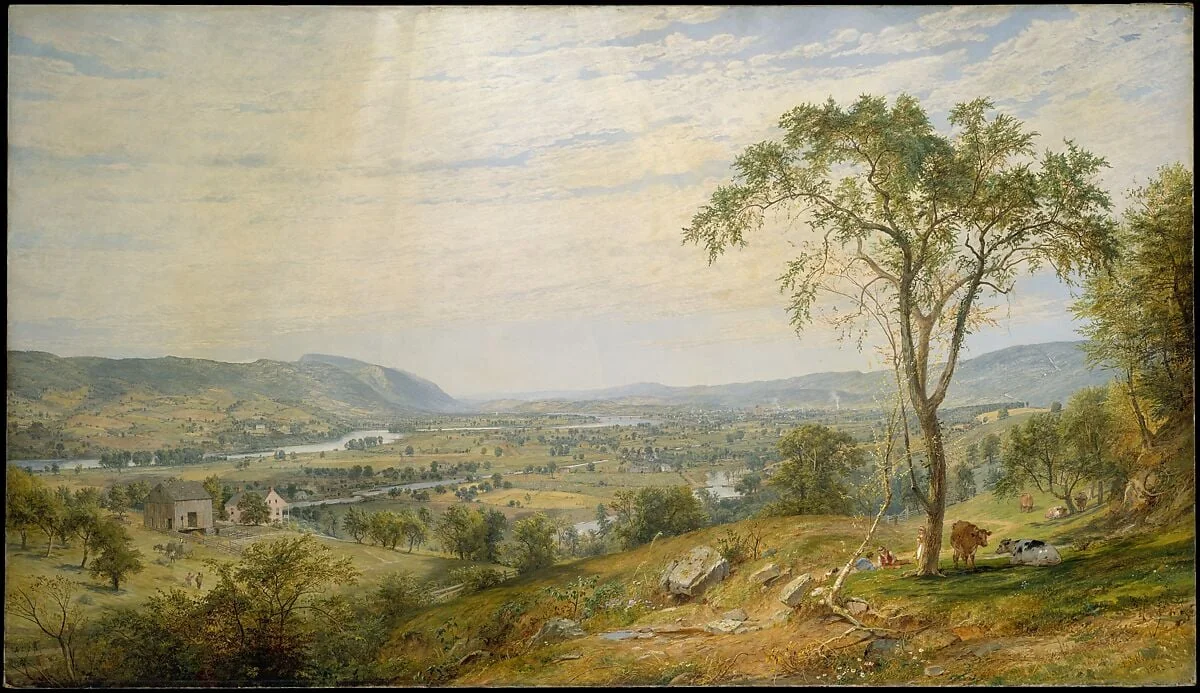
The clearest demonstration I know sits in a single American canvas, Jasper Francis Cropsey's The Valley of Wyoming, painted in 1865. It is a vast, sun-warmed panorama, and the bridge inside it is small enough that a hurried viewer walks past it. That smallness is the point. Cropsey, who could paint a thunderhead or a sugar maple in October with anyone in the Hudson River School, understood that a bridge does not need to dominate to govern. Look closely at how he places it and the whole logic of the valley resolves. So I want to look closely, at that work first and then at five others, and let the bridge teach us how a landscape is actually assembled.
Cropsey's valley, and the one straight line in it
Stand in front of The Valley of Wyoming and the first thing it does is push you back. Cropsey paints from a hillside vantage, so the land falls away beneath you and then opens for miles. The Susquehanna threads the floor of the valley in a long, slack S, catching the light in flat silver patches where the sun finds it. In the foreground, in cool shade, a few figures rest among cut grain and a leaning tree, the kind of repoussoir staffage the school used to set a human scale against the immensity behind. One figure leans on a staff; another sits with the loose ease of someone who has stopped to take in the view, which is also what the painting asks of us. Beyond them the valley brightens by degrees toward a pale, hazed line of mountains. The handling is patient. Cropsey lays the autumn foliage on in small, dry touches that keep their separateness up close and fuse into russet and gold at viewing distance.
Now find the bridge. It crosses the river in the middle distance, a low covered span, dark against the bright water, no taller in the picture than a fingernail. Everything around it curves. The river curves, the treeline curves, the receding fields curve with the land. The bridge is the one firm horizontal in the composition, and Cropsey uses it the way a carpenter uses a level. It tells the eye where the true ground plane lies after all that recession has tried to tilt it. It also does quiet narrative work. A covered bridge means a road, a crossing, a town just out of frame; it converts a wilderness prospect into a settled, inhabited valley without Cropsey having to paint a single rooftop in close-up. The structure is modest and the function is total. Remove it and the valley becomes scenery. Leave it in and the valley becomes a place where people live and cross and come back.
This is what I mean by syntax. The bridge is the verb of the sentence. It is where the latent movement of the whole landscape, all that flowing water and receding distance, is gathered up and made legible as passage. Cropsey, working a few years after the Wyoming Valley had become a charged emblem of American settlement and its costs, chose to state that history with a span you could miss. Restraint of that order is a judgment, and it is the judgment that separates a great landscapist from a competent one. The competent painter would have enlarged the bridge, centered it, and lost the valley to it. Cropsey trusted the eye to do the finding, and the reward for finding it is the sudden sense that the whole prospect has a destination.
What the archive shows
Pull back from the single canvas and the pattern holds across the collection. Artifact World Gallery holds 379 works built around the bridge, drawn from 47 venues, made by 210 different hands, with dates running from roughly 1187 to 2020. That spread is the useful figure. More than two hundred artists across eight centuries is not a niche or a fashion; it is a recurring solution to a recurring problem, which is how to organize deep space and how to mark a transition inside it. When a motif survives that long across that many temperaments, it is doing structural work, not decorative work. The bridge persists because painters keep rediscovering that it solves something.
The venue count matters as much as the artist count. Forty-seven holding institutions means the motif is not the property of one school or one nation's taste; it shows up wherever landscape and city views were collected, from American luminist panoramas to French river scenes to Japanese woodblock series. A handful of centuries cluster the dates, the long eighteenth-into-nineteenth stretch when topographical and Impressionist landscape both flourished, but the tail reaches back to a medieval crossing and forward to living painters. Read against any standard movement survey, which sorts these works by style and keeps them apart, our count puts them in one room and lets the shared device speak. That is information a stylistic history cannot give you, because it never asks the question this way.
Works discussed in this article
The Impressionists make the bridge the whole subject
Where Cropsey hid the span, the Impressionists put it dead center and made it bear the picture. Look at Alfred Sisley's The Bridge at Villeneuve-la-Garenne, a Seine-side suburb downstream of Paris. Here the bridge is no longer a quiet horizontal hidden in the distance. It marches across the canvas on pale stone piers, its arches throwing soft reflections into water that Sisley paints in short, broken strokes of blue, green, and chalk. A small boat and a strolling figure set the human pace beneath it. The bridge gives Sisley exactly what an Impressionist craved and a riverbank alone could not supply: a hard geometry to hold the loose, flickering paint together. The arches are the armature; the shimmer hangs on them. Take that masonry away and the brushwork has nothing to resolve against, which is precisely why he framed the span so it runs the full width of the view.
The same instinct runs through Monet. From 1899 he made a whole series of the green Japanese footbridge he had built over the lily pond at Giverny, and the structure became the recurring spine of the late water-garden pictures. The National Gallery of Art dates his first canvas of that arched wooden bridge to 1899 (nga.gov), and Smarthistory treats his earlier Argenteuil bridge as a frank emblem of suburban modern leisure, the railway-age weekend painted as bright water and iron (smarthistory.org). The footbridge mattered to him precisely because it gave the dissolving surface of the pond a thing to be measured against. Without the arch, the water lilies are a field. With it, they are a depth.
Pissarro pushes the device into the city. In The Louvre, Afternoon, Rainy Weather, painted late in his life from a high window, the Pont des Arts and the river crossings stitch the two banks of the Seine into a single wet, grey continuity. Pissarro was an old man with bad eyes by then, painting series from interiors, and the bridges in his Paris views are the load-bearing lines that let him organize a whole quarter from above. The river would otherwise cut his picture in half. The bridge sews it back together. That is the urban version of the job Cropsey gave his covered span, scaled up to a capital and stripped of sentiment.
Van Gogh learned the lesson from prints rather than from nature. His 1888 paintings of the Langlois drawbridge near Arles set a blunt, counterweighted wooden mechanism against a hard blue sky, the diagonal of the raised span answering the diagonal of the canal bank, the whole thing built on the flat, outlined manner he was taking from Japanese woodblocks (metmuseum.org). He kept returning to that drawbridge through the spring. It gave his restless line a clean geometric problem to push against, which is what he needed in a year when his color was running ahead of his drawing.
The Japanese source
Behind the European bridge pictures of the 1870s and 1880s stands Japan, and one print in particular. Utagawa Hiroshige's Sudden Shower over Shin-Ōhashi Bridge and Atake, from the series One Hundred Famous Views of Edo, shows the Great Bridge over the Sumida River seen from above and cut hard by the frame, with figures hunched under the downpour while the rain falls as crisscrossing diagonal lines drawn straight across the image (metmuseum.org). The print dates to September 1857, near the end of Hiroshige's life. Two things in it changed Western painting. First, the steep, cropped viewpoint that turns a bridge into a flat bold band slicing the picture, which is exactly the device Pissarro reaches for from his Paris windows. Second, the willingness to let weather become graphic, to draw rain as line. The bridge here is a stage for an event, the sudden shower, and the wood of the deck is the only solid thing in a scene otherwise made of water falling and water flowing.
The lineage is direct enough to trace painting by painting. Hiroshige flattens and crops the bridge; Monet builds a real Japanese footbridge in his French garden and returns to it again and again across his last decades; Sisley and Pissarro keep the cropped, structural span and dissolve the weather into broken color. The motif travels east to west and keeps doing the same job under different skies. What the European painters took was not a picturesque foreign accent but a piece of compositional engineering, the proof that a single span, set high and cropped, could discipline an entire field of loose paint.
Older bridges, harder meanings
The device is older than Impressionism by centuries, and in the earlier pictures the bridge often carries a heavier symbolic load. Look at El Greco's View of Toledo, that storm-lit, almost hallucinatory portrait of the Spanish city under a bruised green-black sky. The Alcántara bridge spans the Tagus at the base of the hill, leading the eye up the slope toward the cathedral spire and the Alcázar. El Greco rearranges the real topography freely, but he keeps the bridge, because the bridge is the only way into the city. It is the threshold between the wild river gorge and the sacred, fortified town above. The lightning-charged sky makes the crossing feel like a passage out of nature and into something closer to vision. Notice how the eye refuses to enter the town from anywhere else; the cliffs forbid it. The bridge is not one option among several. It is the single permitted door, and El Greco lights it so you cannot miss the threshold.
The American Hudson River School inherited that moral charge and domesticated it. In Asher Brown Durand's Pastoral Landscape, a small bridge gives passage across a stream in an ordered, Claudian valley, framing trees on one side and a luminous distance on the other. Durand, Cropsey's older colleague and the school's most articulate theorist, used the bridge to assert harmony between people and land, a settled countryside where the crossing is gentle and the far light is benign. Set his bridge beside El Greco's and you can read two whole worldviews off the same motif. One bridge leads up into a storm-haunted faith. The other leads across into a cultivated peace. Same device, opposite arguments, and the device is doing the arguing.
Even the lightest use of the motif is structural. François Boucher's Washerwomen is a Rococo pastoral, all silvery foliage and rustic charm, and a little bridge crosses the stream where the women work. It would be easy to call it pure decoration. It is not. Boucher uses the span to set the middle distance, to give the eye a stepping point between the figures at the water's edge and the soft scenery behind, and to lead a thread of path through the picture so the pastoral feels inhabited rather than merely arranged. The bridge is the smallest hard edge in a scene of feathered brushwork, and the composition leans on it.
The bridge as a name for what art does
By the early twentieth century the metaphor had grown self-aware. When a group of young German artists founded their movement in Dresden in 1905, they called it Die Brücke, The Bridge, and the Tate notes the name was meant to suggest a bridge between the artist and society at large (tate.org.uk). They had stopped painting bridges and started being one. That is the natural end of the long history traced here. The motif that organized Cropsey's valley and braced Sisley's river became, for the Expressionists, a word for the whole ambition of modern art: to carry feeling across the gap between a private vision and a public.
Go back to the small dark span in Cropsey's panorama with that in mind. He could not have meant the Dresden meaning, but he was already practicing it. The covered bridge over the Susquehanna is how the painting reaches the person standing in front of it, the point where all that distance becomes a place a body could walk into. The 379 bridge works in this collection, made by more than two hundred artists over eight centuries, are not eight centuries of repetition. They are eight centuries of the same discovery, remade each time a painter stood at the edge of deep space and realized the eye needed somewhere to cross.
So the next time a landscape stops you, find the bridge before you find anything else. It will tell you where the painter wanted you to stand, how fast the eye is meant to move, and what the picture thinks a crossing is worth. Cover it with your thumb and watch the whole composition lose its nerve. Then take your thumb away and feel it hold. The span was never the scenery. It was the painter telling you the way through.
Sources & further reading
- Brücke (art term) — Tate
- Claude Monet, The Argenteuil Bridge — Smarthistory
- The Japanese Footbridge (Monet, 1899) — National Gallery of Art
- Sudden Shower over Shin-Ōhashi Bridge and Atake (Hiroshige) — The Metropolitan Museum of Art
- The Langlois Bridge (Van Gogh, 1888) — The Metropolitan Museum of Art
- Bridge over a Pond of Water Lilies (Monet) — The Metropolitan Museum of Art
- Water Lilies (Monet series) — Wikipedia
- Sudden Shower over Shin-Ōhashi Bridge (Brooklyn Museum impression) — Internet Archive (Brooklyn Museum)