Pieter Brueghel the Elder is usually filed under peasants and snow: the painter of frozen ponds, wedding feasts, and men trudging home with their dogs. That filing is comfortable, and it hides the fight he picked. The generation that trained him had settled a question on behalf of every ambitious Netherlandish painter. To be serious, you went south, you learned the heroic nude and the idealized body from Rome and Florence, and you brought that figure home as the basic unit of meaning. Brueghel made the journey too. He came back and did close to the opposite of what the trip was supposed to teach.
The argument worth defending across this essay is this. Brueghel's true subject was a quarrel the new Northern painting was conducting with the Italianate, or Romanist, program that came just before it, and his answer was to evict meaning from the single idealized human body and scatter it across an entire observed world. The Romanists asked the eye to climb toward an ideal. Brueghel pulled the eye back and up, to the vantage of a hawk, and let significance break into hundreds of small, true, unglamorous things: a scythe laid in stubble, a skater's bad fall, a tax ledger on a winter doorstep. He was not rejecting ambition. He was relocating it. The position is testable picture by picture, and the pictures hold.
The road to Rome, and the turn away from it
Brueghel came up inside the program he would later contradict. The earliest life of him, written by Karel van Mander and printed in Haarlem in 1604, has him apprenticed to Pieter Coecke van Aelst, a court painter, architect, and designer of woven wall-hangings who had himself travelled to Constantinople and who translated Italian and Roman treatises on architecture into Flemish. Coecke was a conduit for the southern manner, the man who packaged Italian proportion for a Brussels and Antwerp clientele. If you wanted the Romanist syllabus, Coecke's workshop was the room to be in.
Brueghel was born in or near Breda around 1525 and entered the Antwerp painters' Guild of Saint Luke as a master in 1551 or 1552, according to the Metropolitan Museum's account of his life (Metropolitan Museum, Heilbrunn essay). Then he went south, as the script demanded, reaching Reggio Calabria and then Rome by the mid-1550s before returning to Antwerp. Here is the telling part. A young man who had just stood in front of the antique nudes and the new Roman frescoes came home obsessed with the Alps he crossed on the way. The mountains, the river valleys seen from a high pass, the weather, the smallness of people inside a vast terrain. He brought back landscape, not the idealized body.
His first decade of fame was made not in oil but in print. The Antwerp publisher Hieronymus Cock put Brueghel's drawings into circulation as engravings, among them the much-copied Big Fish Eat Little Fish. A gutted leviathan lies on a shore, spilling smaller fish from its slit belly, each of those fish in turn coughing up smaller ones, while a man in a boat points the moral out to a boy. The image illustrates a proverb about the powerful devouring the weak. Note what is absent: no hero, no idealized form, no single body carrying the picture's worth. The meaning is structural, distributed across a chain of bodies. That distribution is the whole argument in miniature.
Where the new painting decided meaning lived
The mode Brueghel was helping invent now has a dry museum label: genre painting, defined by the Tate as painting that depicts scenes of everyday life, with peasant subjects and tavern interiors as its most typical fare. Stated that flatly, it sounds minor, a step down from history and altarpiece. That is exactly the prejudice Brueghel was working against, and the reason his choice was a position rather than a default. The Romanist hierarchy ranked subjects, and the ordinary sat near the bottom. Brueghel took the bottom of the hierarchy and made it carry the freight that the South reserved for gods and saints.
His everyday is never merely charming. It is moralized, encyclopedic, and cold-eyed. The peasants are not noble innocents and not comic grotesques, though lesser painters would later flatten them into both. They are people doing the actual work of staying alive in a specific climate. The shift sounds modest and is in fact radical, because it relocates the source of pictorial seriousness. For the Romanist, seriousness was an attribute of the figure, conferred by ideal proportion. For Brueghel, seriousness is an attribute of the whole system: land, labor, weather, custom, and the slow grinding proverbs people live inside without noticing.
Close looking: The Harvesters
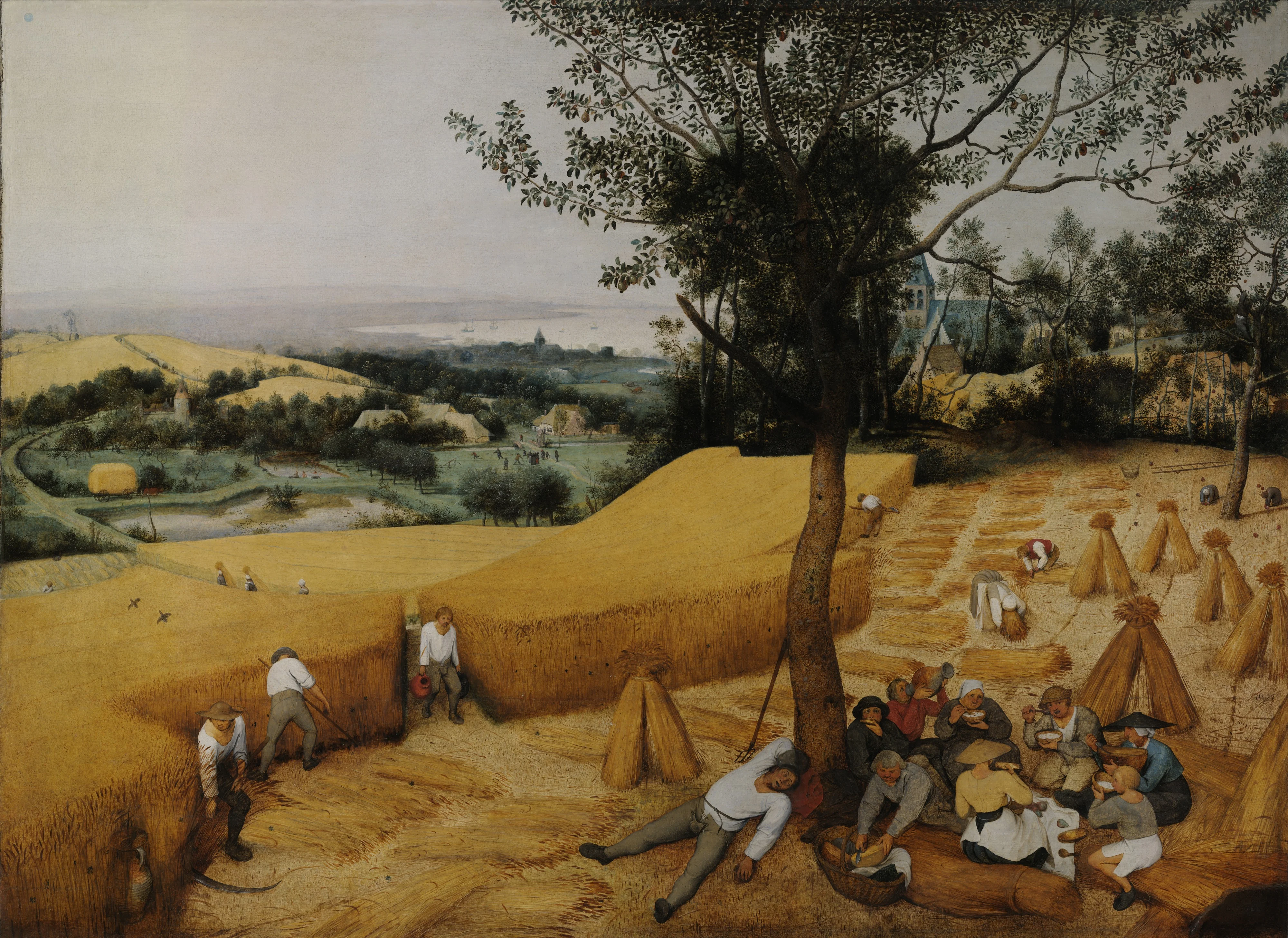
Stand in front of The Harvesters, dated 1565, and the argument becomes something you can point at. A wall of ripe wheat fills the left half of the panel, painted a heavy, almost edible gold, and a single path has been cut straight through it like a corridor. Down that corridor a woman walks toward us carrying jugs, and her smallness against the standing grain tells you immediately who the protagonist is. It is not her. It is the field.
Under a pear tree at the center a man lies flat on his back, legs splayed, mouth open, asleep in the heat with his shirt rucked up. He is not idealized and not mocked. He is simply spent, the way a body is spent after a morning of swinging a scythe, and Brueghel gives that exhaustion the dead center of the composition where a Roman painter would have placed a hero or a Madonna. Around the tree the others eat: bread cut thick, a bowl passed, a man drinking with his head tipped back. To the right the mown stubble runs in pale diagonal stripes against the uncut gold, so the field itself records the labor as a pattern, finished here, still standing there.
Then the eye is released. The land drops away to a valley with a village, a church tower, a pond where tiny figures are bathing and playing a game with a goose, and far off a flat estuary with ships. The horizon sits high, near the top of the panel, which tilts the whole world up toward us and refuses the single vanishing point that Italian perspective had made into a discipline of focus. Brueghel does not want you to focus. He wants your eye to travel, to find the bathers, the loaded cart, the distant sails, and to understand that the napping harvester and the ships on the horizon belong to one continuous, working world. The Met records this panel as one survivor of a six-part cycle of the seasons, the so-called Months, painted for the country house of an Antwerp merchant (Metropolitan Museum of Art). The commission tells you something: a wealthy patron paid for the year itself, the cycle of labor and weather, as a fit subject for a great room. The peasant world had been promoted.
Our own holdings register how durable this body of work has proven. Artifact World Gallery keeps 72 works under Brueghel's name across thirteen venues, clustered roughly between 1546 and 1568, a span that brackets almost his entire working life from the early Italian-period drawings to the late panels. That a single short career, cut off in 1569, still fans out across thirteen separate collections is itself a kind of evidence. The man who painted the unfashionable subject ended up more widely distributed than many of the Romanist contemporaries who painted the fashionable one.
The hawk's vantage
The high horizon of The Harvesters is not a quirk. It is Brueghel's signature instrument, and its job is to dethrone the foreground figure. Look at The Hunters in the Snow, another panel of the same 1565 cycle, now in Vienna. Three hunters and their dogs climb down a ridge in the left foreground, backs to us, heads low, one fox or hare slung on a pole. They are tired and they have done poorly. From their height the land falls away into a frozen valley where, rendered in flecks of dark paint on white, villagers skate, sweep, and play on two green ponds, a bird trap leans against a house, and jagged mountains close the far side. Smarthistory reads the picture not as a candid snapshot of a particular afternoon but as a constructed panorama of winter itself (Smarthistory). That distinction matters. Brueghel is not after the anecdote of three men and a hunt. He is after the season as a total condition, with the men as one event inside it.
The same downward, totalizing gaze drives The Tower of Babel, and here the Italian trip resurfaces in the strangest way. The tower is a spiraling, arcaded drum, plainly built on Brueghel's memory of the Roman Colosseum, ringed by tier upon tier of arches and already cracking as it rises into low cloud. King Nimrod and his retinue arrive at the lower left to inspect the work while stonemasons kneel. The structure is enormous and doomed, and Brueghel paints the doom into the engineering itself, the foundations on one side biting into living rock while the upper stories tilt. He took the single most authoritative ruin in the Romanist's holy city and turned it into a parable of overreach. The south's monument becomes the north's warning.
Brueghel applies the same logic to sacred narrative in The People's Census at Bethlehem. The Holy Family arrives to be counted under the Roman tax, and Brueghel relocates the whole event to a Flemish village in deep winter, snow on the thatch, a frozen river, peasants slaughtering a pig and crowding an inn where a clerk takes names and coins. Mary, wrapped in blue on a donkey, and Joseph leading it are almost impossible to find at first, two small figures lost in the ordinary traffic of a cold afternoon. An Italian painter would have lit the Madonna and centered her. Brueghel buries her in the census line. The point is not irreverence. It is that the sacred enters the world through the same plain door as everyone else, on a freezing day, owing tax.
The world as a single system
Once you see the method, the encyclopedic pictures stop looking like clutter and start looking like a thesis. Children's Games packs a town square and its streets with scores of children playing dozens of distinct games, hoops and stilts and leapfrog and blind-man's-buff, each rendered with the same patient attention. The kids are built like miniature adults, sober-faced, wholly absorbed. The painting is a catalogue, and its high viewpoint makes it readable as one, a survey of an entire activity laid flat for inspection. Brueghel is doing for play what a naturalist does for beetles, collecting and arranging the variety of a single human behavior across one surface.
And the darkest of them, The Triumph of Death, uses the identical machinery to opposite emotional ends. An army of skeletons sweeps across a scorched, smoking wasteland, herding the living toward a giant trap. Skeletons toll bells, drag a cart of skulls, drive a coffin lid like a riot shield, and corner a king whose spilled gold buys him nothing. Cardinals, lovers, a gambler, a pilgrim, all are leveled by the same advancing rank of bone. The composition has the same panoramic sweep as the harvest and the same downward gaze, only now the system being surveyed is mortality. It is the harvest of the world, reaped. Brueghel's vantage works as well for the apocalypse as for an August field, because to him they are the same kind of subject: the whole of a thing, seen from above, with no single body exempted.
Works discussed in this article
What the quarrel settled
Brueghel did not live to defend his position for long. He died in Brussels on 9 September 1569 and was buried in the Kapellekerk, leaving a young family and a body of work made across barely a decade and a half of mature painting. Two sons carried the name forward, one of them copying the peasant scenes so faithfully and so often that the father's compositions became a small industry. That copying is usually treated as a footnote. Read against the argument, it is the verdict. The demand for the unfashionable subject outlived the man by generations.
The longer settlement is visible in the seventeenth century. The independent landscape and the independent genre scene, the two things the Romanist hierarchy had treated as backdrop and filler, became the engine of Dutch and Flemish painting. The frozen rivers like the one in The Hunters in the Snow, the harvests, the kitchen interiors, the low horizons that let weather do the emotional work, all of it descends from the road Brueghel took home from Rome. He did not win by argument or manifesto. He won by making pictures so complete in their account of a world that the older question, which idealized body should the eye worship, simply stopped being the only question a serious painter could ask.
There is one more reason to keep looking at these panels rather than admiring them at a distance. Brueghel rewards the slow eye in a way idealized art rarely does. The ideal is grasped at a glance, which is its purpose. A Brueghel is built to be searched, the bathers behind the wheat, the bird trap in the snow, the buried Madonna in the census line, and the searching is the meaning. Stand long enough in front of The Harvesters and the sleeping man under the pear tree stops being a peasant taking a nap and becomes the still point of a working planet, the one body at rest while everything around him, field and pond and harbor and sky, keeps turning.
Sources & further reading
- Pieter Bruegel the Elder (ca. 1525-1569) — The Metropolitan Museum of Art, Heilbrunn Timeline of Art History
- The Harvesters (1565) — The Metropolitan Museum of Art
- Pieter Bruegel the Elder, Hunters in the Snow (Winter) — Smarthistory
- Genre painting (art term) — Tate
- Pieter Bruegel the Elder — Wikipedia
- Bruegel, Pieter, the elder (ULAN record) — Getty Research Institute, Union List of Artist Names
- Het Schilder-boeck (Haarlem, 1604) — Carel van Mander, via Internet Archive