Artwork
The Tower of Babel
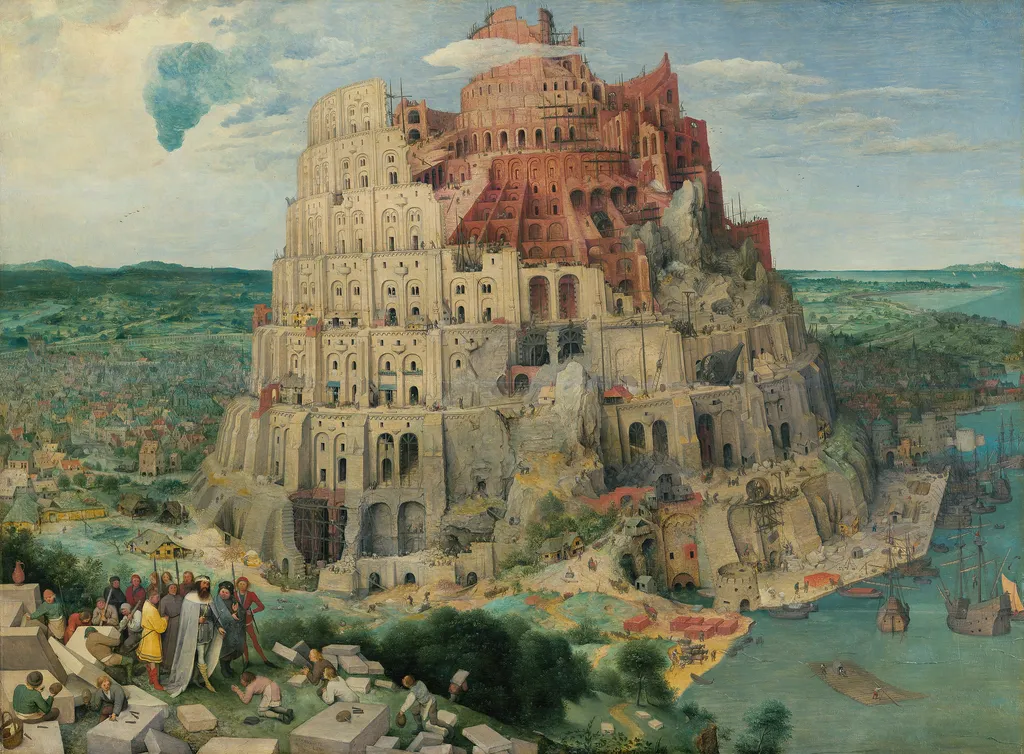
The Tower of Babel is an oil painting by the Northern Renaissance artist Pieter Brueghel I. It dates from 1563 and is held in the collection of the Kunsthistorisches Museum.
About this work
Pieter Brueghel the Elder painted this Tower of Babel in 1563, an oil on wood panel and one of two surviving versions he made of the biblical story; the other is now in Rotterdam. The two are often called the 'Great' and 'Little' towers to tell them apart, and both sit in major European collections.
Subject & Meaning
This impossible, upward‑spiralling form symbolizes human pride and the futility of earthly ambition, echoing the moral of pride punished (3,4).
The painting depicts the biblical construction of the Tower of Babel, showing King Nimrod directing a bustling workforce amid ships, cranes, scaffolds and fortified city walls (2,3,5). Its iconography borrows the arched façade of the Roman Colosseum, rendered as a spiral‑etage structure that reveals brick cores faced with stone and employs period building tools such as treadwheel cranes (3,4). This impossible, upward‑spiralling form symbolizes human pride and the futility of earthly ambition, echoing the moral of pride punished (3,4).
The work also alludes to contemporary religious strife between the Catholic Latin liturgy and the rising Protestant vernacular, recalling the Polyglot Bible published in Antwerp (3). Thus Bruegel presents the tower as a visual sermon on vanity and the limits of human endeavour.
Technique & Style
Executed in 1563, this work is an oil painting on an oak panel measuring 114 by 155 centimeters. The artist signed and dated the piece on a stone block in the lower left corner. Physical analysis suggests the panel may have been trimmed by approximately four centimeters in height and eight centimeters along the right edge, though the left original painting edge remains intact.
Stylistically, the composition features a massive, spiraling tower reminiscent of the Roman Colosseum, rendered with encyclopedic attention to architectural detail. Bruegel depicts specific construction techniques of his era, including treadwheel cranes, scaffolding, and the use of limestone facings over red brick frameworks. The structure is shown as fundamentally unstable, with arches built perpendicular to the slanted ground rather than horizontally.
The scene utilizes atmospheric perspective to convey scale, set against a Dutch polder landscape populated by tiny, active figures.
History & Provenance
Pieter Bruegel the Elder painted the Vienna Tower of Babel in 1563 on an oak panel measuring 114 × 155 cm, signing and dating it on a stone block at the lower edge: "BRVEGEL·FE·M·CCCCC·LXIII." By 1566 the painting was in the possession of the Antwerp merchant Nicolaes Jonghelinck. It was presumably transferred that same year to the city of Antwerp.
In his 1604 Schilder-boeck, Karel van Mander recorded two Bruegel Tower of Babel paintings in the collection of Emperor Rudolf II, a large and a smaller version, which are generally identified with the Vienna and Rotterdam panels. The work subsequently entered the collection of Archduke Leopold Wilhelm of Austria, who bequeathed his holdings to his nephew Emperor Leopold I, after which it became imperial property. It is now held in the Kunsthistorisches Museum in Vienna.
The painting is held in the Kunsthistorisches Museum, Vienna. It is inventoried as oil on oak panel, measuring 114 × 155 cm, signed and dated 1563 at lower left. After passing from the Antwerp collector Nicolaes Jonghelinck to Emperor Rudolf II by 1566, it entered the imperial collection and later the holdings of Archduke Leopold Wilhelm; upon his death it became part of the imperial collections that now constitute the museum’s holdings. The work was included in the Europeana 280 initiative.
Context
Pieter Bruegel the Elder's The Tower of Babel (1563) stands as a seminal work of the Northern Renaissance, widely regarded as one of the artist's finest achievements and a prime example of his encyclopedic attention to detail. Art historical scholarship emphasizes the painting's deliberate architectural reference to the Roman Colosseum, a motif linking the biblical narrative of hubris to contemporary critiques of the Catholic Church and the vanity of earthly power. Bruegel's depiction of the tower's structurally impossible spiral construction serves as a visual metaphor for human incompetence and the futility of grand endeavors, resonating with the religious turmoil of the 16th-century Netherlands.
The work's influence is evidenced by its emulation by contemporaries such as Lucas van Valckenborch and its status as the most famous iteration of the subject. Bruegel's unique synthesis of biblical exegesis, Roman engineering studies, and local Flemish landscape cemented the painting's place as a defining masterpiece of the period.
Legacy
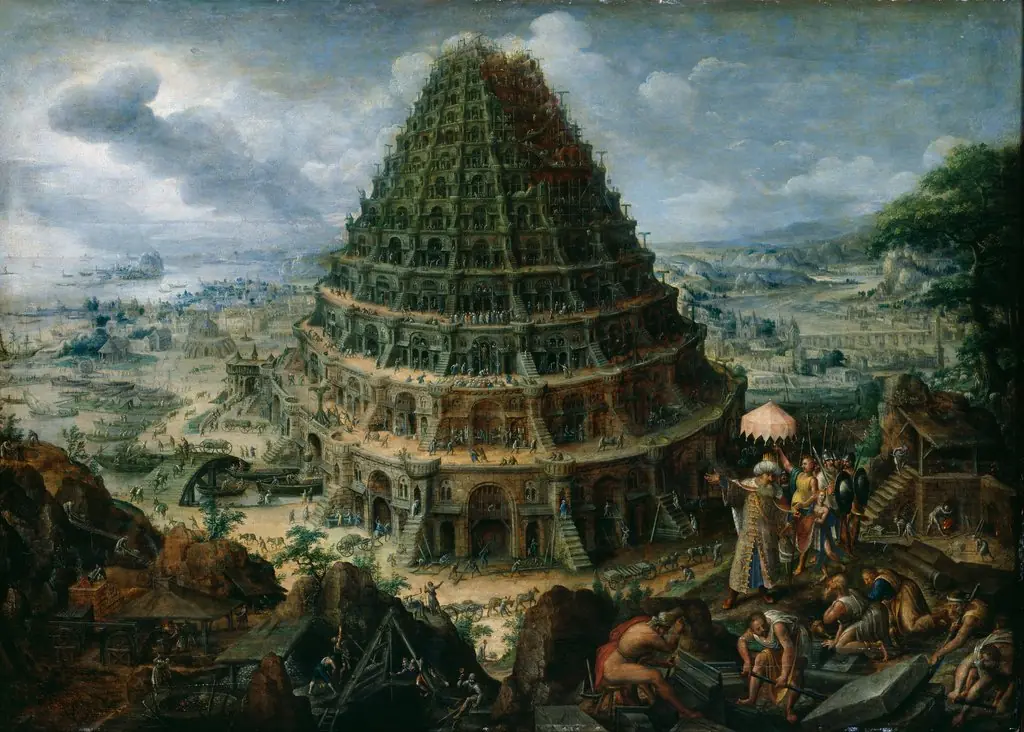
Pieter Bruegel the Elder's Vienna version of The Tower of Babel (1563) is widely regarded as his most famous and extensively emulated depiction of the subject, standing alongside the Rotterdam variant as a definitive exemplar of his encyclopedic attention to detail. The work's architectural composition, which deliberately mirrors the Roman Colosseum to symbolize hubris and the transience of earthly power, influenced contemporaries such as Lucas van Valckenborch, who painted the theme in the 1560s possibly after viewing Bruegel's interpretation. Both surviving paintings are celebrated for their painstaking rendering of construction techniques and their complex allegorical layers regarding religious turmoil and human vanity.
The Vienna painting's enduring reputation is anchored in its status as a masterpiece of the Northern Renaissance, securing its place in the Kunsthistorisches Museum and ensuring its continued study as a pinnacle of 16th-century religious art.
Overview
Pieter Bruegel the Elder's 1563 oil on wood panel painting, "The Tower of Babel," illustrates the biblical account of humanity's attempt to build a tower reaching heaven. This particular rendition, housed in the Kunsthistorisches Museum in Vienna, is often distinguished as the "Great" Tower of Babel. It represents one of two significant surviving interpretations of this narrative by the Dutch Renaissance artist, demonstrating his characteristic blend of detailed landscape and moralizing subject matter.
Own this work as a print
Artist & collection

Artist
Pieter Bruegel (also Brueghel or Breughel) the Elder ( BROY-gəl, US also BROO-gəl; Dutch: ; c.