Artwork
The People's Census at Bethlehem
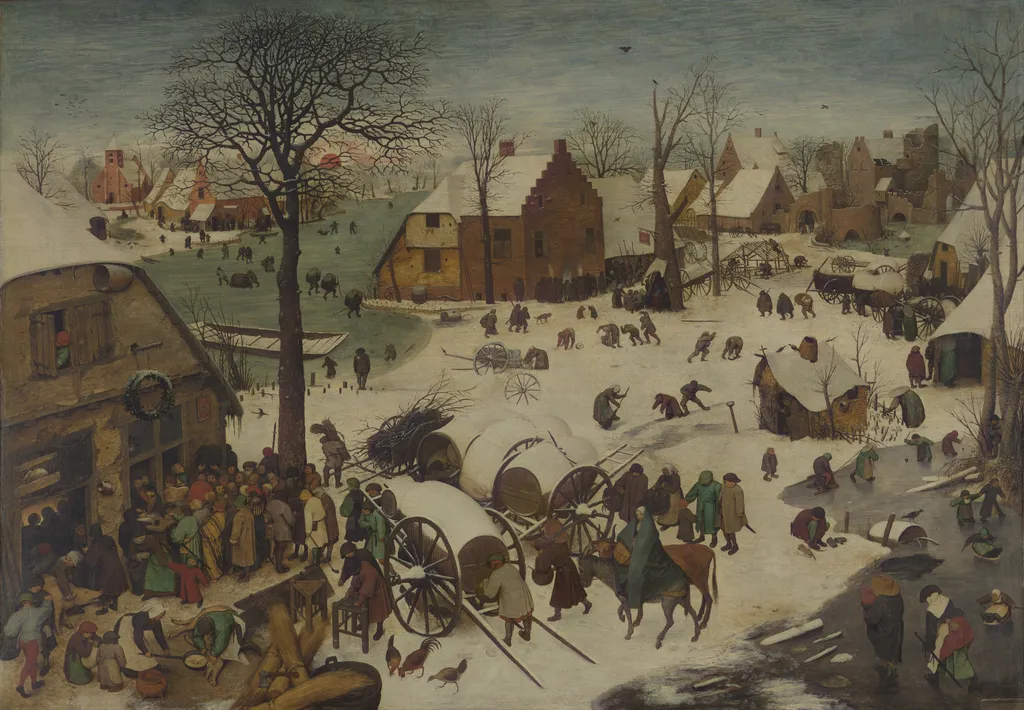
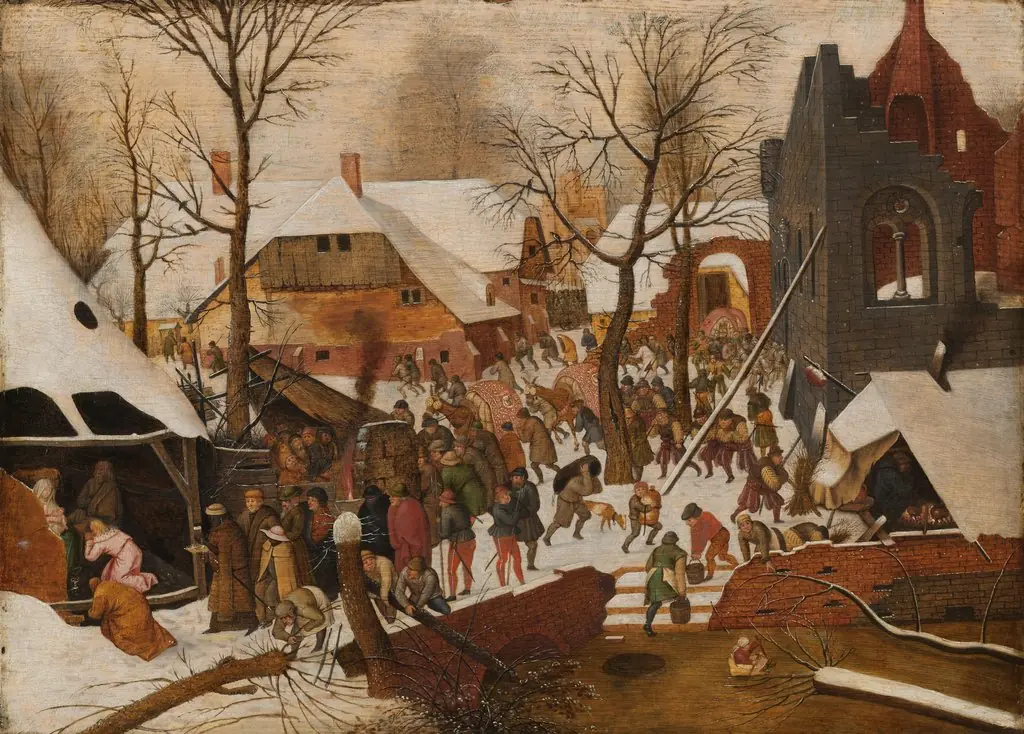
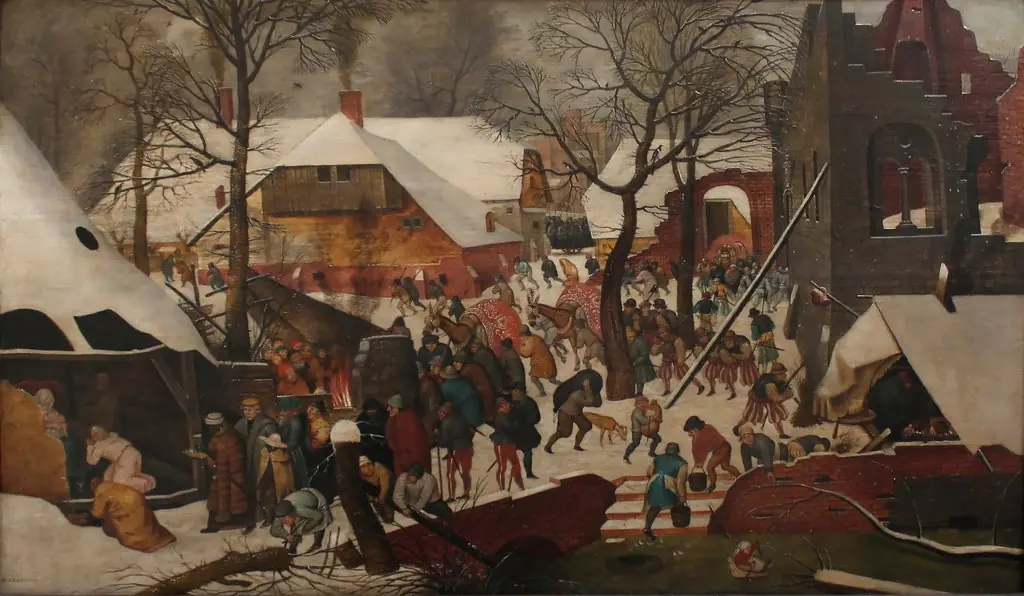
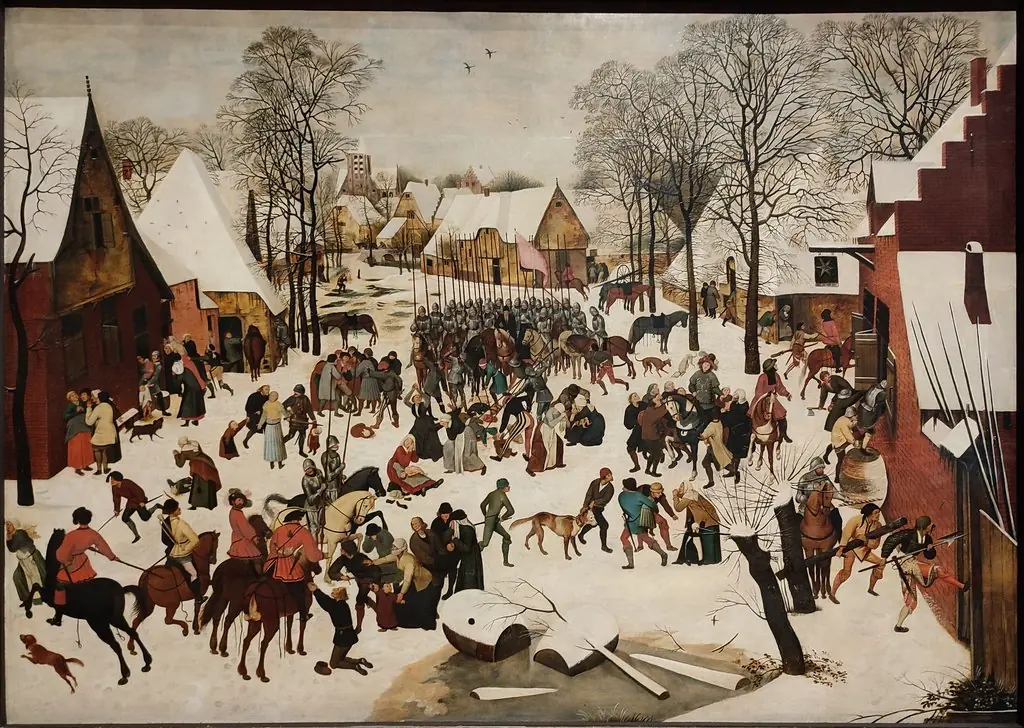
The People's Census at Bethlehem is an oil painting by the Northern Renaissance artist Pieter Brueghel I. It dates from 1566 and is held in the collection of the Royal Museums of Fine Arts of Belgium.
About this work
The People's Census at Bethlehem is a painting by Pieter Brueghel the Elder. It was created in 1566.
The painting is an oil-on-panel work, signed by the artist. It measures about 1155 × 1645 mm and is now held in a museum in Brussels, where it was acquired in 1902.
You can learn more about the artist who created this work, Pieter Brueghel the Elder.
Subject & Meaning
The painting depicts the biblical census at Bethlehem from the Gospel of Luke (2:1–5), in which Joseph and the pregnant Virgin Mary travel to be registered.
The painting depicts the biblical census at Bethlehem from the Gospel of Luke (2:1–5), in which Joseph and the pregnant Virgin Mary travel to be registered. Bruegel transposes the event into a contemporary Flemish Brabant village at winter sundown, where villagers queue at an inn bearing the Habsburg double-headed eagle to pay taxes to the Spanish administration. Joseph, identified by his carpenter's saw and drill, leads Mary on a donkey, while she wears an archaic blue mantle. The Holy Family is rendered nearly indistinguishable among ordinary villagers, fusing the sacred with everyday life.
Numerous symbolic details enrich the scene. A spoked wheel at the center has been read as a reference to the wheel of fortune. A leper with a clapper and begging bowl warns of disease, while a slaughtered pig, an event out of place in Jewish Bethlehem, evokes traditional December calendar imagery.
Children play on the ice with sleds and tops, and a ruined castle in the upper right (modeled on Amsterdam's towers) stands opposite a well-kept church, interpreted respectively as the Old and New Covenants. Scholars have debated whether the work critiques Habsburg taxation or allegorically meditates on the difficult path toward God.
Technique & Style
Pieter Bruegel the Elder's The People's Census at Bethlehem (1566) is executed in oil paint on an oak panel, measuring 115.5 × 163.5 cm. The support is a radially cut oak plank prepared with a traditional white ground, over which Bruegel applied thin, translucent glazes to build luminous winter effects. His handling is meticulous yet fluid: fine brushstrokes define architectural details and individual snowflakes, while broader passages render the muted sky and distant figures. The composition relies on a high horizon and intersecting diagonals, creating a panoramic depth that contrasts with the compressed, bustling foreground.
Stylistically, the work blends Flemish genre realism with Mannerist spatial disruptions, such as the off-center focal point and concealed religious narrative.
History & Provenance
Pieter Bruegel the Elder painted The People's Census at Bethlehem in 1566, as confirmed by the signed and dated oak panel (115.5 × 163.5 cm). Its early ownership history remains uncertain, though it was once part of the Van Colen de Bouchout collection in Antwerp. Later, it entered the collection of Edmond Huybrecht in Antwerp before being acquired in 1902 by the Koninklijke Musea voor Schone Kunsten van België (Royal Museums of Fine Arts of Belgium), where it remains, inventoried as inv. 747.
Context
Created in 1566, The People's Census at Bethlehem is a seminal work within Pieter Bruegel the Elder's brief but influential series of snowy landscapes, which established the winter landscape as a distinct genre in Western art. Scholars debate the painting's political subtext; while the Habsburg double-headed eagle on the tax office suggests a critique of Spanish administration, recent analysis argues it may instead function as a meditation on the difficult path to salvation. The work is notable for subverting Renaissance conventions by burying the biblical narrative of Mary and Joseph within a bustling, secular Flemish village, rendering the holy figures almost invisible among the crowd.
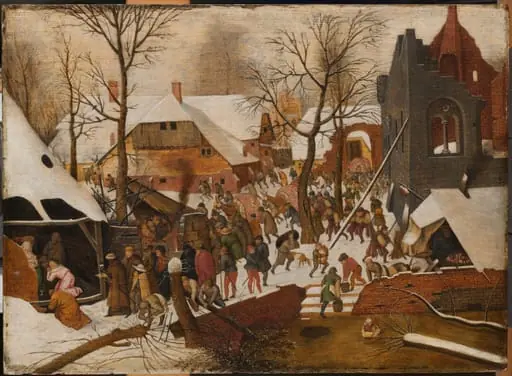
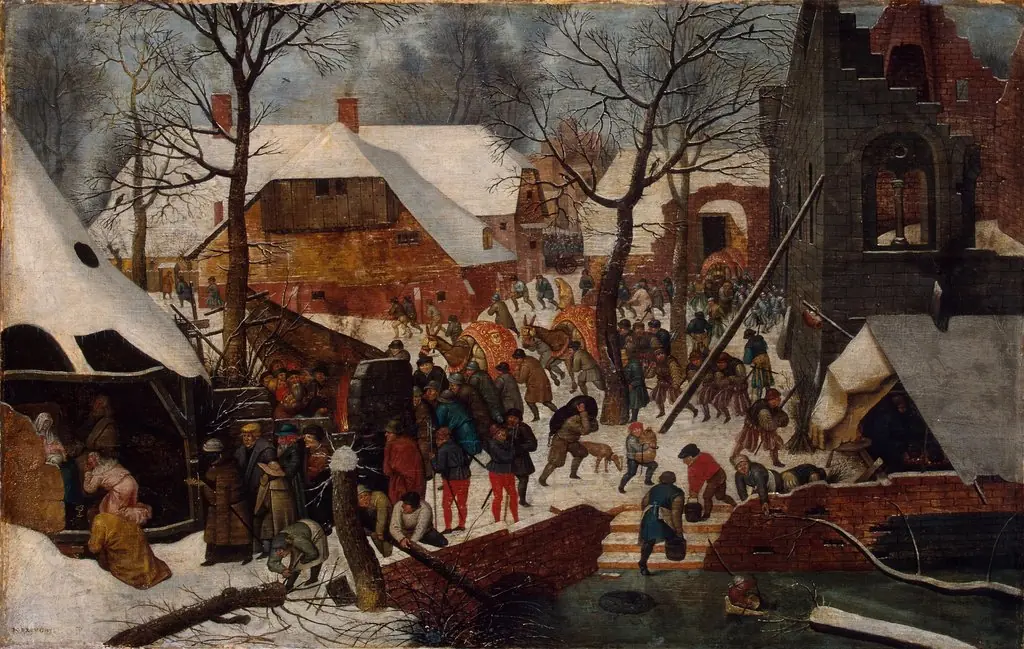
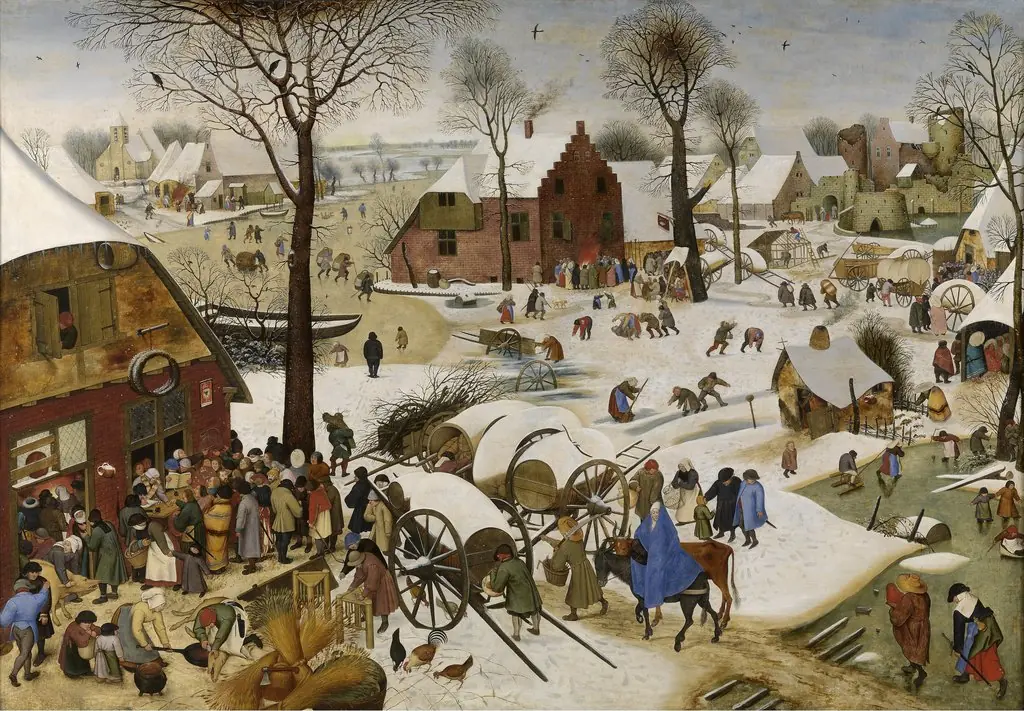
The painting's enduring legacy is evidenced by numerous copies produced by Bruegel's son, Pieter Brueghel the Younger, between 1600 and 1610.
Legacy
The painting is recognized as a decisive work in Western art, included in Michel Butor's imaginary museum of essential paintings. It established a genre of winter landscapes, forming part of a series of snowy scenes by Bruegel that responded to severe cold periods in Northern Europe during the 1560s. The work's legacy is significantly defined by the prolific reproduction efforts of the artist's son, Pieter Brueghel the Younger, whose studio produced numerous copies between 1600 and 1610.
These replicas, some signed and others varying in color or detail, suggest the use of preserved preparatory drawings or tracings. The painting's influence extended into the 19th century, appearing in the background of Alfred Stevens' 1869 work The Studio.
Overview
Pieter Bruegel the Elder completed The People's Census at Bethlehem in 1566. This oil-on-panel painting, signed by the artist, measures approximately 1155 by 1645 millimeters. It depicts a rare subject within Western art, set against a winter landscape.
The work is currently housed in the Oldmasters Museum in Brussels, which acquired it for its collection in 1902.
Own this work as a print
Artist & collection

Artist
Pieter Bruegel (also Brueghel or Breughel) the Elder ( BROY-gəl, US also BROO-gəl; Dutch: ; c.

Museum
Royal Museums of Fine Arts of Belgium
Continue through works from the same source collection.