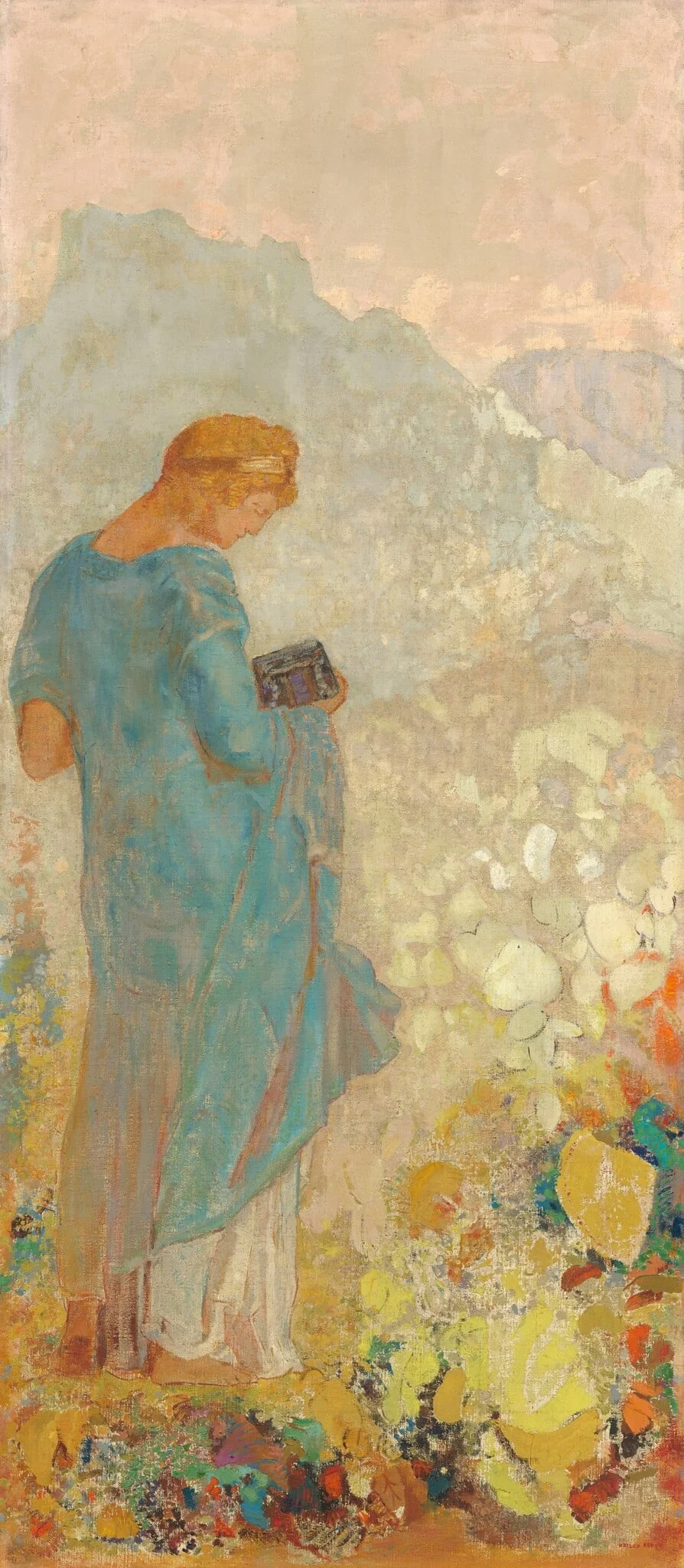
The early modern period in European painting is usually taught as a relay race of styles, each runner handing a baton to the next: Renaissance, Mannerism, Baroque, Rococo, and on into the nineteenth century. That tidy sequence hides what actually drove it. The continuity across these centuries is not inheritance but rebuttal. The painters of this long stretch were the first in Western history to define themselves chiefly by refusing to do the thing the way their teachers had done it. A style was a position taken against the position before. Run the textbook timeline forward and you watch one workshop after another stake its whole identity on what it would not do.
Here is the claim this essay defends, work by work: the early modern era is the period in which an argument with the immediate predecessor became the engine of painting itself, and that argument never reached a verdict. Giorgio Vasari built the founding myth in 1550, writing the lives of the painters as a single rising line from the stiffness of Cimabue toward the perfection of Michelangelo, a story of error steadily corrected (Vasari's Lives, digitized at the Internet Archive). Once painting had a history written as progress-by-correction, every ambitious artist had someone to rebut. The textbooks like to close the period around 1800. Our own holdings suggest the quarrel ran a great deal later, and that the late arguers were the most interesting of all.
A quarrel with no agreed start date
Even the boundary is contested, which is fitting for a period built on disagreement. Standard reference dates the early modern era to roughly 1500 to 1800, with the opening pinned to no single event but to a cluster of them: the printing revolution of the 1440s, the fall of Constantinople in 1453, the Age of Discovery, the start of the Reformation (Wikipedia, “Early modern period”). Art historians tend to push the curtain up earlier still, framing the visual early modern as roughly 1400 to 1800, the years in which Italian workshops and then northern ones rebuilt picture-making from the ground up. The lack of a clean opening tells you something. There was no founding moment because there was no founding agreement, only a running disagreement about what a painting was for.
This is where our archive earns its keep. Artifact World Gallery files 18,429 works under the early modern banner, made by 3,599 artists and held across 205 venues, with attributed dates that stretch from roughly 1350 to 1977. Set that 1977 tail against the textbook's 1800 close and the gap is the whole point. The corpus is not making a dating error. It is registering the fact that the argument the period started kept being had, by Redon and Rousseau and Bellows, long after the supposed end of the room. More than six hundred years separate the earliest dated panel from the latest canvas in this file, and the works at either end were made by people doing fundamentally the same thing: looking at what came just before and deciding it had gone wrong somewhere. The early modern was less a span of years than a habit of mind, and the habit outlived its calendar.
The first rebuttal: against the recent past, in the name of a deeper one
The opening move set the template for everything after. Tate defines the Renaissance plainly as the great revival of art that took place in Italy from about 1400 under the influence of the rediscovery of classical art and culture (Tate, art term: Renaissance). Notice the rhetoric of revival. To revive antiquity, you first have to declare the centuries just behind you dead. Vasari did exactly that, branding the medieval manner as crude and Germanic, a fall from grace that his own generation had reversed. The Florentine painters were not really arguing with the Romans they admired. They were arguing with their fathers and grandfathers, the Gothic carvers and panel painters, and they dressed the quarrel up as a return to a more distant ancestor.
That structure, rebut the immediate past by invoking a deeper one, is the genetic code of the entire period. Linear perspective was a rebuttal of the gold ground. The modeled, weighty body was a rebuttal of the flat icon. Oil glazes were a rebuttal of the matte certainties of tempera. Each technical advance carried an implicit insult to the work of the previous generation. By the time the method reached the Renaissance hub of values we now treat as timeless, those values had been won as victories in an argument that the winners then pretended had always been settled.
The northern counter-argument
The most consequential rebuttal of the seventeenth century came from the north, and it was aimed squarely at Italy. Where the Italian tradition idealized, raising figures toward a perfected type, the Dutch painters of the Golden Age insisted on the particular: this merchant, this kitchen, this slant of grey light off a canal. They painted herring on a pewter plate, a woman reading a letter by a window, a windmill set against flat cloud, and they gave these things the patience earlier centuries had reserved for saints and emperors. They argued that a picture's job was not to improve the world but to attend to it. The scale of that achievement is not a matter of opinion. Seventeenth-century Dutch art forms the nucleus of the Rijksmuseum's collection of more than 5,550 paintings acquired since 1800, which the museum describes as the most representative overview of the period anywhere (Rijksmuseum collection catalogue). The Getty has built exhibitions on the same holdings, presenting the great Dutch masters of the century as a coherent school with a coherent position.
It matters that the Dutch rebuttal was also a market rebuttal. These were paintings made for private walls, not altars or palace ceilings, and the buyer was a citizen rather than a prince or a pope. The argument with Italian grandeur was inseparable from a new economics of looking. A picture small enough to hang above a hearth, cheap enough for a brewer or a notary to own, and secular enough to show nothing holier than a swept floor, is a different proposition from a fresco commissioned by a cardinal. A culture that hangs ordinary life in the parlor is making a claim about what deserves attention, and that claim was a direct contradiction of the courtly tradition it grew up watching.
What Redon refused
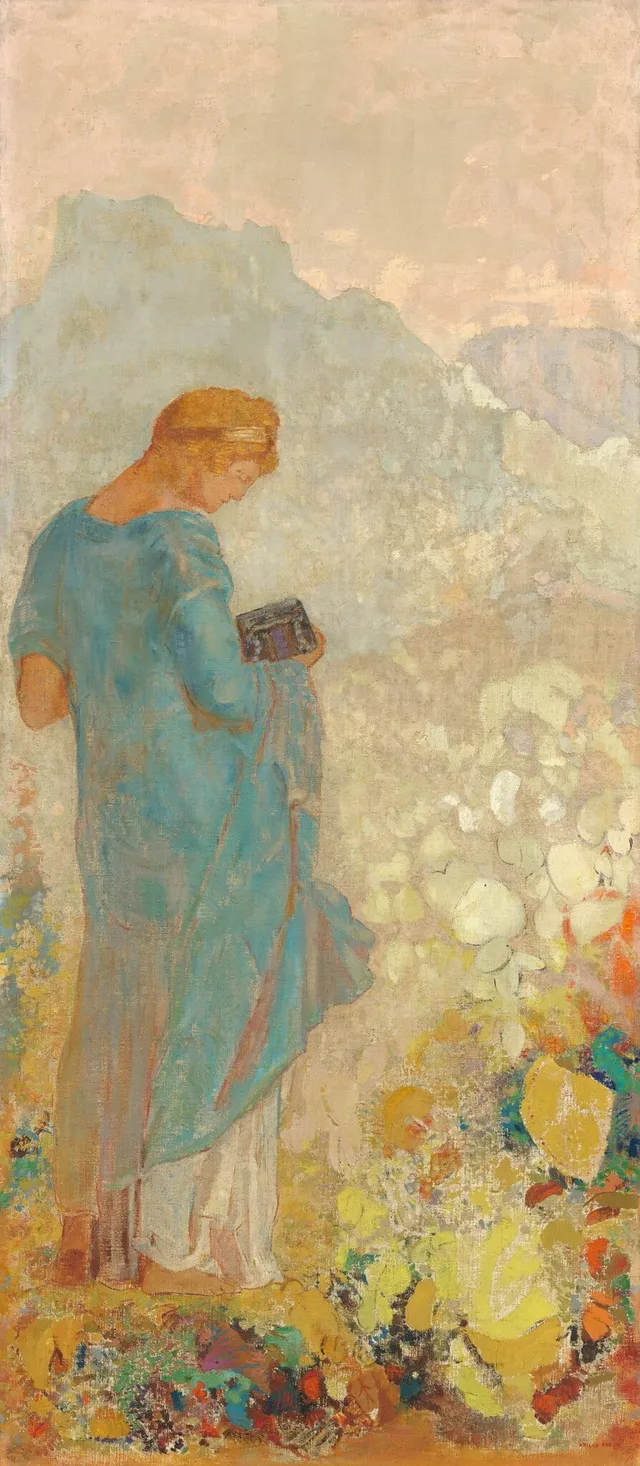
Skip ahead to the far end of the period and the argument is still running, only now it has turned against the heirs of the very revolution that began it. Look closely at Pandora by Odilon Redon. Pandora stands at the center, nude and pale, her weight settled onto one hip, the jar held low against her thigh. Around her Redon has not painted a garden so much as a wall of blossom: small dabs of cobalt, rose, and pale yellow laid on thickly enough to catch real light, so that the flowers rather than the sky appear to be the source of the picture's brightness. Up close the surface is busy with hatching that never quite resolves into petals or skin, only into the suggestion of both. Her contour never hardens. The shoulder dissolves into the foliage behind it, and the legs fade toward the lower edge where the paint thins almost to bare ground. She is made of the same flecks as the field she stands in.
Now read it as a position. Redon is refusing two things at once. He refuses the academy's polished, legible surface, the inheritance of the Renaissance contour, by letting his figure leak into her surroundings. And he refuses Impressionism's daylight positivism, its loyalty to the observed instant, by lighting the scene from inside an imagined color rather than from the sun. The myth is the giveaway. An Impressionist painted the boulevard in front of him; Redon paints the moment before all the world's troubles escape the jar, a subject no eye could witness. He keeps the period's hard-won handling of paint and points it at the unseeable. That is a quarrel with both of his predecessors, the classical and the realist, conducted in a single quiet canvas.
The long tail of the argument
The works our corpus dates past 1800 are not stragglers. They are the argument's later chapters, and each one is talking back to something. Take The Louvre, Afternoon, Rainy Weather by Camille Pissarro. The subject could not be more pointed: the old palace of art seen through wet glass from an upper window, its monumental stone softened to a grey smear by weather and distance. The institution that codified the Renaissance rules sits there in the rain while the painter, high above it, records light instead of architecture. Impressionism was the period's argument with its own academy, and Pissarro stages it almost literally by putting the Louvre at a distance and the atmosphere up close.
Cross the Atlantic and the quarrel turns physical. Stag at Sharkey's by George Bellows jams two fighters into a knot of bodies under a single hard light, the brushwork as bruising as the bout. One boxer's back arches as he takes the blow; the other drives forward off a braced leg, and between them the referee is barely more than a smear of white shirt. The ropes cut across the lower third of the canvas, pinning the violence at eye level so the viewer cannot back away from it. Genteel American taste wanted landscapes and flattering portraits; Bellows answered with sweat, a private boxing club, a crowd lit like a furnace. With 322 of his works in the archive, he is well represented enough to read as a sustained position rather than a single provocation, and the position is a rebuttal of the polite picture.
The society portrait, too, could be turned into an argument from within. Mr. and Mrs. Anson Phelps Stokes by Cecilia Beaux accepts the genre's commission and then quietly bends it, giving the sitters a candor and a psychological weight the formula did not require. Hugo Reisinger by Anders Zorn does something adjacent with bravura brushwork, building a banker out of a few confident, loaded strokes rather than the licked finish the old portrait tradition prized. Stand near the cuff or the lapel and the strokes stop describing cloth and become frank deposits of paint, yet step back and the man snaps into focus. Both painters keep the form and contradict its manners.
And then there is the painter who refused to argue on the terms offered at all. The Equatorial Jungle by Henri Rousseau stacks its foliage in flat, overlapping screens, every leaf given a clean edge, the perspective ignored rather than mastered. Rousseau had no academic training and wanted none. By declining the whole apparatus of modeling and recession that the period had spent four centuries perfecting, he mounted the most radical rebuttal of all: a picture that behaves as if the argument never happened. The trained eye reads it as naive. It is better read as a refusal.
Why the period reads as one long sentence
Line these works up and a shape appears. The Renaissance rebuts the Gothic. The Dutch rebut the Italians. The Impressionists rebut the academy. Redon rebuts the Impressionists. Bellows rebuts the parlor, Beaux and Zorn bend the portrait, and Rousseau walks out of the conversation entirely. The forms change beyond recognition across these five centuries, yet the underlying gesture is identical every time. A painter looks hard at the most admired work of the previous generation and decides it has missed something, then builds a method to supply what it missed. The period is not a sequence of styles so much as a single argument conducted in many accents.
This is also why the corpus boundary runs to 1977 rather than 1800. A period defined by a habit ends when the habit ends, and arguing-with-your-predecessor did not end at the French Revolution. It accelerated. The closer painting came to our own moment, the more openly each movement announced itself as a correction of the last, until the rebuttal stopped being a private workshop calculation and became a public manifesto. The early modern centuries trained painters to treat the recent past as a problem to be solved. Modernism simply inherited the reflex and turned the volume up.
Works discussed in this article
What the argument left us
There is a temptation to treat all this contradiction as destruction, each generation knocking down the last. The opposite is closer to the truth. Every rebuttal kept most of what it inherited and quarreled with one thing. Redon kept the oil technique and abandoned the daylight subject. Pissarro kept the framed easel picture and abandoned the finished surface. The Dutch kept the illusion of depth and abandoned the idealized body. Bellows kept the figure group the old masters had perfected and threw out its dignity. An argument of this kind is a form of transmission. You cannot contradict a tradition you have not first absorbed, and the act of contradicting it carries it forward in altered form.
So the early modern period is best understood not by its monuments but by its disagreements, and the disagreements are still legible in the paint. Stand close to any of these canvases and you can see the artist deciding what to keep and what to throw out. The next painter will stand in the same spot, look at this very picture, and decide it kept the wrong thing. That refusal, repeated for six centuries and counting in our own holdings, is the period's real bequest. The argument is the inheritance, and it is still open.
- The pattern: rebut the immediate predecessor by invoking a deeper one, from Vasari's antiquity to Rousseau's refusal of training.
- The evidence: 18,429 works across 205 venues and 3,599 artists, dated roughly 1350 to 1977, a span far longer than the textbook close of 1800.
- The bequest: a habit of treating the recent past as a problem to solve, which modernism inherited and amplified.
Sources & further reading
- Early modern period — Wikipedia
- Renaissance (art term) — Tate
- Lives of the Most Eminent Painters, Sculptors and Architects — Internet Archive
- Dutch Paintings of the Seventeenth Century (collection catalogue) — Rijksmuseum
- Early Modern Art, c. 1400-1800 (curated guide) — Smarthistory
- Heilbrunn Timeline of Art History — The Metropolitan Museum of Art
- Paintings by the Great Dutch Masters of the Seventeenth Century — The J. Paul Getty Museum