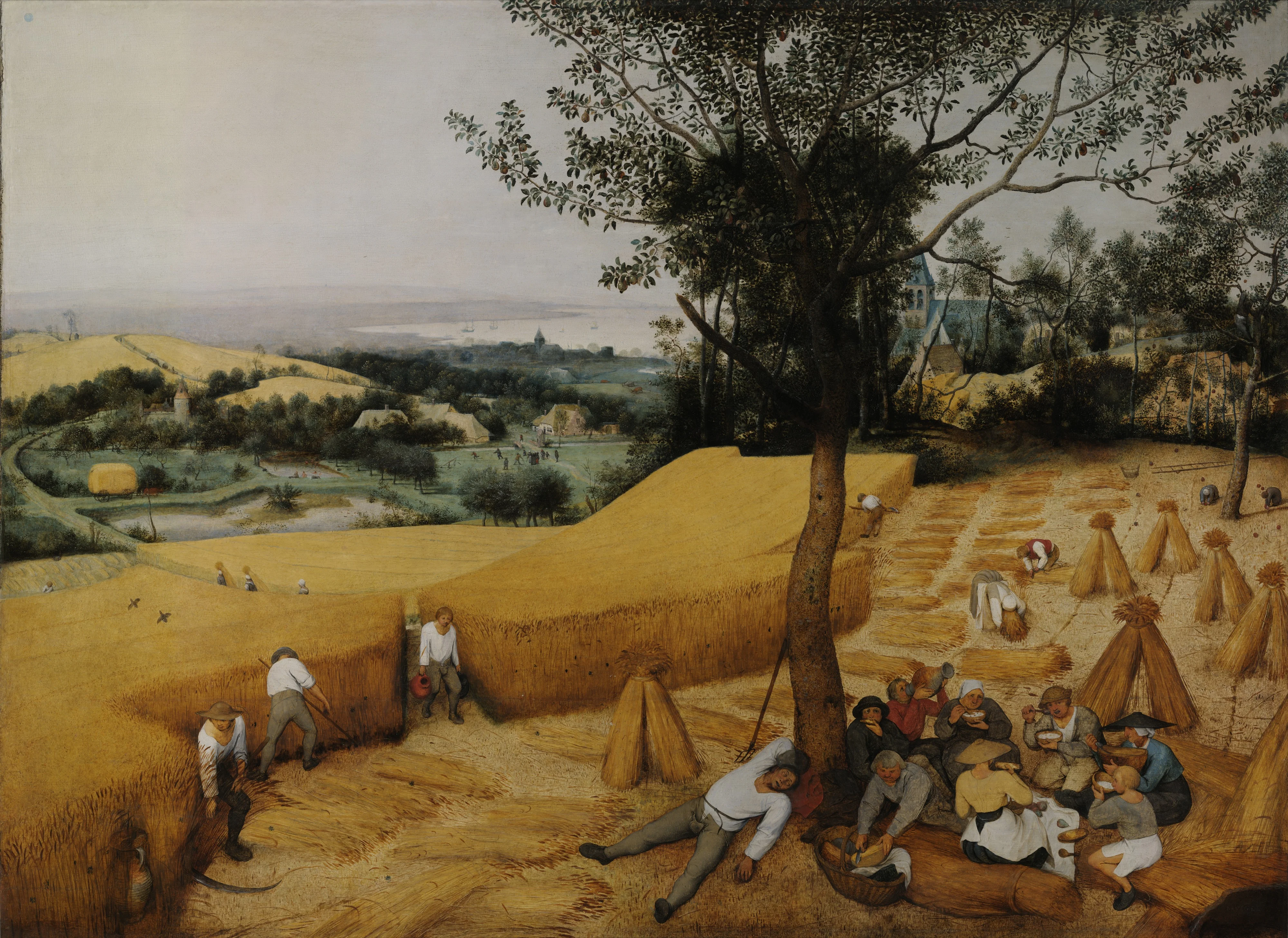
The story of the Northern Renaissance is usually told as a late arrival, a provincial echo of something that had already crested in Florence. That telling is tidy, and it is mostly wrong. The painters of Bruges, Ghent, Antwerp, Nuremberg, and Haarlem were not running behind their Italian contemporaries. They were answering a different question, and they kept on answering it for the better part of two centuries, each generation convinced the last had left the matter open.
Here is the question, as plainly as I can put it: could the sacred be found inside the ordinary, observed world without dissolving into it? Nearly every major Northern panel made between about 1420 and 1565 is a fresh attempt on that one problem, and the attempts contradict each other. Jan van Eyck hid God in a brass chandelier and a convex mirror. Hans Memling answered with stillness. Albrecht Dürer answered with a printed line light enough to cross a continent. Pieter Brueghel the Elder, the latest and the boldest, answered by letting the holy figures walk out of the picture and leaving a wheat field where they had stood. One question, several answers, each one revisiting the others as though nothing had been settled. Nothing had.
A question with no antique to dig up
Tate dates the Italian revival to about 1400, set off by the rediscovery of classical art and culture. The North had no buried Forum under its feet. Its usable past was Christian and close to hand: the carved altarpiece, the illuminated book of hours, the donor kneeling at the lower edge of a Nativity. So the northern problem was never how to recover the antique nude. It was a quieter and harder question about how much of the visible, touchable world a devotional image could absorb before it stopped being devotional at all. A book of hours was made to be held and turned by one pair of hands in a private chamber. The painting that grew out of that habit wanted the same intimacy, the same closeness of looking, and it wanted to reward the eye that lingered. That habit of close, handheld attention is the seed of everything that follows; the panel inherits the page's demand to be read slowly, at arm's length, by one believer at a time.
The Metropolitan Museum's account of Early Netherlandish painting sets the school's span at roughly 1420 to 1550 and records that van Eyck acquired an almost legendary status as the purported inventor of oil paint. The legend is false in the narrow sense, since oil binders were known well before him. What van Eyck actually did was drive the medium until it could carry a density of observed fact no tempera panel could hold. He built his pictures in thin translucent glazes, layer over layer, so that light seems to pass into the surface and come back out again carrying color. The nap of velvet, the haze on a far hill, the separate bristles on a dog's back: his answer to the question was to make the panel function as evidence, sworn and notarized.
Van Eyck's answer: the world as inventory
Take the painting the J. Paul Getty Museum lists under the title Marriage of the Arnolfini, made after van Eyck's 1434 double portrait. A man and a woman stand in a Flemish bedchamber, hands joined. Around them sits a deliberate inventory: a single lit candle burning in daylight, a pair of shed clogs, a small dog, a round mirror throwing the whole room back at us in miniature with two extra figures in the doorway. None of these objects is merely a prop, and none of them stops being a real object either. That is the Eyckian settlement in one room. The sacred does not hover above the furniture; it is smuggled in disguised as the furniture. The art historian Erwin Panofsky called this disguised symbolism, and scholars have argued the reading down to the candle ever since, but stand in front of the panel and the doubleness is plain. Every domestic thing is also a sign, and refuses to choose.
Look harder and the room keeps yielding. The window throws a soft grid of light across the back wall, the oranges on the sill catch a separate warmer glow, and the brass of the chandelier holds a different sheen again from the brass of the mirror frame. Van Eyck graded each of those surfaces by hand, one glaze at a time, so that the eye is forced to slow to the speed of a man counting his own possessions. The picture rewards greed and patience in the same gesture, and it never lets you decide whether you are looking at a marriage, a household, or a sermon.
The conventional frame runs from Robert Campin and van Eyck in the 1420s to the death of Gerard David in 1523. David makes a telling endpoint. His Virgin and Child with Four Angels keeps every Eyckian habit of close description, the brocade, the carved column capitals, the city glimpsed through an arch, yet the mood has gone soft and frontal, almost sedated. The evidence is all still present on the panel. The urgency to decode it has drained away. By David's death the first answer had hardened into a manner, and a hardened manner is usually the sign that someone is about to ask the question again from the beginning.
The answer of stillness
Hans Memling ran a busy Bruges workshop and gave the question its calmest answer. His Annunciation stages the most charged instant in the Christian story as a quiet domestic interior. Gabriel arrives, the lilies stand in their vessel, the canopied bed hangs heavy behind the Virgin, and the light falls with no drama at all. Memling's wager is the opposite of urgency. If you make the room calm enough and exact enough, the viewer slows down, and the holiness arrives through patience rather than through shock. This is an answer built for private devotion, for a single merchant kneeling at home rather than a congregation craning under a vaulted nave. A panel this size could be folded into a travelling case and set up on a table in a bedchamber, which is exactly where many of them ended their working lives. The miracle is domesticated on purpose, and the domestication is the argument.
Petrus Christus, who absorbed much of van Eyck's old clientele, pushed the same logic toward emotional restraint. His The Lamentation arranges the mourners over the dead Christ with a geometric calm that holds the grief in check rather than performing it. The bodies make a slow horizontal across the panel. Nobody wails. The feeling is real and it is governed, and the governance is itself a position about the sacred: that it reads as most credible when it is most composed, that screaming would cheapen it. Christus also gave the Netherlandish panel one of its first convincing single-vanishing-point rooms, quietly importing the Italian discipline of perspective without surrendering the northern appetite for surface and thing.
Joos van Cleve carried that Bruges and Antwerp settlement into the sixteenth century, when Italian fashion was already pressing hard on the North. His The Holy Family keeps the northern love of household detail, the cut fruit and the carved chair, while softening the faces toward an Italian sweetness borrowed at second hand from Leonardo. You can watch the question being renegotiated inside a single prosperous workshop. How much southern grace can the panel take on before the hard northern fact that made it convincing begins to blur into mere prettiness? Van Cleve never quite resolves it, and the unresolved tension is what makes him worth a second look rather than a footnote.
Dürer: the answer that could travel
The Italians had their treatises and their academies. The North had the press. The spread of the Renaissance northward owed much of its velocity to the printing press, which moved images and ideas faster than any apprentice could carry a panel. Albrecht Dürer understood this better than any painter of his century. Early in 1500, just before his twenty-ninth birthday, he finished a frontal self-portrait, now in Munich, that borrows the rigid symmetry usually reserved for images of Christ and sets the year beside his monogram so that the date reads as both calendar and Anno Domini. He signed it with a Latin inscription claiming that he, Albrecht Dürer of Nuremberg, made himself in lasting colors. The boast is staggering, and it is also a theological dare. The painter casts himself as a maker in something close to the divine sense. It is an audacious turn on the old question. The sacred is not only out in the observed world, Dürer suggests; it is in the trained hand that does the observing.
But Dürer's real revolution was reproducible. His engraving Adam and Eve, dated 1504 and no larger than a sheet of letter paper, packs the first human pair, an ideal nude proportioned from Italian theory, into a dense northern forest crawling with a cat, a mouse, an elk, an ox. The plate could be inked again and again. Where a painted panel could hang in exactly one church, the engraved sheet multiplied. A printseller could carry a hundred impressions in a satchel from one fair to the next, and the proportioned bodies Dürer had worked out from Italian measure travelled with them into towns that had never seen an Italian painting. The same exacting image hung in workshops from Nuremberg to Antwerp within a few years, all from one piece of incised copper. Hans Baldung Grien, his most gifted pupil, took the printed line somewhere darker, toward witches and the frank carnality of the body that his master had kept under classical control. Jan van Scorel went the opposite way, traveling all the way to Rome and bringing the antique home to Utrecht in his luggage. The engraved line could carry the question anywhere, and it did.
Brueghel: the sacred leaves the frame
Pieter Brueghel the Elder gave the last and most radical answer, and you can read it whole in The Harvesters. Look at what is actually in the picture. A great wedge of cut wheat fills the right foreground in hot, dry gold, and a path has been mown straight back through the standing grain toward a clump of trees. Under the central pear tree a man lies flat on his back, mouth open, one knee raised, his shirt pulled loose, dead asleep at midday. Around him the others eat: bread torn by hand, a wooden bowl, pears, a jug being tipped to a mouth. Women carry sheaves on their heads down the slope. Far off, past a low church tower, the land falls away to a pale bay with ships and a few tiny figures swimming. The horizon sits high, almost at the top edge, and that single decision is what flattens the world into a working surface rather than a window onto distance. Brueghel tips the whole field up toward us so that the labor and the heat press flat against the picture plane and fill the frame from edge to edge.
Now notice what is not there. No saint. No halo. No donor kneeling in the corner, no disguised symbol waiting to be decoded into doctrine. The question van Eyck answered by hiding God in the furniture, Brueghel answers by removing God from the visible scene altogether and leaving the heat, the bread, and the bone-tired body in His place. The sacred has dissolved into season and labor so completely that the picture carries its full weight without naming it once. This is the secular northern landscape arriving fully formed, and it is the same old question driven all the way to its end. Our own archive lets you measure how far that drive ran. Artifact World Gallery holds 3,751 works tagged Northern Renaissance, spread across 111 venues and made by 509 named hands, with dates stretching from about 1390 to 1949. Set that span against the Met's tidy 1420-to-1550 school and the textbook endpoint of Gerard David's death in 1523, and the gap is the whole point. Cataloguers reach backward into International Gothic and forward into the later revivalists who could not stop painting like van Eyck. The label stays elastic because the question never closed.
Works discussed in this article
Who decided this was a "Renaissance"?
The painters themselves never used the word. The first person to gather these northern hands into a single proud lineage was Karel van Mander, whose Schilder-boeck, printed at Haarlem in 1604, built a biographical canon for Netherlandish and German art in conscious answer to Vasari's Italian lives. He wrote in Dutch, for Dutch readers, and he gave each painter a life with anecdotes, rivalries, and deathbed scenes, so that the trade could see itself as a tradition with heroes of its own rather than a guild of anonymous craftsmen. Van Mander handed van Eyck the role of founding genius and fixed the story the way it would be retold for three centuries. The term Renaissance itself was pinned onto the North only later, by nineteenth-century historians who needed a category and borrowed the Italian one because no better word was lying around. The painters had simply kept asking their question, generation after generation. The naming came afterward, the way naming usually does, and it imported a southern frame that fits the northern achievement only loosely.
Here is my own position, for what it is worth. The Northern Renaissance is the most undervalued chapter in European painting precisely because it refused the heroic Italian story of steady progress toward the ideal. It progressed toward the actual instead, and the actual does not flatter a historian's love of a clean ascending arc. The question these painters kept asking is not a museum question, sealed off in the fifteenth century. A photographer today framing a kitchen counter in raking light, deciding how much plain fact a single image can carry before it tips over into meaning, is working van Eyck's problem with a different tool. The brass chandelier has become a steel tap. The answer is still not settled, which is the surest evidence that the question was a good one to begin with.
- Keep looking: the Northern Renaissance movement hub gathers every panel in our archive tagged to this school, from the International Gothic edge to the late revivalists who could not stop painting like van Eyck.
Sources & further reading
- Early Netherlandish Painting — The Met (Heilbrunn Timeline of Art History)
- Marriage of the Arnolfini (after Jan van Eyck) — The J. Paul Getty Museum
- Northern Renaissance — Wikipedia
- Early Netherlandish painting — Wikipedia
- Self-Portrait (Dürer, Munich) — Wikipedia
- Karel van Mander, Het Schilder-boeck — Internet Archive (Getty Research Institute copy)
- Renaissance (art term) — Tate